


Mount Analogue is a landmark work from a master artist in tribute to the great chain of influence that goes from one seeker to another, from one artist to another. I consider it another essential clue in my own quest for discovering an applying obscure knowledge.
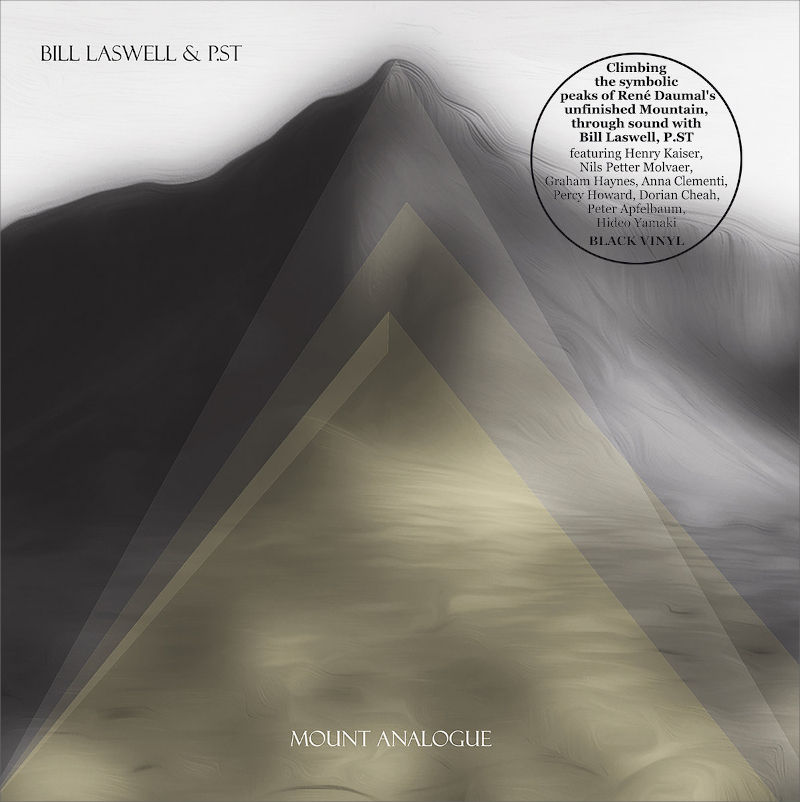
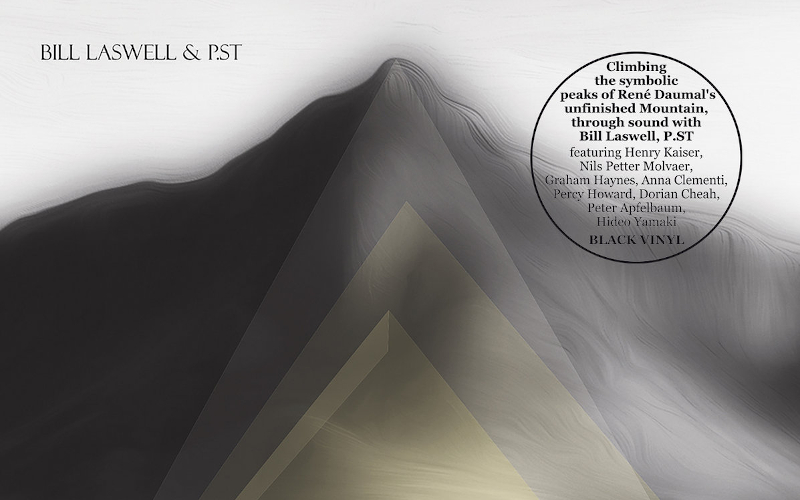
Climbing the symbolic peaks of René Daumal‘s unfinished Mountain
I remember the first time I bought music by Bill Laswell. It was 1998, my last year of high school, and I was in Cleveland with a friend on a spring break road trip fueled by punk rock shows and NoDoz. Record stores were an important part of that trip too, and I remember finding a section of CD’s marked “Bill Laswell” and I was intrigued. I picked up a CD called Jihad (Points of Order) by one of his voluminous side projects, Automaton. It consisted of two long tracks, each around 23 minutes. The album featured musician Tetsu Inoue whose name didn’t mean anything to me then, though now it occupies a special place in my long-term love affair with ambient music. It also featured Lili Haydn on violin, and Nicky Skopelitis, a frequent collaborator with Laswell, on guitar. In my opinion, Skopelitis could get a lot more love for his expressive guitar work then I’ve seen. Of course, Bill Laswell was also on the record providing bass, electronics, treatments, and without question, his expansive musical vision. It was the beginning of a journey into his wide-ranging musical world.
I started keeping my eyes and ears open for anything Laswell had his hand in, and as I would soon find out, his hand was in all kinds of interesting material; and Material happened to be the next group of his I discovered. The next real gateway drug, however, was the double album under the Axiom Ambient moniker, Lost in Translation. With song titles like “Cosmic Trigger” how could one go wrong in picking up an album like this unheard? It was around the same time I was reading deeply across the works of Robert Anton Wilson, and his book Cosmic Trigger had set me off on my own quest for Sirius.
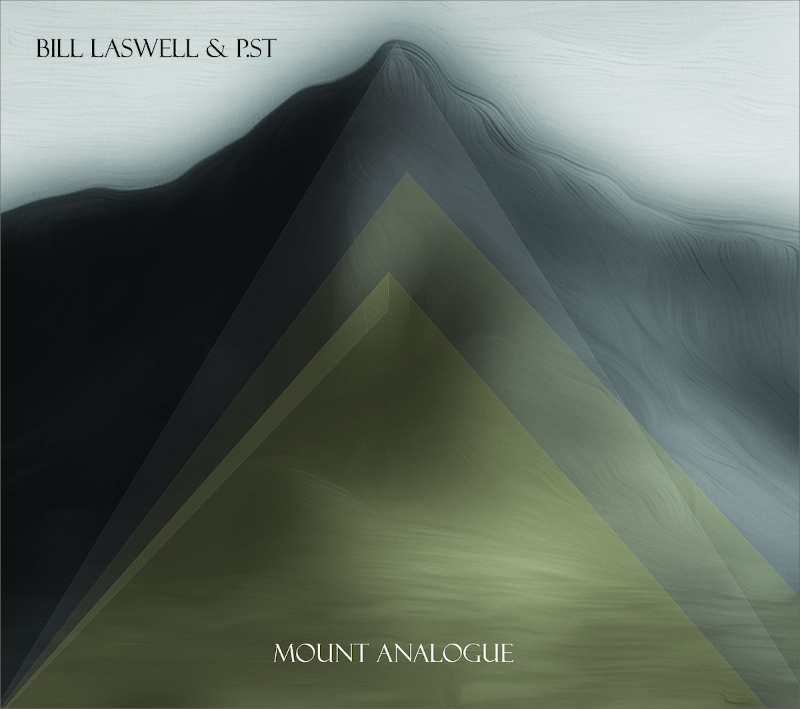
There is also a song on that record called “Holy Mountain” which brings us to the present album, Mount Analogue, marking yet another vast peak in Laswell’s long career. There is a connection between that song and this album.
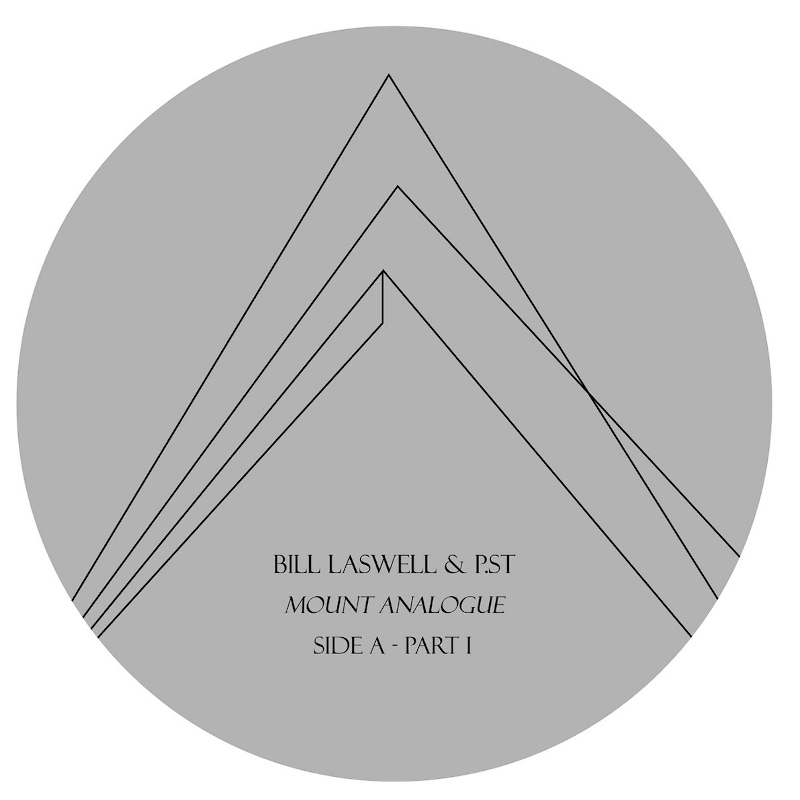
This musical journey pays tribute to René Daumal and his enchanting world of mysteries and magic. The album shares its title with Daumal’s novel, Mount Analogue: A Novel of Symbolically Authentic Non-Euclidean Adventures in Mountain Climbing, published posthumously in 1952, eight years after the author’s untimely death.
Another connection that encompasses Laswell’s singular talent as a sound sculptor and practitioner of the alchemy of music reconstruction and mix translation, as well as his ability as a studio conductor in bringing the work of disparate musicians into progressive harmony. Lost in Translation featured a vast army of adventurous ambient musicians whose work he fused into its singular form. Inou and Skopelitis both made contributions, as did Terre Thaemlitz, The Orb, and various players from the expanded funakdelic pantheon.
The cast of supporting musicians on Mount Analogue is a little bit less than Lost in Translation, but still substantial, and reflects another wave of audio connection and total immersion in contemporary music. Contributors to this poetic musical vision include Bill Laswell (bass), Henry Kaiser (guitar), Anna Clementi (vocals), Percy Howard (voice), Hideo Yamaki (percussion), Graham Haynes (cornet), Dorian Cheah (violin), Nils Petter Molvaer (trumpet), Peter Apfelbaum (keyboard), and P.ST (concept, electronics), who all lend their talents to a series of excerpts from Daumal‘s text.
Beyond P.ST, who I’ve written about before, I’m not familiar with the work of these musicians. That in itself is an invitation to discover their other work, expanding the field of musical knowledge and mystico-musical kinship.
Finding a CD in a record shop has the possibility of sending a person out on a quest. The references to books and novels, the different artists, all become keys for future exploration when trying to find a way through labyrinthine tunnels of reality.
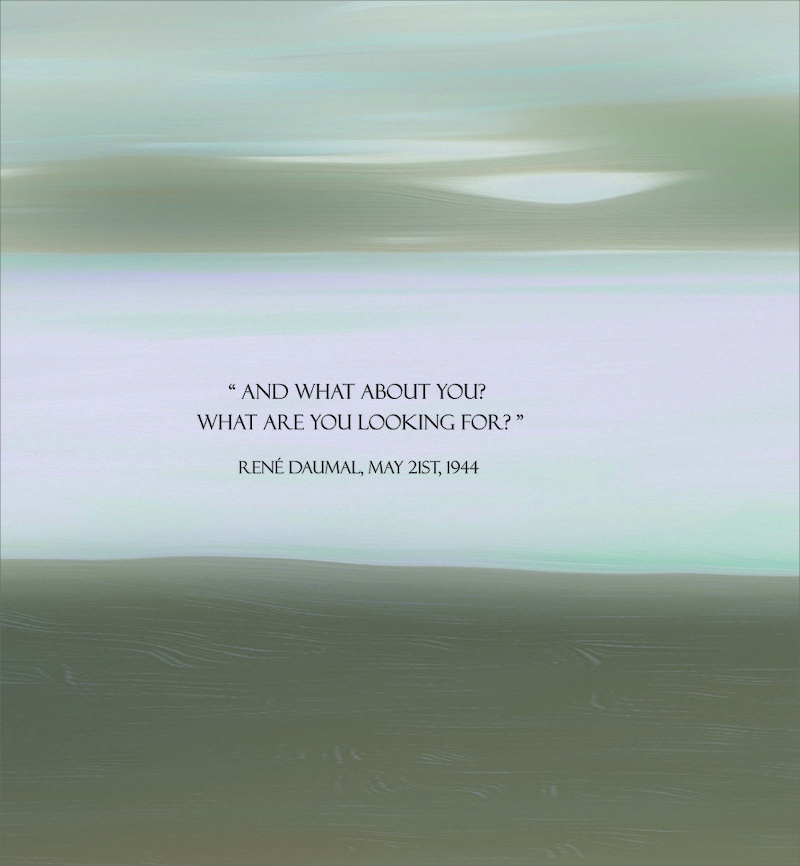
“And what about you? What are you looking for?” Daumal asks.
Me? I was looking for the kind of clues Laswell leaves for fellow seekers. Directions for navigating my path out of the labyrinth and up into the foothills towards the ascent beyond.
HOLY MOUNTAINS ::
Another linking thread is how the song “Holy Mountain” from Lost in Translation, and the first fifty minute piece “Mount Analogue” both deal with the alchemy of ascent. There are many kinds of land formations that humanity looks to for spiritual connection. The forests with their groves of ancient trees and ages of wisdom. The desert with its dry heat and ability to conjure visionary vistas. Rivers without end whose meandering flow bridges the material and immaterial, offering purification and pilgrimage to those who attend their rites. And the mountains, the holy mountains, the high places of the world.
All across the world mountains are revered. According to Shinto beliefs Mount Fuji in Japan is the dwelling place of the spirits and deities. Two other holy mountains in Japan complete a trinity of such, Mount Haku and Mount Tate. Mount Kailash in the Ngari Prefecture of Tibet, China is considered the spiritual center of the universe in Hinduism, home to Shiva and Parvati. For Buddhists that same mountain is known as Mount Meru and the place where the deity Chakrasamvara dwells. It is also revered by Jains and in the Tibetan Bon religion, and is considered the place where the first Jain Tirthankara (a kind of savior) achieved liberation and freedom from the wheel of birth and rebirth. In the Bible, Moses had to go up Mount Sinai to receive the Ten Commandments.
Yet another link is to the 1973 surrealist mindfuck film Holy Mountain by Alejandro Jodorowsky. The Chilean filmmaker was inspired by René Daumal’s novel Mount Analogue, a book that has held several generations of creators and makers under its spell. The second epic tracks here is “Jodorowsky’s Peradam.” We will get to that, but I want to explore some other correspondences that float into my mind when I listen to this fresh masterpiece.
Another person who fell under the spell of Daumal was John Zorn. He has his own album called Mount Analogue as well, out on his Tzadik label in 2012. Zorn is another master at bringing disparate musicians together for magical exegesis of sound. Zorn and Laswell are likewise frequent collaborators with each other. The two have worked on numerous projects including in the band Painkiller. In 2021 they recorded a record together called The Cleansing for Tzadik featuring six songs. The first five songs on that album are dedicated to various mystical, magical and artistic luminaries who have inspired the composers. Included on that record is a song “Alejandro Jodorowsky.”
All of this makes sense when you consider that Laswell and Zorn have been friends since the 1970s. That they share similar obsessions and influences should come as no surprise to those who’ve been following along.
As Laswell wrote in an interview for the Music Hertz blog, “We have different approaches, but knowing each other for so long has shaped our tastes. While we may have different approaches to music, there is no denying the significant impact of John‘s work on my tastes and creative outlook. On the other hand, you can say he didn’t influence me at all. We just have a great relationship. Our collaborations have been characterized by a sense of mutual respect and a shared commitment to artistic integrity. We understand that the strength of our partnership lies in our differences, and we cherish the creative energy that emerges from our diverse perspectives.”
The energy presented on Laswell’s Mount Analogue is of a different point of order than Zorn’s. But they can all be enjoyed together, along with Daumal’s novel, and Jodorwosky’s film. All of this forms a rich creative and nourishing creative stew.
Yet Daumal’s novel is short, and it was left unfinished when he died at age 36. Why has this little short novel been so important to so many people? How did it come to be, and how did it come to influence the living masters of Jodorowsky, Zorn and Laswell in the creation of their own epic works?
The answer gets into the heart of the mysticism and magic that wind their worth through the creative artifacts manifested by all of these artists. To get to there, we have to take brief detour into the mysterious world G. I. Gurdjieff, a master musician in his own right, and his circle of disciples. Exploring the history of ideas around all this material is very much a huge part of my own enjoyment of the music. However if you want to skip reading these origin stories about Gurdjieff, his friend Alexander de Salzmann who formed a massive influence René Daumal and became a character his novel, you can scroll down to the sections Mount Analogue and Jodrowsky’s Peradam, where I finally talk about the music itself.
CIRCLES OF MYSTIC ART ::
Zorn’s entire catalog is replete with hermetic, Kabbalistic, mystical and magic iconography, as is Laswell’s. They name drop names and hints in the form of album art with strange symbols and sigils alluding to mysterious figures who have influenced history from the fringes of culture. For those who are in the know, they are in the know. For those who aren’t, curiosity gets piqued, and the quest begins.
John Zorn’s album draws inspiration “from the life and work of the towering spiritual figure Georges Ivanovitch Gurdjieff.” The brief liner notes and catalog description doen’t even mention Daumal. Yet Daumal’s book was influenced by his friendship with Alexander de Salzmann, a pupil of Gurdjieff.
So why did Gurdjieff have pupils? He wasn’t teaching grade school, but was a teacher of spiritual matters. Hailing from Alexandropol, Yerevan Governorate, Russian Empire (now Gyumri, Armenia) he was of Greek ancestry. As he sought meaning to life went out on a quest in his early adulthood. This quest for wisdom led him to Egypt, Iran, India, Central Asia and Tibet.
At the heart of Gurdjieff’s oeuvre was the notion that people aren’t really conscious of themselves and exist in an entranced hypnosis like a waking sleep. Sometimes they wake up for a spell only to fall back in the stupor of slumber, like automatons. Yet having once glimpsed the awakened state, he thought it was possible for people to reach that consciousness again. His search for the means of waking up led him back to ancient truths and wisdom traditions that he thought could help people wake up. It’s my own contention that music made by the likes of Bill Laswell and John Zorn can serve as one of the vehicles for helping people snap out of the trance.
Daumal took Gurdjieff’s teaching and put it this way in his novel, “All the means we’ve been given to stay alert we use to ornament our sleep. If instead of endlessly inventing new ways to make life more comfortable we’d apply our ingenuity to fabricating instruments to jog man out of his torpor!”
Gurdjieff had seen that torpor in the form of a mass psychosis that had led to the mass slaughter of World War I. He feared that those caught up in the perambulations of a sleepwalker were more susceptible to being controlled by others. (The psychologist Wilhelm Reich would also question the way people voluntarily turned themselves over to one form of authoritarianism after another as explored in his book The Mass Psychology of Fascism. It’s still relevant.) Helping people get out of this trance became Gurdjieff’s life work.
Gurdjieff had noted that most people in the past who had wanted to awaken retreated to monasteries, ashrams and hermit caves. This is not really possible for everyone in any society. He also noted that it was usually just one part of a person that got developed in various esoteric schools or sects: their heart, mind or body. He looked for another way, and that way came to be called the “Fourth Way” by his student P.D. Ouspensky who furthered these teachings. The Fourth Way would work on the mind, body and emotions together and in harmony to help bring awakening to individuals.
One of those individuals who set out on this path was Daumal’s friend Alexander de Salzmann, from the country Georgia. He was a painter, theater designer and stage lighting artist who counted Wassily Kandinsky and Rainer Maria Rilke as his friends, tapped in to the artistic and spiritual currents of his time. He had been living in Russia but in 1919, because of the revolution, he left with his wife to live in Germany. It wasn’t long after that Gurdjieff and his pupils arrived, and they were introduced by another mutual friend, the Ukranian composer Thomas de Hartmann.
The Salzmann’s and Gurdjieff hit it off and they became immediately involved in “the work.” They worked with him as close disciples and collaborators to further it along. After various activities in different countries for several years, Gurdjieff and his followers arrived in France in 1922. It was here that they established his Institute for the Harmonious Development of Man at the Prieuré.
The Institute was a place for seekers to live together communally in pursuit of psychic transformation under Gurdjieff who provided both guidance and friction. Conditions were often difficult and hard labor was meted out along with spiritual exercises and practice of art and music. The purpose was to create “conditions in which man could be continually reminded of the sense and aim of his existence by an unavoidable friction between his consciousness and the automatic manifestations of his nature.”
Thus begin eight years of intense activity. De Salzmann was painting, his wife was dancing, Gurdjieff went on trip to America and got into a near fatal auto accident. Gurdjieff worked closely with Jeanne de Salzmann in developing movements for her dance, and all of them were trying to keep the Institute running. Yet by 1930 Salzmann had disappeared from the Institute. He felt that Gurdjieff’s attentions to his wife’s dancing were a bit much, while his own considerable talents as a painter had been neglected by his teacher. It seemed to be a bit of a triangle between the master and the married couple. There were rumors that de Salzmann’s son, Michel, might have actually been the son of Gurdjieff, so there may have been something else going on leading to Alexandre’s period of discontent.
Whatever the actual case may be, de Salzmann left and joined a monastery, noting that “I had entered … under the name of Brother Petrus. I came out with the title of Father Sogol.” After that he made his living as an antique dealer and interior decorator. Father Sogol was the name given to de Salzmann in Daumal’s singular novel.
It was in October of that year that started hanging out at the Café Figon on the Boulevard St. Germain. This was the place where he and the bohemian circle around artist Josef Šíma went to drink after their meetings in Sima’s studio. Daumal, Sima and the others noticed this man, always drinking calvados and writing scripts in Arabic and Chinese.
One evening Šíma was struck with recognition for de Salzmann, having previously met him at a publishers event some seven years earlier. He went over to the now familiar man, and introduced the artist to his own circle. De Salzmann later approached them again and after they conversed for some time, asked them to hold their arms out straight to the side for as long as they could, testing them. Some minutes later, Daumal was the only one who still had his arms extended.
After this test was completed de Salzmann that he was very taken by the character of Daumal. The two became friends and now the older artist had a younger pupil to transmit the Gurdjieffean gnosis. For Daumal it was a revalation and he became enamored and totally devoted to the work.
MOUNT ANALOGUE ::
Daumal had already been on his own journey by the time he met de Salzmann. Born in Boulzicourt, Ardennes, France in 1908, by the time he reached his teens he was already known for his precocious avantgarde poetry that was landing him in the leading journals of the time. A literary wunderkind, he came under the spell of Alfred Jarry, who had died the year before he was born. Jarry was a symbolist writer, forerunner of surrealism and Dada, author of the play Ubu Roi, and the novel Exploits and Opinions of Dr. Faustroll, Pataphysician. Daumal came to think of himself as a pataphysician. That is, someone who practices the “science of imaginary solutions,” a philosophical concept created by Jarry.
Like other teens, Daumal got interested in the effects of drugs and what they might do to his consciousness. Unlike many other teens, what he messed around with was carbon tetrachloride. This chemical has a direct effect on the central nervous system and in the past was used as a cleaning agent, in early refrigeration systems and fire extinguishers. It was dangerous stuff and got phased out. Daumal wasn’t afraid of a bit of danger, and if taking the drug took him closer to the precipice of death, that was okay with him, because he wanted to see and know what was on the other side.
These experiments allowed him to, in his own words, “burst the limits of the possible and projected me brutally into another world.” The lingering after effects of the chemical in his body also might have been one of the contributing factors to his early death at age 36 while he was writing Mount Analogue.
He was friends with a group of misfits who were so weird they even got kicked out of the surrealists, which was fine with them because they thought the surrealists and dadaists were too passe. These fellows called themselves Les Phrères Simplistes or The Simple Brothers, and included the poet and morphine addict Roger Gilbert-Lecomte, the novelist Roger Vailland and another writer Robert Meyrat. They were an inseparable bunch and beyond their shared literary aspirations, they shared a commitment to exploring their consciousness. Bohemians to the core, they were sometimes referred to as “the many headed Rimbaud.”
Together they created the literary journal Le Grand Jeu and put three issues into circulation. The Czech modernist painter Josef Šíma became the artistic director for the publication. It was in the pages of Le Grand Jeu where they denounced surrealism, and in turn had their provisional micro-society in turn denounced by Andre Breton.
After Daumal’s encounter with de Salzmann at the Café Figon he increasingly gave himself over to the teachings of Gurdjieff transmitted to him by way of his new friend, and he kept busy writing including a column on pataphysics for La Nouvelle Revue Française. Alexander de Salzmann had already died in 1934, and after his passing, Daumal continued to study and work with his widow Jeananne. She had set up communal homes dedicated to “the Work”, and he worked with her in those settings. By 1938 he was working the work directly with Gurdjieff himself.
It was the same year his first novel A Night of Serious Drinking was published. It contains allusions to Gurdjieff’s ideas of being asleep in a dreamlike existence through the metaphor of drunkenness, but it was his second novel, the one he died in midst of writing, that shows the unmistakable influence of Gurdjieff. He started Mount Analogue in 1940.
Part of his inspiration was to “do for metaphysics what Jules Verne had done for physics.” Indeed, the book can be looked at as being related to science fiction. It is the record of expedition to climb a mountain that most people in the world do not even know exists, a mountain range that cannot be seen, even though it is the highest mountain range in the world, much higher even than the Himalayas.
The books narrator talks about “how it was proved that a hitherto unknown continent really existed, with mountains much higher than the Himalayas; how it happened that no one had detected it before; how we reached it; what creatures we met there; how another expedition, pursuing quite different goals, barely missed destruction; how we have begun little by little to put down roots, so to speak, in this new world; and how, nevertheless, the journey has barely begun.”
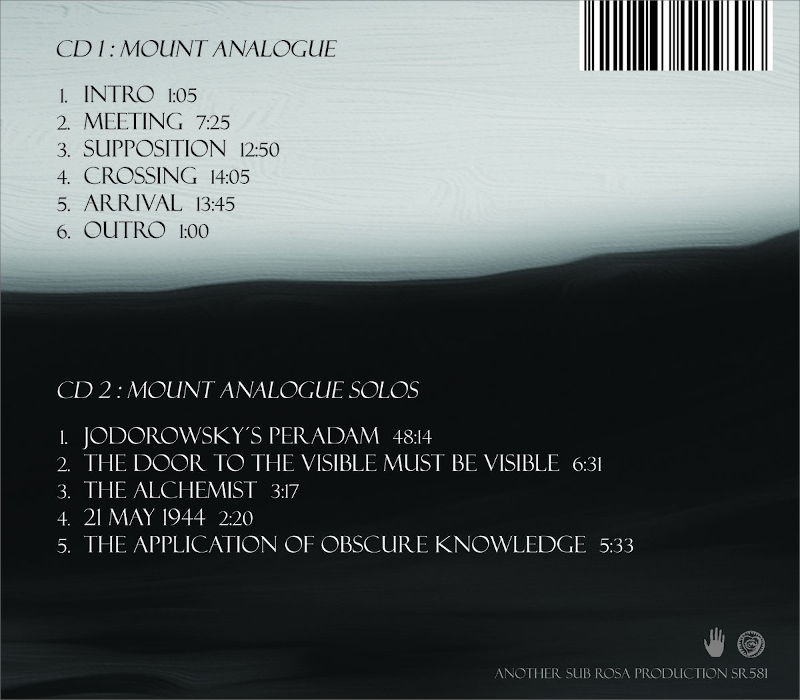
These are some of the words quoted in Bill Laswell’s masterful musical interpretation of the novel on the first fifty minute side titled after the book. It is a musical work that begins in sections with various spoken quotes from the book. Then he and his fellow musicians come in and explore the meaning of that quote through their instruments.
Voice, cornet, and electronic soundscapes drift along a cool breeze in the opening section. Attainment is still far ahead, but there is buoyant joy in beginning the journey. Thin violin lines begin to weave in complex counterpoint with delicate fretwork on bass and guitar. As the music progresses bits start to get processed, glitched, a phrase will skip like a skipping CD snapping the listener out of the trance of sleep and returning them to the present musical moment.
Swirls of chaos threaten the first wave of bliss with the panic that comes to any seeker, and from this panic, new ways around temporary obstacles are improvised. Escalating electronic sweeps and swoops climb and rise marking new vistas. A female voice, in keening ululations recalls the female voice on “Holy Mountain” on the Axiom Ambient album, creating a correspondence system of parallel musical symbolism.
So it goes on through several movements, each inaugurated by a slowly read quote from the book. Each quote can be heard before sinking into a new phase of discursive meditation along with the music, each section bringing the listener closer to the peak, closer to discovering Mount Analogue itself.
JODOROWSKY’S PERADAM ::
The second half of the album is dedicated to a series of five intricate solo electric guitar fantasias by Henry Kaiser. The first of these, clocking in at 48 minutes, is titled “Jodorowsky’s Peradam,” taking us further along the journey. Jodorowsky’s story is as epic as any of the other mystical artists, seekers and musicians already written about whose lives have been touched by the teachings of Gurdjieff. He was born in Chile in 1929 to a family of Jewish immigrants who had fled the pogroms of Russia. When he was 23 he emigrated to France.
It wasn’t long afterwards that he started working in Marcel Marceau’s mime troupe. Jodorowsky started hanging around Breton and his circle. Among many of his other antics, he instigated The Panic Movement, a school of transformative performance art dedicated to the ancient god Pan.
In the 1950s and 60s of Paris the circles that had been built up around Gurdjieff in previous decades weren’t just a memory gone with the passing of a remarkable man, but an objective reality. Students were still around. In particular, Jeanne de Salzmann. Not only was she still alive, she lived until she was age 101, passing away in the year 1990. The work continued. (Jodorowsky himself is 97 at the time of this writing.)
In the filmmakers autobiography, The Spiritual Journey of Alejandro Jodorowsky, he writes about his relationship with G.I. Gurdjieff’s purported daughter Reyna d’Assia. They had met after a screening of El Topo in Mexico City. There was instant sexual chemistry between them and they went back to her hotel. According to the story they talked about her father and his travels in India while they made love. She went on to transmit to him eighty-two different sayings that she attributed to her father. Jodorowsky wrote these down in his book. Whether or not the eighty-two saying were really part of an oral transmission from Gurdjieff to d’Assia to Jodorowsky, I’m not sure matters. They are worthy of meditation and contemplation. I tend to believe the story myself.
From his fertile mind came his film Holy Mountain. Jodorowsky has always been forthright and clear on his influences, and he acknowledged how reading Daumal seeded aspects of his film into his mind. Like anything else that Jodorowsky came across, whether it was learning painting from Leonora Carrington, or taking sacred mushrooms with María Sabina, or practicing Zen Buddhist meditation with his master Ejo Takata, he was never content to simply let any one of them be end of his own spiritual quest. He kept on seeking even as he learned from these individual masters and used that knowledge to become his own master, acknowledging the genius in them, but never bowing down to any of them alone.
Even so, the fingerprints of Gurdjieff and Daumal are all over his film Holy Mountain. In this movie Jodorowsky plays the roles of an alchemist to a messianic figure who has come in search of knowledge, joined by a group of figures representing the seven planetary archetypes.
The alchemists puts these seekers through a series of rituals that mimic the alchemical process of transformation: calcination, where the ego gets burned asunder, preparing the way for new growth, then dissolution, the soul now untethered, into separation where different parts are further purified from one another before being brought back together again in conjunction, followed by further distillation, all culminating in the in the final stage of coagulation, the creation of the philosophers stone, inner gold.
As their identities are stripped away and reforged they head to the summit of the Holy Mountain, the summit of true of knowledge, of final enlightenment. Yet in the end even this attainment is seen to be illusory. After reaching the final rung of one ladder, comes the realization that they are once again at the bottom of another.
In the final part of the film, the camera turns towards the audience and the alchemist implores everyone to awaken. “Real life awaits.” It is here in this world that at our spiritual efforts must be employed.
A peradam is a kind of crystalline stone described in Daumal’s novel. They are described as being “a clear and extremely hard stone… a true crystal… harder than diamond.” A person could only discover a peradam through intense inner work. Those who sought the higher realms would be gifted with one after peak moments of realization.
For the mountain guides who took people to Mount Analogue a peradam was the only payment they would take. The guitar fantasia here is a true peradam, a manifestation of intense effort and dedication to the inner work of musicianship and artistic vision. It continues on the next four shorter tracks completing this magnum opus, “The Door To The Invisible Must Be Visible,” “The Alchemist,” “21 May 1944” (this track a tribute to the day of Daumal’s death), and the “Application of Obscure Knowledge.”
For those who pick up the album on Bandcamp, a third album length track is available, a remix of first “Mount Analogue” piece by PS.T. It’s a great reinterpretation of the source material and another chance to voyage upwards into liminal verticality. It finds a fitting home on the Sub Rosa label whose expansive catalog peradams in the form of discs, vinyl, and downloads suitable for the seeker who wishes to find a guide for further exploration of landscapes and vistas remain shrouded in mystery.
This album is a landmark work from a master artist in tribute to the great chain of influence that goes from one seeker to another, from one artist to another. I consider it another essential clue in my own quest for discovering an applying obscure knowledge.
Mount Analogue is available on Sub Rosa. [Bandcamp]

Related posts ::
 Hoppy Kamiyama + Bill Laswell :: A Navel City/No One Is There (Kanpai, CD)
 Bill Laswell :: Version 2 Version: A Dub Transmission (ROIR, CD)
 Mount Shrine :: The Mount Hibiki Tapes (Cryo Chamber)
 V/A :: Fluxus & NeoFluxus / Stolen Symphony (Vol. 1) (Sub Rosa)
 V/A :: Distance: Sounds for an Empty Space (Clan Analogue)