




Twenty-five years after its release, Markus Guentner revisits IN MOLL, reflecting on youthful intuition, creative freedom, the limitations that shaped his sound, and the enduring importance of making music without expectations.
The space between sounds
- Markus, you were twenty years old when you released IN MOLL in 2001. Twenty-five years later, when you listen to that record, can you still recognize the person who created it, or does it feel like listening to someone else’s work? And is there something that twenty-year-old knew about music, perhaps precisely because of his inexperience, that the Markus Guentner of today has had to learn not to lose?

Markus Guentner :: I can still remember that period quite clearly or, more precisely, what it felt like for me at the time, and what was going on around me and occupying my thoughts. It was the time when everything was just getting started. I had turned my back on school, vocational training, and the “normal” working life. Following the conventional path simply didn’t make sense to me. Of course, I wanted to be “successful” at what I did, but not in the sense of becoming rich and famous. I just wanted to be able to do what I enjoyed in life, and to work on something without feeling tense or putting myself under pressure. It wasn’t an entirely easy time, of course, but it also gave me a certain kind of freedom: I could create what I wanted without ulterior motives. That’s why the album still feels like my own work. I shaped the album, just as the album shaped me.
And it’s true: that very “lack of knowledge and certainty” allowed the music to emerge so freely. I had no formal musical education, and I had never learned to play an instrument. So the question of what was “right” or “wrong” never really arose. I approached it through pure feeling and intuition. Over the years, of course, you learn things about theory, techniques, different approaches, and so on. You also want to become better and more precise. But you should never lose that pure, unfiltered quality that allows tracks and albums to come into being, even if they aren’t 100 per cent perfect in terms of production. That’s something I have to keep reminding myself of, and fortunately I have never lost it completely.
- Michael Mayer recalls that he and Wolfgang Voigt spent an entire night listening to your CD-R while driving around Cologne, and realized they had discovered something extraordinary. But do you remember the moment before that story began, the moment you handed over your music? At twenty, were you already aware that you had found a musical language of your own, or did IN MOLL emerge precisely because you lacked that awareness?
MG :: I remember it very well indeed! I had already been making music for a while, but only for myself. I had absolutely no intention of releasing it or sending out demos. My best friend at the time, and still my best friend today, was also passionate about electronic music. One day he simply said, “Hey, why don’t we go to Cologne for a few day, visit KOMPAKT and buy some records?” We’d always ordered from them before. More or less, he forced me to take a demo CD along and leave it there. That demo eventually became the Regensburg EP. I think it was Jürgen Paape whom I asked at the counter whether I could leave a demo there.
Even then, I haven’t thought about: “I’d like to release something on KOMPAKT.” It was more about the possibility that someone beyond the small circle I moved in might hear my music. It really didn’t take long before Wolfgang called. That was the moment when it suddenly hit me: here was someone whose music I admired and had in my own record collection at home, someone who knew what he was talking about, and who saw something in what I was doing. That’s when I truly realized that other people liked my music, that it could reach them and move them.
The tracks for IN MOLL were made around that time, too. Nobody had specifically suggested making a whole album, but it all came together very naturally, without any pressure, almost effortlessly.
My second visit to KOMPAKT, shortly before the Regensburg EP came out, was even more of an eye-opener. As I talked with Wolfgang, it became increasingly clear that this wasn’t just going to be a release; it was also, more or less, the starting point for Pop Ambient. Of course, there had already been a number of releases that could be associated with the term, but that was when the idea of Pop Ambient really took shape at KOMPAKT.
But was I aware at the time that I’d made something distinctive, perhaps even something different? Absolutely not! I think it was precisely that unconscious, carefree approach that made the music turn out the way it did. I wasn’t trying to sound like anyone else, or to make tracks that would appeal to particular people or labels just so I could get something released.
The shape of intuition ::
- Early critical responses to IN MOLL inevitably emphasized its similarities to GAS, but Mark Richardson had already identified an essential difference: while GAS could evoke vast, almost natural landscapes, he perceived something more enclosed and unsettling in your music, almost as though it existed “inside a concrete box.” Twenty-five years later, how much do you still recognize yourself in that distinction? What was the imaginary space of IN MOLL, if there was one?
MG :: Of course, it wouldn’t be right to deny certain parallels. GAS was one of the things that inspired and influenced me back then. We’re inevitably influenced by what we surround ourselves with, and if you listen to a lot of GAS and similar music, that doesn’t simply disappear from your own work. But I didn’t want to sound like GAS or do exactly the same thing. That already existed, and it was so brilliant that there was no need to try to repeat it. Perhaps that very ambition, not to repeat it, was what ultimately made my music sound different, and made it something else, as it still is today.
Looking back, it’s really fascinating to see how other people perceived the music. When Mark Richardson describes it as more “enclosed,” that may well have reflected the space I was in at the time. I wasn’t really looking left or right; I was making things in the way that felt right to me, without worrying about anyone else’s opinion. You really have to take my circumstances back then into account. It was one of the most formative periods of my life. From the outside, I had no school qualification, no job, and no “future.” Luckily I had plenty of support, of course, and I’ll always be grateful for that. But it’s only natural to retreat into yourself in that situation and, perhaps not even consciously, to think about who you are, why you’ve ended up where you are, and where all of this might lead. So an “imaginary space” definitely emerges, a place where things can take shape and grow, but also be discarded or brought to an end.
After all this time, things are perhaps a little different. You’ve experienced so much and learned a great deal, both positive and negative, and those experiences can take you in different directions. But that formative period is still a very important part of how I think and act.
- The title IN MOLL literally means “in a minor key,” but the album is not simply melancholic: it contains beauty and unease, warmth and coldness, consolation and a certain darkness. Are you still drawn to that emotional territory where it becomes impossible to determine whether music is sad or comforting? And do you think this emotional ambiguity is one of the reasons the record has aged so well?
MG :: It has never been important to me to decide exactly which emotions my tracks should convey. I never compose or produce with a particular emotional direction in mind. Whatever emotion is there is my own, even if I’m not consciously trying to express it. Of course, there’s often a certain melancholy in the music, I don’t make “happy house” or anything like that, but I don’t want to manipulate anyone into feeling something specific. I don’t want to suggest that because a piece doesn’t sound cheerful, you have to feel sad, or vice versa.
Even an ordinary pop song can make someone feel melancholy or sad, while a very profound or “heavy” piece might not move someone else at all. That plays a part in my music, too. As you said, this emotional ambiguity is something timeless: the music can’t be easily categorized, and it doesn’t need to be clearly defined. I can feel however I want when I listen to the album. Nothing is imposed on me.
However, it is quite funny when you think about why the album is actually called IN MOLL … and I have to say that the title didn’t even come from me. It was Michael Mayer’s idea. KOMPAKT basically only had my demos, without any specific titles. So, when it came to releasing the album, the suggestion to call it IN MOLL was absolutely spot-on. We all agreed on that.
- Before IN MOLL, there were “Regensburg 1” and “Pilot” on Pop Ambient 2001. Regensburg is not merely the city where you were born and where you live: it returns throughout your music as memory, nocturnal landscape, church bells, architecture, the harbor, childhood. How much of your music do you believe is genuinely “German,” or even specifically Bavarian? If you had grown up in London, Detroit or Tokyo, could IN MOLL have existed?
MG :: Personally, I’d say no, it couldn’t have, especially not at that particular time. As I mentioned briefly earlier, inspiration and influence always come from our immediate surroundings. Or for me even more the situation back then. And it was definitely more about that, than a “geographical” thing. It could’ve happened somewhere else, but I think that specific time and place was more responsible than anything else.
Back when my music and DJing were becoming more successful, I seriously considered leaving Regensburg. On one level, the reason was quite simple: it felt as though nothing was really moving forward in the city, or that it might even be limiting me in some way. There was also the idea of moving to Cologne, in particular, because that’s where the label and the people I worked with were based.
But then I quickly started asking myself: why, actually? I don’t need to be successful in the city where I live. Things here don’t have to move forward according to my ideas or expectations. I’d spent enough time travelling and being away that returning to a relaxed environment was almost a relief. Do I really need to surround myself every day with people who do the same thing as I do? Of course, exchanging ideas and giving each other feedback can be valuable, and it still is. But I can also do my own thing here in Regensburg, away from all of that.
At the time, a lot of people were leaving Regensburg and moving to Berlin. I could understand their reasons, at least to some extent, after all, “things are happening” in Berlin. But I also felt that, for some people, it was simply a pursuit of recognition, and that was never something I was looking for. In Berlin, I’d be one of thousands playing the same game. Here in Regensburg, I can do what I want.
- You have spoken about growing up near a church and developing a particular fascination with the sound of bells, which has stayed with you ever since. What makes this interesting is that a bell is simultaneously sound, space and time: you cannot separate it from the place in which it resonates or from the silence that follows each strike. Could this be one way of understanding your music, in which the true compositional material often seems to be not the note itself, but the space that the note makes perceptible?
MG :: Absolutely! I really do have a strange affinity with bells, and there’s something rather contradictory about it. Church bells can be completely enveloping and ever-present. They fill their surroundings with something impossible to ignore, a sound that seems to float. But the exact opposite can happen, too. They can be disruptive and irritating; they can pull you right out of your surroundings.
I think you can hear quite clearly in my music that I’m not particularly concerned with exactly how an individual note should sound or what specific theme it should follow. It’s much more about the space and atmosphere that emerge from it. Many of my tracks contain so many layers that, considered individually, they make relatively little sense, some are even completely dissonant. But when they interact with other sounds, and flow through time via delays, reverbs and other effects, they create that very space in which everything can happen.
- Electronic music in 2001 was shaped by technological limitations that have now virtually disappeared. Paradoxically, however, IN MOLL retains an exceptionally strong sonic identity, while much contemporary music, produced with almost limitless possibilities, risks sounding increasingly homogeneous. Have you ever considered the possibility that those limitations were secretly among the album’s most important compositional tools? And do you now have to impose artificial constraints on yourself to recover that same degree of focus?
MG :: Oh yes, they really were! Back then, I started editing sounds in Sound Forge on my incredibly slow computer and arranging them in ACID, using the most basic effects and, if possible, not too many tracks, because otherwise the computer would grind to a halt. The goal was simply to keep working and experimenting until something emerged that I liked.
I was entirely a software-based producer at the time. A lot of people didn’t believe that, because they thought you could only get that kind of sound from hardware. But working that way absolutely shaped the sound. I had many conversations and discussions with people who would say, “I’ve got a €10,000 studio, but I’m nowhere near making that kind of music and as “successful” or professional as you.” The answer is simple: you can have the best equipment in the world, but if you don’t have an idea, or the feeling for how to turn it into something, then it won’t get you very far. Something has to come across on an emotional level, and you can’t achieve that simply by using perfect-sounding samples and producing everything flawlessly. Honestly, a track can sound terrible, but if it gets to you emotionally, it still works.
Interestingly, once I started making money from music, I bought quite a lot of hardware. But a short time later I realized that it simply didn’t suit the way I approached, composed and produced music. So I sold it all again and invested in the equipment I actually wanted to work with: an audio interface, speakers, a computer, plug-ins and so on.
Eventually, producing music became genuinely easy, sometimes all you needed was a laptop. Please don’t misunderstand me: that’s not a bad thing. It’s simply how things evolve, with technological progress bringing new possibilities and dimensions. But it also meant that a lot of music started to sound generic, and still does. It became easy to get sounds from a program that already sounded as though they worked. Back then, all I had was my computer and a few plug-ins. I didn’t have a sample bank to draw from, or a plug-in that would simply give me a huge, ready-made “XY bass” sound.
I don’t want to criticize or demonize any of this. Some incredible music has been made with those tools. But I don’t think it’s a particular piece of equipment, or the technical setup itself, that makes something special.
I have to admit that I still produce almost everything in ACID. The software has passed through a lot of hands and companies over the years, but for me it’s a familiar way of working, if you can even call it a workflow. Naturally, I’ve added new plug-ins and techniques over the years. But it’s genuinely helpful not to have the “latest and greatest” way of making music at my disposal. If I don’t know how to use something properly, it won’t do me any good.
So yes, in a way I’m a bit of an advocate for limitations. Too many possibilities mean too many ways to get lost; fewer possibilities help you concentrate on what’s essential. In a sense, it’s also about having a certain humility towards what you do: be content with what you have, and make the best of it.
Revisiting the unfinished ::
- You have said on several occasions that you do not necessarily begin with a concept, and that, as you work, the music itself almost seems to reveal what it wants to become. I am interested in the boundary implied by that statement: how do you know when to stop intervening? How do you distinguish an unfinished work from one in which adding something would actually mean taking away some of its mystery?
MG :: That’s right. Since I very rarely start a track with a specific idea, all possibilities are basically open to me. I don’t begin by trying to make something turn out as well as it possibly could, and I don’t tie myself to a particular goal. Fortunately, I can simply throw sketches away if they don’t work.
At some point, which I really can’t define precisely, many things start to feel good and somehow right. That’s when I sense that I can keep working on them, explore them more deeply, try different things, add elements or take them away. Sometimes ideas come to me about what else I could add, or I feel the track might need something specific. At other times, it has already reached an atmosphere that feels right to me, and it simply doesn’t need anything more.
It’s a very fine line, and one that can never really be defined. One person might think a certain element would have worked well; another might think it wasn’t needed at all. There’s absolutely no right or wrong, and certainly no such thing as perfect. It just has to feel right to me. There isn’t a simple formula or a precise moment when something becomes “finished.”
- Much of your music has no defined BPM, does not follow a rhythmic grid, and in the past even an attempt to transcribe it for an orchestra encountered difficulties because of the absence of conventional structural reference points. And yet, when listening to it, one clearly perceives an underlying temporal logic. If time is not governed by bars and beats, what governs it? Breathing, memory, intuition, the density of sound?
MG :: I think that’s exactly what makes this kind of music so interesting. The human ear gets used to repeating patterns quickly, and things can become boring quite fast. Of course, that isn’t always the case, techno, for example, deliberately relies on repetition. But its function is different. A defined rhythm produces a different effect.
In my music, sounds flow into and out of one another, creating forms that are often indeterminate. There are rarely conventional, clearly defined melodies or melodic sequences. But at the same time, there are some elements you can hold on to. The crucial thing is the mixture of the two. They support each other, give each other a sense of stability, and merge together. You get a feeling of something familiar, of structure even though, fundamentally, that structure may not actually be there.
That’s perhaps the paradox, and it’s what makes it exciting. The music isn’t hypnotic or repetitive in the conventional sense. As you listen, you might think, “This sounds the same; it’s repeating itself.” But then you stop and ask yourself: wait, is it really?
When I think about this in terms of composition and production, intuition is what guides me. I don’t follow a time signature or a BPM. I’m free to decide when a sound comes in, when it disappears, how long it stays, how many layers I put on top of one another, and so on. Sometimes the sounds themselves determine the timing: how long can a sound remain before it stops making sense? Effects play a role, too. One sound might work with ten seconds of reverb, another with seven, and a third with sixteen.
- In 2009, you made the decision to stop depending on music for your livelihood and to work as a graphic designer, explaining that this gave you back your creative freedom. It is a radical decision in an era that constantly measures artists in terms of visibility, productivity, streaming figures and public presence. For you, did artistic freedom require, in some sense, rejecting the idea of an artistic career as a career? And what did it cost you to achieve that freedom?
MG :: That’s right. I reached a point where making music had become more routine than adventure. It became really difficult when I had to think more about what I needed to deliver next to remain successful than about what I wanted to discover and explore musically for myself. It raises a fundamental question: why do I make music? To be successful, or because I want to express something? So I decided to pursue a different profession and to make music only when I genuinely felt like it, without the pressure of having to deliver something at a particular time or in a particular way.
There are plenty of musicians and artists who manage to make both sides work brilliantly at the same time. It just wasn’t really working that way for me at that time. Looking back, it was definitely the best decision I could have made. Of course, I’ll never know how things would have turned out if I’d chosen differently, but it still feels absolutely right. You could argue that I might have had a more successful or “better” musical career if I’d stuck with it, but that’s pure speculation.
As you say, it seems that visibility, streaming and similar metrics have become increasingly important. But that’s exactly the contradiction: is it about music, or is it about social media? Am I automatically better because I have more followers or streams? Of course, “success” has always been measured in certain ways, through sales figures, public presence and so on. And naturally, I’m happy when lots of people listen to my music and appreciate it. But if the only goal is to keep producing content and staying visible, then it no longer has much to do with the work itself. Music becomes a vehicle for generating attention, rather than something that deserves attention in its own right.
I saw plenty of this back then, especially when I was DJing. Clubs where I’d been playing for years increasingly became part of the entertainment industry. Artists were no longer booked because they played good music, but because they could fill the venue and attract as many customers as possible. People became less and less interested in the music itself. All that mattered was loud music, a name they recognized, and plenty of drinks. At that point, it becomes a service, with no real artistic ambition.
Of course, a venue has to make money and pay attention to whether its business is working. But when that’s all that matters, it might be good for business, yet it becomes uninteresting and interchangeable. That doesn’t really fit with my understanding of culture. That approach simply didn’t work for me. But of course, here are many exceptions as well who managed the mixture of both things.
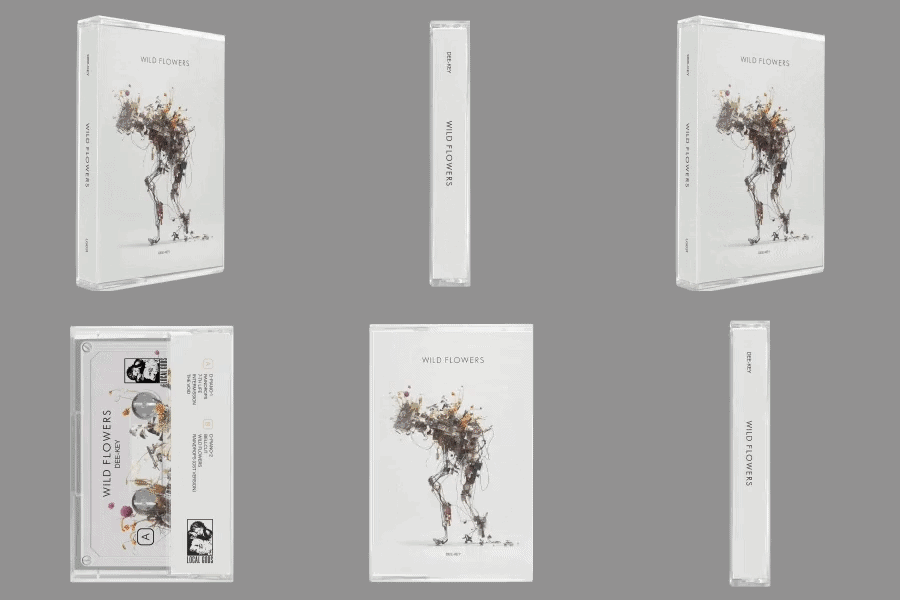
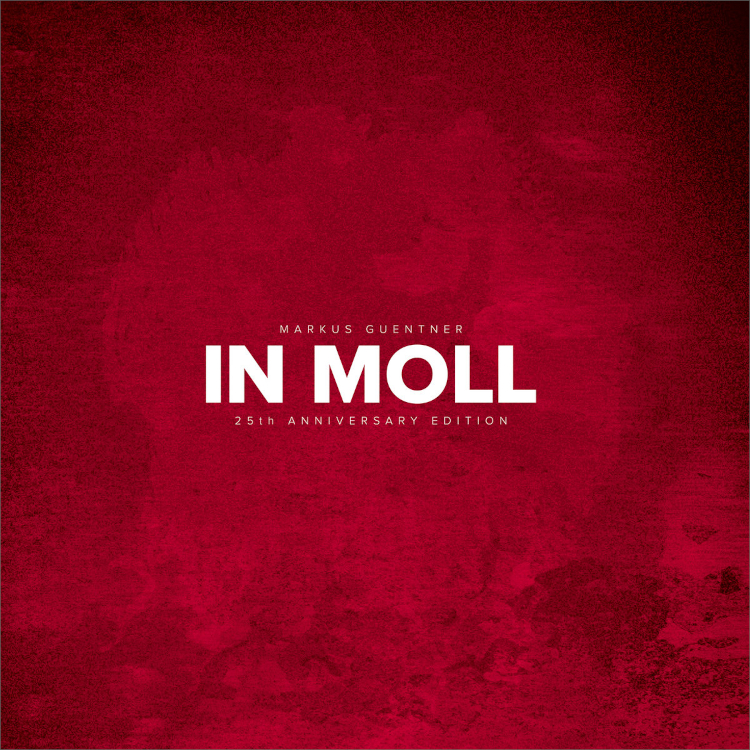
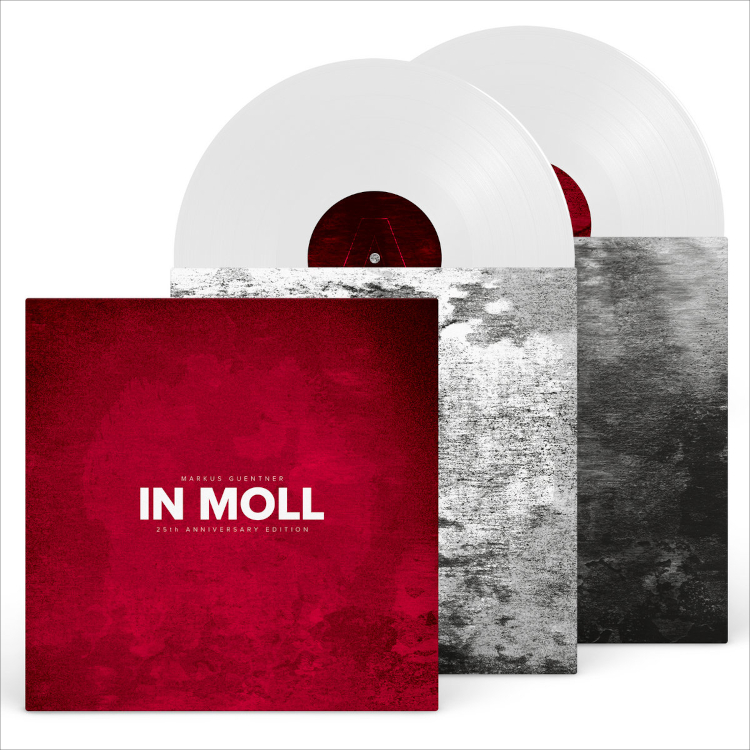
- Precisely because you are also a graphic designer, and have created visual identities as well as sonic ones, I would like to ask whether, for you, a record possesses a kind of “visual temperature.” When you redesigned the artwork for IN MOLL for this edition, were you trying to represent the album as it was in 2001, or your present-day memory of that album? Are those two different images?
MG :: Yes, there are always visual elements that I associate with an album’s artwork, and they’re closely connected to the music. It makes no sense to use a picture simply because it’s “beautiful.” The music and the titles play a major role. What does the overall mood feel like? Should the artwork be restrained, or can it be bold and striking?
It’s similar with IN MOLL. I definitely didn’t want to reuse the original cover. The original is what it is; it doesn’t need a new coat of paint. It stands on its own and represents the time in which it was created. But with IN MOLL, the color was—and still is—what people associate with the album. I’ve often heard people say, “Oh, the album with the red cover.” That became the starting point for the new artwork.
I wanted to create something that exists in the present, something that simply evokes a memory. Fundamentally, the image of IN MOLL is still the same as it was twenty-five years ago, but now it’s a memory of something that has already happened. That’s the feeling I wanted the artwork to convey. The essential element, the color, has remained. Everything else is no longer tangible; it’s blurred and distorted.
Twenty-five years within ::
- “IN MOLL 4” was part of the original work but did not appear on the 2001 vinyl release; twenty-five years later, it finally takes its place on the record. Does this retrospectively alter the work itself? I am interested in whether, for you, IN MOLL has always consisted of seven parts, even when the public physically possessed a different version, or whether an album, once released, takes on a form independent of its creator’s intentions.
MG :: I remember that back then, the vinyl and CD versions were often both available, whenever a CD version existed. People would often buy both, so in a sense the album was complete from the outset. That has changed enormously. These days, people tend to buy either vinyl or CDs, or listen digitally or through streaming.
I think the good thing about IN MOLL is that it works both with and without “IN MOLL 4.” It was never necessarily conceived as a concept album that only makes sense when you listen to it from beginning to end. The tracks can stand on their own, which perhaps emphasizes its Pop Ambient character even more. That may also be what distinguished it from albums with a clear, unambiguous, continuous structure. The fact that ambient can work in this way was probably the interesting part.
- For this edition, you decided to revisit the material creatively, rather than simply hand it over unchanged for a reissue. I would like to know what rules you set for yourself when returning to those tracks: what did you forbid yourself from correcting? Because I imagine that the greatest danger, with twenty-five additional years of experience behind you, would be precisely the temptation to “improve” something that worked because of the inexperienced young man you were at the time.
MG :: The 25th-anniversary edition itself is the original album, simply remastered. It should, and deserves to, be heard as it was intended. A quarter of a century later, it still stands on its own. But, there are also reworks of the tracks (which will be released digitally on Black Knoll Editions in December). The idea behind those was to explore how I see and reflect on the pieces after such a long time. I definitely wasn’t trying to improve them. I wanted to look at them from a distance, after all these years, and give them a slightly different form.
It’s important to preserve their essence, because these aren’t new tracks. They still need to be recognizable. But it was fascinating to take the sounds and work with them here and now. In a way, it meant working with the same material again after all this time: reworks, simply a new treatment of the original material.
One thing that made the whole process more complicated was that I no longer had the original sounds or individual tracks. A computer crash (around beginning 2002) destroyed everything I had been working on, including the projects I’d completed. All I had left were the finished tracks, without the individual sounds, arrangements or anything like that. So I started rebuilding things, sampling my own music, and experimenting with stem separation in some very unconventional ways.
In the end, that actually made me engage with the original tracks more deeply than I would have if I’d simply taken the original sounds and “remixed” them. You could say that the result was a complete reworking of the original, but always with the idea of keeping it recognizable in mind.
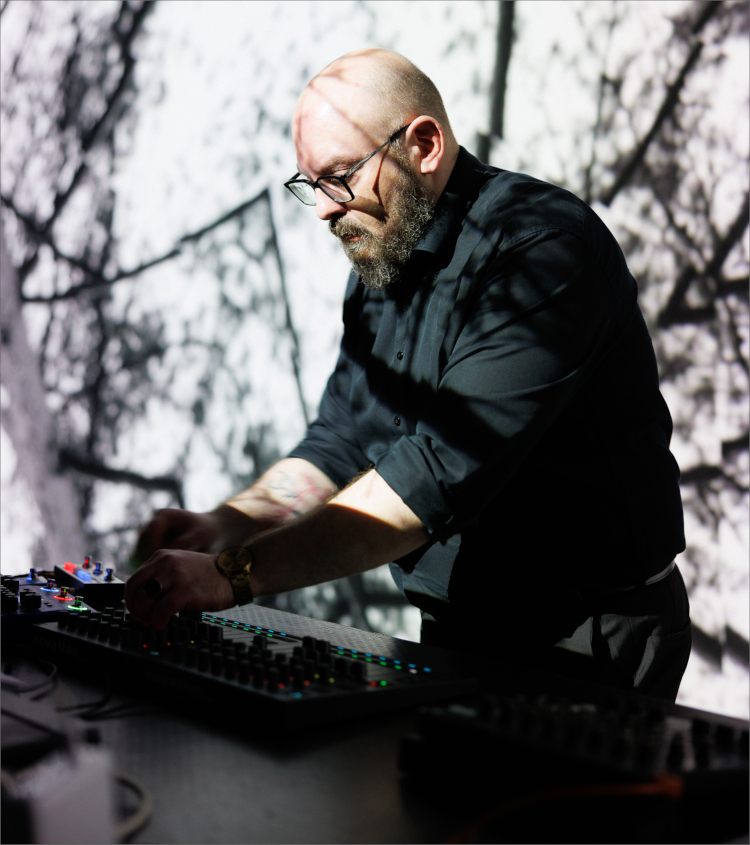
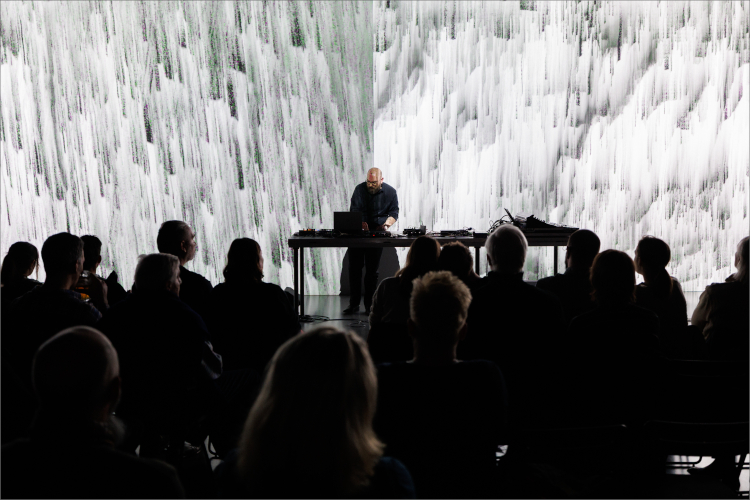
Another reason for making the reworks was the possibility of performing the material live. Since I no longer have the original project files, I needed something I could play on stage. That made me examine the music even more closely. What can I use digitally? What could I add with analog equipment without moving too far away from the original idea? Which parts are so important that I can’t simply reproduce them differently?
All in all, it certainly wasn’t an easy process, but it was incredibly interesting for me to revisit such old material, remember what it meant to me, reflect on it, and make conscious decisions about how to approach it now.
What remains unchanged ::
- Rafael Anton Irisarri has said that hearing IN MOLL in 2001 revealed expressive possibilities he had not previously imagined, and has even stated that The Sight Below would not have existed without that album. Now he is the one remastering it using an analog process. What does it feel like to entrust your own past to someone whose future was, at least in part, made possible by that very past? During the mastering process, did you discuss preservation or reinterpretation?
MG :: For me, it was actually a completely logical step. If not someone like Rafael, an artist like him, then who could I entrust it to? For a long time, I had no idea that IN MOLL meant so much to him. I knew and loved The Sight Below back then, too, but it never occurred to me that my music might have played a part in it, let alone that Rafael might even know my work. We only made that connection when we met in 2013 … funnily enough in Cologne.
When it came to mastering the album now, we both felt it was important not to reinterpret it, but to improve the sound of the original while smoothing out some of the imperfections from back then. Perhaps certain sounds could be made a little brighter, or the bass adjusted in places so that the rest of the sound felt a little more open.
This wasn’t the first album of mine that Rafael had mastered. After the first one, I knew that he understood exactly how my tracks were meant to sound and how to master them without making them sound like something else, without cutting things back too much or emphasizing other elements too strongly. So I have complete trust in him, and I didn’t interfere with or request changes to his work.
- There is also a fascinating technological paradox here: IN MOLL emerged from an electronic music culture that, at the beginning of the millennium, was discovering new digital possibilities; yet in 2026, Irisarri has chosen an entirely analog mastering process. What were you seeking in analog technology that digital processing could not have delivered in quite the same way? And to what extent can our memory of a work change simply because we alter the way we perceive its depth, dynamics and sonic texture?
MG :: It’s true that this was a time when new possibilities for digital processing and creation were emerging, or at least becoming accessible to people who previously couldn’t afford them or didn’t have access to complex hardware. Since I started out entirely digitally, with the limitations of what was possible at the time, I grew up with that world. For me, it was a process of discovery and exploration, much like the way people had explored hardware in earlier years.
The decision to remaster the album entirely in analog was more about the idea that, although digital technology can now do so much, perhaps even more, it felt appropriate to use an analog process for a record that came from that particular era. I wasn’t involved closely enough in the mastering process to say whether one approach was better suited to the material than the other. But I do think the original recordings lent themselves very well to analog mastering.
There are all kinds of theories, philosophies and debates about whether analog sounds better. Of course, there are huge differences depending on the equipment you use (as I said before); hardware always has its own character. For people who work closely with it, those things can make a real difference. But I learned quite early on, right after IN MOLL, that the first question people asked when they liked the album was: “What hardware do you use?” When I told them it had been made entirely digitally, the reaction ranged from disbelief to more or less insulting comments that digital production was rubbish and that I couldn’t possibly have achieved that sound digitally.
That was very revealing to me. I’d ask in return: “So the album is worse now just because it was made digitally?” There was never a clear answer. So, again, I don’t think there’s a right or wrong way. It’s about what you do with the material and tools available to you. The means you use to get there are secondary.
And as for whether changing certain parameters can alter how we perceive or remember something: absolutely! There are plenty of examples of remastered recordings that no longer sound like the versions people knew. Suddenly, certain elements that defined the original are missing, perhaps a kind of imperfection, an “incorrect” mix, or something else that gave it character. Or something unnecessary has been added. The music has been treated too intellectually and rationally, with the goal of making it sound “perfect”.
But music can’t simply be reduced to perfect frequencies and parameters. Everything doesn’t have to be perfect; it has to have character. That’s why it’s so important that whoever takes on the mastering or remastering understands the music and knows how to judge it, rather than following a rigid process just to make it sound supposedly better.
Against the expected ::
- Over the years, your music has moved through ambient, techno, drone, collaborations and considerably darker works such as Black Dahlia, in which you deliberately sought to move away from dense layers and “warm” atmospheres, allowing a smaller number of elements more room to breathe. Listening to IN MOLL today, do you primarily hear the beginning of a path you have continued to follow, or do you recognize possibilities you left behind that might now interest you again?
MG :: Because of the anniversary, I’ve thought a lot about this and reflected on what happened between IN MOLL and now, how my music and my way of working have changed. And yes, I have to say that it really has been a path I’ve followed, sometimes consciously and sometimes not. One thing always leads to another, whether I decide to pursue something or move away from it.
Sometimes I catch myself approaching things a little too rationally. I’m generally a very rational person; I can usually find an explanation for almost anything. But music is the exact opposite. Back then, the way I worked and the things I worked on were completely irrational. And, as I’ve said, I still almost always approach my music without anything concrete or tangible in mind. That’s a good thing.
That said, I do find myself wondering more often now whether something should sound this way or perhaps another way, whether I’m allowed to do something or not, whether there’s enough there or perhaps too little. You learn over the years, and you become better at analyzing things. But that’s exactly where musical freedom comes back into play, a freedom I have to remind myself of and keep becoming aware of. It doesn’t matter how I do something as long as I’m happy with it. I don’t have to meet anyone’s expectations or please anyone. It’s simply my own expression, and nobody gets to tell me how it should sound.
That’s really the same feeling I had back then, when nobody could interfere or tell me what to do.
- In 2001, ambient was still, at least relatively speaking, a marginal musical form; today it is everywhere: streaming platforms, playlists for sleeping or concentrating, wellness culture, algorithms, functional sound design. You, however, have said that works such as Black Dahlia demand active listening and are not necessarily intended to be pleasant. Do you fear that ambient’s cultural success has ultimately domesticated it, turning music capable of altering our perception into little more than sonic wallpaper? And where do you draw the line today between ambient as art and ambient as a service?
MG :: Fundamentally, every musical form and genre has a right to exist. I don’t condemn or despise any of it. If people enjoy something, find meaning in it, and are emotionally moved by it, I’m certainly not going to argue against that.
The idea of genre is still very dominant, which is unfortunate in some ways, but you can’t really blame anyone for that. There’s simply so much music out there: too many subgenres and too many branches. But that isn’t necessarily a bad thing. If something doesn’t fit the strict definition of a genre, something new and different emerges. And if someone identifies with “ambient” but hasn’t explored drone, for example, I can’t blame them for not knowing that part of the music or for not having explored it. Perhaps they haven’t discovered it yet, or perhaps they don’t want to. I remember the same thing from the techno scene. If I told someone I listened to or played techno, they’d understand it in terms of whatever they already knew. They might not realize that I was more into house or minimal. But that wasn’t bad or wrong.
These days, I wouldn’t really say that I’m making ambient in the strict sense. The ideas and structures associated with the genre are certainly present, but what I do doesn’t necessarily fit the classic definition. When I explain my music to someone, I usually say, “I make ambient, BUT …” The genre is a quick way to introduce it, but what I’m doing is something else, something that moves away from the functional aspect of music and from simply assigning it a label.
I’ve never wanted to make music that merely “works,” whether in techno or ambient. I want music to move me and give me something. I don’t want simply to be able to use it for a particular purpose.
Because you engage so deeply with your own music and put your emotions into it, you naturally hope that listeners will engage with it, too. But ultimately, that’s entirely up to the person listening. And perhaps, for that person, my music does work as “ambient music” in the purely functional sense as well.
Still outside the lines ::
- You have said that your experiences, your surroundings, the people you meet and your emotional state inevitably find their way into your music. I would therefore like to expand the scale of those “surroundings” quite radically: we live in a time marked by wars, political polarization, the climate crisis, technological acceleration and a widespread sense of instability. Can history find its way into your music even when you have no intention of making explicitly political music? And if it does, how can a composer working in an abstract musical language transform fear, violence or collective uncertainty into sound without reducing them to mere aesthetics? Or do you believe that preserving a contemplative space, sheltered from the noise of the present, can itself be a form of response today?
MG :: The “environment” that influences us isn’t just a particular place or region, whether human or geographical. Every piece of information that comes our way is something we have to process, whether or not it matters to us personally.
Unfortunately, much of the information we receive at the moment is negative. That’s an objective observation, although of course it affects me personally as well. These are existential issues that many of us have to confront. We have to deal with injustice. Rationality and logic are increasingly pushed into the background. That’s difficult to come to terms with, because we’ve been taught to expect the opposite. And that’s the contradiction: why do the rules apply to me but not to others? Why do things happen that are completely unreasonable? The problem is that these things are driven by politics. It no longer seems to be about human actions and feelings; it’s about politics, industry and keeping the system running. Everything has become tangled up in contradictions that are no longer easy to explain.
All of this influences or, perhaps more accurately, inspires me and my music more than many other things do. Since I don’t make functional music, let alone music that tries to make things look more beautiful than they are, what comes through is always somehow the emotional state I’m in. It’s a direct expression of that state, translated into music. So I think people could find a connection to my music through these things, even if it isn’t expressed consciously or in an obvious, explicit way. It runs through the music more subtly.
And yes, absolutely, I think music can offer places of retreat. I need that myself. There is music that allows you to forget, for a moment, what’s happening around you. When I listen to it, I don’t have to confront those things directly, because they aren’t being thrust in my face. Perhaps that’s the difference between music with an explicitly political purpose and other kinds of music. With one, I want to make a statement based on a clear position about what I believe is right or wrong. With the other, I can communicate something that moves people and conveys how something feels, without wagging a finger or telling them what they should think.
- Twenty-five years ago, IN MOLL could have sounded like music arriving from the future. Today, it is being reissued at a time when a new generation of ambient musicians is using a vocabulary that works such as yours have, in part, helped establish. What is your relationship with the idea of influence? Does it give you satisfaction to recognize something of your own music in the work of others, or does influence become truly interesting only when the artist who has absorbed it breaks away from the original model and reaches somewhere you yourself would never have gone?
MG :: Influencing or inspiring other artists was never a goal of mine, and for a long time I wasn’t even aware that it might happen or that it had happened. It’s an incredible honor when someone feels inspired by something I’ve made and is moved to create something of their own. And I don’t mind if the influence is obvious. Everyone is inspired by other musicians and artists.
I often say that if you really love something, you should try making something like it yourself. In the end, it won’t sound exactly the same anyway, because everyone has their own perspective and interpretation of the original, and will express it accordingly.
That’s why it’s so exciting to see what someone creates after being inspired or influenced by you. They’ll find their own voice, it was already there inside them. It’s more than wonderful, and genuinely remarkable, when that inspiration helps someone find a path to something you couldn’t have influenced, predicted or achieved yourself.
It’s fascinating to think about how someone might move beyond what you’ve done and reach somewhere you never did. And perhaps the process even works in reverse: you might then be inspired by their work and create something that had never occurred to you before.
- I would like to conclude by completely reversing the perspective of this anniversary. I am not asking what IN MOLL means after twenty-five years, but rather this: if, twenty-five years from now, in 2051, someone were to hear this album for the very first time, knowing nothing about KOMPAKT, Pop Ambient, GAS, you, or the historical context in which it was created, what would you want to remain once all that information had disappeared? And if the music could still communicate something to that person, would that be your definition of “timelessness”?
MG :: Goodness, if nothing unexpected happens, I’ll still be alive in 2051, and I’ll be seventy years old! Unfortunately, I can’t look into the future or know how things will develop and change. People might find themselves longing for things that exist today, or everything from the past and present might simply become irrelevant or obsolete.
But if things do unfold in a way that leads people to rediscover the album, then I would want the feeling of that time to remain. For me, it was a relatively carefree period, but also one that challenged me personally. It was a time when it was possible to experiment, to let things find their own way, not to see everything in black and white, and to find a sense of freedom and peace within yourself.
If that happens, then perhaps that is the definition of timelessness: nothing specific, just something that is simply there.
In Moll (25th Anniversary Edition) is available on Black Knoll Editions. [Bandcamp]
Photos by Jakub Dolezal, David Westlake, and Alexandra Magheru