




Rudy Adrian’s Southern Isles Sketchbook is a deeply atmospheric and meditative journey through cinematic piano textures, haunting flutes, shimmering electronics, and spontaneous improvisations, evoking the stillness, mystery, and natural beauty of imagined landscapes.
Stillness, memory, and the subliminal beauty of nature
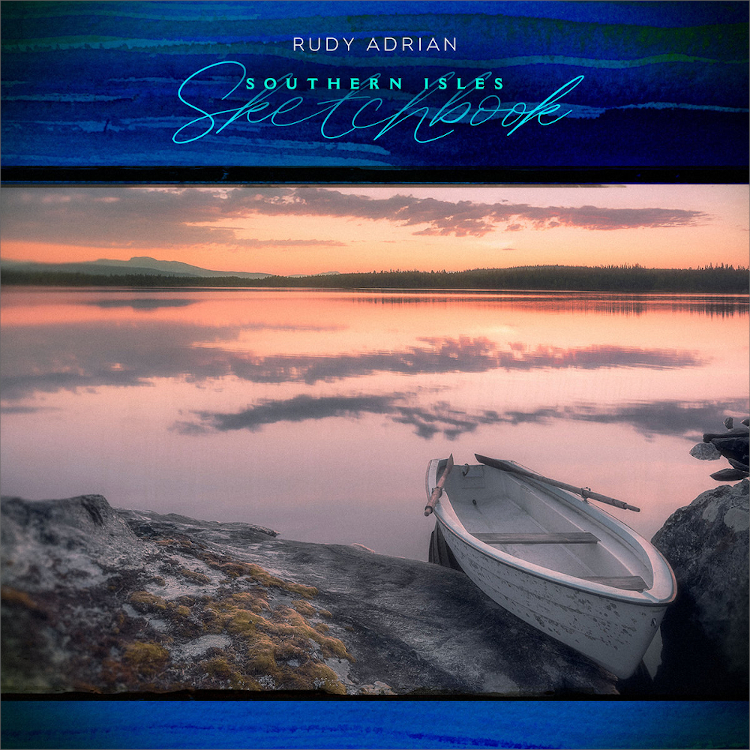
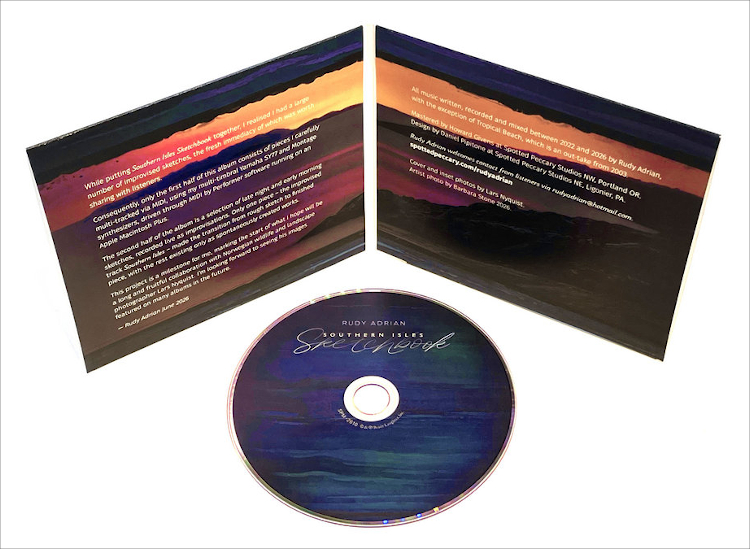
Each track transports me mysteriously into a new direction with every listen, I hear a polished, cinematic, and atmospheric layering of mysterious piano textures, dry flutes, synth chimes, and subtle electronic sounds. Filled with powerful psychic balm, half of the album is made from rough, improvised sketches Rudy Adrian recorded late at night between January 2003 – March 2026. The common thread to Rudy‘s music is the exploration of sonic landscapes, where melody and rhythm play a secondary role to the tones and textures created by synthesizers, wood flutes and the human voice. The album’s visual design by Daniel Pipitone is so serene, the colors sublime, the view is one of the beautiful glacial-smoothed lakes or inlets they have up in Scandinavia. Rudy lives in Dunedin, New Zealand. The photographer lives in Norway.
Southern Isles Sketchbook brings a creative collaboration with Norwegian photographer Lars Nyquist, whose imagery graces the album cover. “This project is a milestone for me,” reveals Rudy, “Marking the start of what I hope will be a long and fruitful collaboration with Norwegian wildlife and landscape photographer Lars Nyquist. I’m looking forward to seeing his images featured on many albums in the future.”
“Lars has already had a number of his photos used by other ambient artists such as Lauge and Spacecraft and it’s a great honour to be allowed to feature his images as covers on my albums. I consider working with his photographs in mind to be a collaborative, creative process.” During the recent Bandcamp Listening Party, attended in real time by Rudy Adrian, the discussion revealed many new details and included opinions which I would like to include today. For example, Spotted Peccary co-owner and visionary musician Deborah Martin opined, “I absolutely love the sublime continuity of each of these tracks, timeless vignettes into a scenic realm. These tracks ebb and flow in a dreamlike state which so beautifully matches the photo in the cover art.” I think I’m in love.
The title Southern Isles Sketchbook was chosen because Rudy is based in New Zealand which is essentially a collection of islands in the South Pacific, almost exactly halfway between the equator and the South Pole, known for undulating granite hills, dense podocarp forests, sheltered inlets, and pristine sand beaches. Terra Australis Ignota (Latin for ‘the unknown land of the south’) was a hypothetical continent appearing on European maps from the 15th to the 18th centuries, with roots in an ocean introduced by Aristotle. It was depicted on the mid-16th-century Dieppe maps, where its coastline appeared just south of the islands of the East Indies. It was often elaborately charted, with a wealth of fictitious detail. The isolation of these southern islands creates unique terrestrial and marine ecosystems. Previously isolated regions of the world became permanently connected through global trade networks, bringing about a massive transfer of plants, animals, foods, human populations, using astronomical charts plotting the location of the stars, fed by stories of the phantom islands and other islands of the sea.
Rudy ruminates. “While putting Southern Isles Sketchbook together, I realised I had a large number of improvised sketches, the fresh immediacy of which was worth sharing with listeners. Consequently, only the first half of this album consists of pieces I carefully multi-tracked via MIDI, using my multi-timbral Yamaha SY77 and Montage synthesizers, driven through MIDI by Performer 2.31+ software running on an Apple Macintosh Plus.”
“The second half of the album is a selection of late night and early morning sketches, recorded live as improvisations. Only one piece—the improvised track “Southern Isles”—made the transition from rough sketch to finished piece, with the rest existing only as spontaneously created works. I feel they possess a magic that seems so often to be reduced when a piece is carefully crafted.”
“The late-night live improvisations have had a few tidy-up edits but are largely what came out at the time. They were supposed to be simple sketches to remind me of ideas to one day flesh out, but re-doing them proved not so easy, plus, I was very surprised they seemed to stand up as releasable tracks. About 100 improvisations were pared down to the ten we have here. The playing is a bit random, with odd, changing time signatures. I could have digitally edited the changing time signatures into more “even” pieces, but in the end I decided to leave them the way they were…”
As a constant listener, I am unable to distinguish any qualitative differences between any tracks from the second half and tracks from the first half of the album; the continuous listening experience is entirely sublime. “The sketches came first and I tried to re-do them as multi-tracked works, but only one sounded as good as the improvised piece, and that’s this one! So the album starts and ends with the two versions,” finishes Adrian.
From the Lars Nyquist website I learned that Urmodern is a Swedish word for the foremother, the genetrix, the fertile Earthmother, the creatress of beauty, the divine feminine, the lost Muninn of the world. “She talks to us through a sleepy mountain, a hidden story of a ragged boat, a mystical Aurora that moves in the sky, a frosty breath of a moose, or an anemone daydreaming in the first sunbeams.” The photography of Lars Nyquist is an attempt to read the messages that She gracefully uncovers for us to see, attempt to describe something, and deliver it to show Her beauty, bounty, and wisdom and help reconnect with Her. Music and photography can evoke important aspects of the human experience, which plays a very important role in interpreting music and the timeless human quest for understanding and balance between intellect, fantasy and memory.
It is now time to turn into the music. Cautiously wending its way in, a flute and a piano awaken, “Southern Isles” (3:43) sets the mood: slow, relaxed , mysterious and deep, it leaves us lingering in the keyboard and luminescence. Adding a swelling raspy dry breath flute to the piano and magical electronic sounds, we greet the sunrise. There are small gentle waves lapping on the shore, with an ethereal alien quality, the wordless vocals were sung by Rudy, 25 years ago. “Tropical Beach” (2:35) begins with the sound of the water, joined with rattles and ghostly ethereal signals in a dreamy place. The faint drums are real Pacific Island drums, slowed down to half speed, little hand drums, massively slowed down, “Sheltered Harbour” (4:11). As the waves continue, synth chimes ascend into a new sunrise, small bells and wispy flutes are gloriously sprinkled across the music, slow drifting ghosts call over carillons, an electric guitar makes a single note or not, add backwards and forwards sounds, orchestral swoons and floating. Overall, nothing much happens, which I find very relaxing and satisfying.
A tableaux in luminous moonlight ::
Rudy shared an interesting story about the next track, “The Silver Talisman was created for a Ukrainian jeweller who kindly sent me a present of an amulet for me to wear. The music here came together quite quickly, and I think she spent far longer on casting the one-off piece of lovely jewelry, than I did on making the piece!” “The Silver Talisman” (4:58) releases the nocturnal insects, with a brief possible ghost and the synth rising in and out, a tableaux in luminous moonlight, the piano barely emerges later. I hear something sneaking around in the night, perhaps crickets and little pitch-bent musical notes, mysterious and atmospheric, spreading layers of oblivion.
From the mists something unfamiliar materializes, church organ drones, dragonflies, a dry flute, soon a piano takes over, “Foggy Day” (3:31) is slow, with sustained tones almost like a drone, delicate hidden details, calm, clear, relaxed and pretty to behold. Rudy said that “This piece is actually a very structured and measured-out track. It’s almost like verse-chorus-bridge-verse-chorus-bridge repetitions, featuring a little bit of a wispy flute breath, a few piano notes, a deep bass note, a windy-type sound… which all come back and repeats, but each time with slight variations. I wouldn’t want to have every track as strictly measured out like this, but I think it makes for a nice change in style on the album.”
Organ drones, abstract sounds of birds, “Drifting Skies” (3:36) brings nature sounds with extra touches, no hurry, there are some strange birds in the distance maybe, the fade goes on forever. Here nothing is happening in an endless drone sky. “It is Written in the Stars” (5:17) starts to fade in slowly, an organ drone gets bigger, the cosmic wind in the distance starts stirring the calm, then letting it float freely. “Stargazing is something I enjoy on a clear night away from city lights,” reflects Rudy. “In many places you can see the Clouds of Magellan, which are nearby mini-galaxies, looking like little fluffy clouds at night.” Perfect for a “Hilltop Walk” (3:19), head over heels, repeating phrases and melodic fragments, chimes synth, lots of little variations tucked into the repeating form. I am thinking of Donnie Darko, and Rudy volunteers that “This is definitely my LEAST FAVOURITE track on this album. The slightly screechy resonating violin-like sound that comes in was something I explored with half a dozen attempted tracks, but I was dissatisfied with. In the end only this one, with the softest of screeches, made the grade. A couple of people told me they liked the climbing piano (hence the title), so, with some reluctance, I left it on the album.” I think it was worth it. Nicely done.
The name Portobello is from unknown origins but has many stories. Some say that the name means beautiful door, or beautiful harbour. Portobelo is a seaside suburb of Edinburgh, Scotland, and Portobello Road in London is famous for its market. Portobelo is also a fictional British colony in the Long John Silver film universe. Portobelo, Panama is a historic seaport on the Caribbean coast discovered by Christopher Columbus in 1502. Rudy said that “George Washington‘s older brother fought alongside the British there, under Admiral Vernon. Washington re-named his family’s home farm after the British naval leader. Admiral Vernon wore a grogram coat (for heavy weather) and was nicknamed “Old Grog.” He became famous for watering down the sailor’s rum ration, which they called “grog” (hence the word “groggy” – slightly drunk). The Portobello township near where I live has a pub which I visited during a recent walk. I ordered a glass of rum, watered down with Coke – so I was practically drinking “grog”! This track and the earlier “Sheltered Harbour” are from an abandoned album project from four years ago.” Me? Mostly I think of the flavorful Portobello mushroom, which to me evokes the earthy and versatile world we live on, “Portobello” (5:59) starts to fade in slowly, a sunrise with wind blowing, sometimes calm and slow, we get to the beach, gentle waves push onto the shore as we drift away from the last of the studio compositions. Fellow Kiwi Dark Shark adds, “For people who haven’t been to Dunedin, Portobello has a similar look and feel to the cover photo, albeit with residential and shipping port development on the other side of the harbour.” Now I feel like I have been there.
“Sometimes nothing happens and it happens slowly. I love it.” ~Robin B. James
“Moorlands V (improvised sketch)” (3:36) suggests a wide open wilderness of endless gently rolling scrub brush plains in the dark, this is where the piano is. I hear part of a slow haunting melody, I think it is night but there is no time indicated, quieting like death. A weeping piano, so sad, melancholic, coloring a catatonic void. The next track, “Moonlight (improvised sketch)” (2:26), opens more than one piano here, there is slow moving silver, calming slowing down, a lingering fade going into all that echo, so slow. I thought it was over. Sometimes nothing happens and it happens slowly. I love it.
Orion was said to be the most handsome of all earthborn men, and he was blinded for his lust. Orion was a hunter placed amongst the stars by the goddess Artemis, and was famously seen by Odysseus hunting in the underworld with a bronze club. Orion must have been a great slayer of animals, a shamanic hunting hero, gigantic in stature, and blessed with the ability to walk on water. “Memories of Orion is probably my favourite track on the album,” chuckles Rudy. “The “wave sound effects” are actually an accidental addition, performed by FM feedback surges (I think). I could have stopped everything to adjust the settings and remove the noise, but I so like the accidental effect that I left them in.” Orion is also a constellation, one whose rising and setting with the sun is used to reckon the year, and always evokes one who follows after the Pleiades. The seven sisters were transformed into the constellation, and it is said that even now in the heavens Orion still chases after them. “Memories of Orion (improvised sketch)” (3:48), sweeps me into legendary bliss, soon I think we are at the beach. I might hear the drone synth strings orchestra under the water nearby, and I might imagine an endless long slow fade out.
I love the sound of nocturnal insects, add a chimes flute drone, “Ancient Stones (improvised sketch)” (1:42) maybe some tiny viol sounds, maybe the crickets are playing the flutes. “Ripples (improvised sketch)” (3:27) starts with a repeating form, perhaps with a long slow drone above, a few notes with lots of room for the reverb to expand and work its way into a long slow fade out. The ripples would be something found on the surface of the water, maybe we are underwater, everything is suspended and almost still in the darkness, a church organ or not really but almost, and there could be flutes. I hate to guess, it sounds perfect. Woestijn means “desert” in Dutch, “Woestijn (improvised sketch)” (3:04). Rudy said that they do actually HAVE a desert in Holland—a large area of sweeping sandhills from glacial deposits at Hooge Veluwe, and De Hoge Veluwe National Park. I picture our Southern isles with various themes, hot sand, or rocks, or jungles, or ice, or salt dominated landscapes. There is a piano, sparse with a bit of electronic refreshment. The feeling is not barren, the tones are rich and thick.
“I can smell the breeze, the sharp spirit is wandering slowly into the reverb. We have come to the finality, evoking symmetrical bookends, another version of the first track, keeping the symmetry with a cold flute.” ~Robin B. James
Silver apples and white blossoms can act as a magical passport or calling card from the Otherworld (Annwn or Avalon), luring mortals away into realms of eternal youth and enchantment. Morton Subotnick brought us Silver Apples of the Moon in 1967. It all fits so well. “Silver Apple refers to the moon (the sun being a golden apple),” confirms Adrian. “These two tracks reminded me of Brian Eno‘s album Apollo, so I stayed with a lunar theme for the titles.” The famous lines “the silver apples of the moon, the golden apples of the sun” come from W. B. Yeats‘ 1899 poem “The Song of Wandering Aengus,” and can symbolize an eternal, magical quest or the enchanting allure of the otherworldly as well as the unreachable, magical desires of youth and dreams. First, “The Silver Apple, I (improvised sketch)” (3:16) opens the icy cosmos, suggesting a mountaintop, a keyboard maybe some metal reverberates at key moments and a bottleblow chirp. I love it here, perhaps because of something in the way the apple wobbles slightly. Next, “The Silver Apple, II (improvised sketch)” (3:59), with a part two feeling, I hear slower different notes, on the same instruments as part I, the feeling is dark slow empty with changes, yearning. I found a miniature story within this one, keeping the slow motif, adding new surprises that arrive and stay forever. “Moonbeams (improvised sketch)” (3:31) bears rising synth, until the piano breaks through, slow quiet delicate layers blend, the piano nudges into the fade. Rudy illuminates, “Moonbeams” has a very odd-sounding piano effect. It’s actually on the Yamaha SY77, with a piano-sound going through a very short delay with high feedback, to create a resonant, muffled ringing quality to the sound.”
“Fields of Lavender (improvised sketch)” (1:28) takes the piano deeper into the ice caves, while painting a picture of all those flowers. I can smell the breeze, the sharp spirit is wandering slowly into the reverb. We have come to the finality, evoking symmetrical bookends, another version of the first track, keeping the symmetry with a cold flute, “Southern Isles (improvised sketch)” (3:55) also adds a new synth sound, and an icy piano under glaciers of reverb, opening slowly pausing sometimes, its a sunrise one slowly expanding long sustained main note with more activity sprinkled about, we awaken and rejoice. The reverb increases as we go, a dry breath reed blown tones, the piano is here, everyone is happy and warm, calm and bright, and we fade off for the last time. If you replay the album now you can compare this with track 1.
Rudy has a unique style of atmospheric music for private release as well as for international record labels, including Spotted Peccary. Always experimental and original, the sound is also peaceful and listenable-similar to listening to a film soundtrack without pictures. He first started making electronic music in the recording studios at Canterbury University while he was studying Forestry Science. Eventually abandoning Forestry Science, he tutored electronic music at the University of Otago while completing a degree in Botany. This was followed by several years as a freelance musician and sound effects creator for television, advertisements and short films. Eventually this culminated in full-time sound design work for a television production facility and occasional freelance composition. Some comparisons to the atmospheric works of Brian Eno and the soft arpeggios of Tangerine Dream and Jean-Michel Jarre of the seventies are at times apt, but the music nevertheless remains positively that of Rudy Adrian.
Southern Isles Sketchbook is a deeply peaceful, meditative record that feels like an imaginary film soundtrack—perfect for late-night moods, introspection, and quiet focus. The album focuses heavily on space, texture, and mood inspired by the natural landscapes, and geography of Adrian’s home country of New Zealand (and its mythical ties to Terra Australis Ignota), the album reflects on stillness, memory, and the subliminal beauty of nature.
Souther Isles Sketchbook is available on Spotted Peccary Music.
Related posts ::
 Rudy Adrian :: Beyond the Sleepy Hills (Spotted Peccary Music)
 Rudy Adrian :: Reflections On A Moonlit Lake (Spotted Peccary Music)
 Rudy Adrian :: Along The Coppermine Ridge (Spotted Peccary Music)
 Rudy Adrian :: As Dusk Becomes Night (Spotted Peccary)
 Rudy Adrian :: A Walk in the Shadow Garden (Spotted Peccary)