




Our world is moving faster today. Deuter wants to go the opposite way, and people love it. They want to slow down, sit on a silent island, and reflect. Deuter creates music by hearing one tone and by listening to it, which tells him where the second tone is coming from or where it’s going.
Intended to settle the listener
The Swahili song titles on What the Elephant Told are named after elephants who reside at the Sheldrick Wildlife Trust (SWT), a global leader in elephant conservation. Its pioneering Orphans’ Project, the world’s first and most successful program of its kind to rescue, rehabilitate, and reintegrate orphaned African elephants, rhinos, and other creatures into the wild, has earned international acclaim. SWT’s broader conservation mission encompasses extensive aerial, field, and community support initiatives that protect wildlife and preserve vital habitats across Kenya.
I think that many of the Elephant’s songs are lullabies, intended to settle the listener, both calming and intellectually engaging at the same time, warm, atmospheric synthesizer pads and gentle bell-like tones that act like a soft, comforting blanket of sound. The central instruments heard on What the Elephant Told are cello, violin, piano, belts, oboe, flute, and synths. Our world is moving faster today. Deuter (aka Chaitanya Georg Deuter) wants to go the opposite way, and people love it. They want to slow down, sit on a silent island, and reflect. Deuter creates music by hearing one tone and by listening to it, which tells him where the second tone is coming from or where it’s going.
The first track translates as Memories, “Kumbukumbu” (4:37) and begins with a piano, and atmosphere. There are periodic beeping sounds which makes me think of outer space. Now imagine elephants in zero gravity, reaching for the stars. Basking in the golden light of dawn comes naturally, “Mapambazuko” (8:52) joins keyboards, reeds and strings with flute, and there could be a choir joining using the keyboard too. Here, the flute tells the story and the keyboard holds up the sky as the sun warms the world and the elephants walk along. The new day begins.
We are in outer space with sweeping stardust trails ::
In ancient Greek folklore, a nymph generally refers to a beautiful, eternally young maiden, perhaps a guardian of the wilderness, dwelling in the mountains, forests, trees, and waters, with powers of healing, prophecy, and shapeshifting. “Nymphaea” (4:33) brings a sad but proud mood, slow and processional in pace. The whistle has a wee bit of an accent, perhaps I am imagining a certain Green Isle in the North Sea. The cello brings extra flavor, and bringing together everything all at once, we are in outer space with sweeping stardust trails. The title track, “What The Elephant Told” (12:46) is an extended relaxing stretch, the flute leads us forward, while the strings and reeds lift us up, maintaining the slow thoughtful pace, the sweeps send us higher and I think I hear a harp.
With a flute, a drone instrument, and a keyboard choir, the “Pollen Path” (7:02) brings in a variety of new sounds from many instruments, perhaps this is how the bees bring to the hive the essence of so many flowers. The cosmic element gives even more dimension to the slow majestic sure and true sound. Elephant Dreams, “Ndoto za Tembo” (9:48) is slow and restful, the illusion of a voice elevates the mood and inspires a very sacred feeling that is calm and spiritually uplifting, perhaps close to heavenly.
Music which disappears into silence ::
The Swahili way to say Soft and Big is “Laini na Kubwa” (9:26), where the path starts slowly then changes, and the piano leads the way here. The other instruments make their entrance into this story with no words, sometimes feeling like an anthem, sometimes a cascading piano melody, and at other times I think of chamber music with sweeping arc sounds going across the night sky. The flute adds much color, instruments pair up and play out, leading to new discoveries and sensations. It is finally time for the Elephant Hug, “Kumbatio la Tembo” (5:20). I am again transported by the whistle to the Green Isle, like an imaginary view from the highlands looking over vast distances. Perhaps a lonely voice of the hill in the breeze, the flute loves the mountain talk and gets emotional for the old days and dear lost ones, starting with both flute and synth together and ending alone.
There is silence before there’s music. And then there is some sound and there’s music. And that disappears again into silence. For Deuter that second part is very important. He always tries to make music which disappears into silence, that takes the listener with it into the silence. Not an abrupt silence finish of the music, but a slow guiding into a silence. So for at least a little while, silence becomes audible. And many people experience it, even though it might not be a conscious experience, but it’s somehow happening. That was always an important aspect. The melodies move slowly and gracefully with no sudden shifts, letting the listener drift and unwind, to give the electronic and ambient layers an emotional touch.

Deuter is a German new age instrumentalist and recording artist known for a unique meditative style that blends his own sound with Eastern and Western musical elements. Deuter was born in the German town of Falkenhagen and was drawn to sounds of nature and musical instruments as a child. He taught himself the guitar, flute, harmonica and “just about every instrument I could get my hands on…”
“I am trying to create something,” Deuter muses, “but basically the music is there, the same way hunger is there. You don’t create the hunger. The hunger is there and knocks on your door and wants to go to a restaurant.”
What is music? “Basically, it’s just a sound. I can just play around with sounds,” says Deuter. “I also like painting and I love paintings. With sound you create with a piece of wood or with some metal things or a spoon on the table or whatever. Trying to do something with it the same way a painter, I guess, when he sees some colors wants to do something with the colors. Any sound, like a bird singing, water running, waves on the ocean. And then sounds which are created by an instrument, which are built to create a harmonious sound hopefully, something which is pleasing and helping to go through our life with some pleasure.”
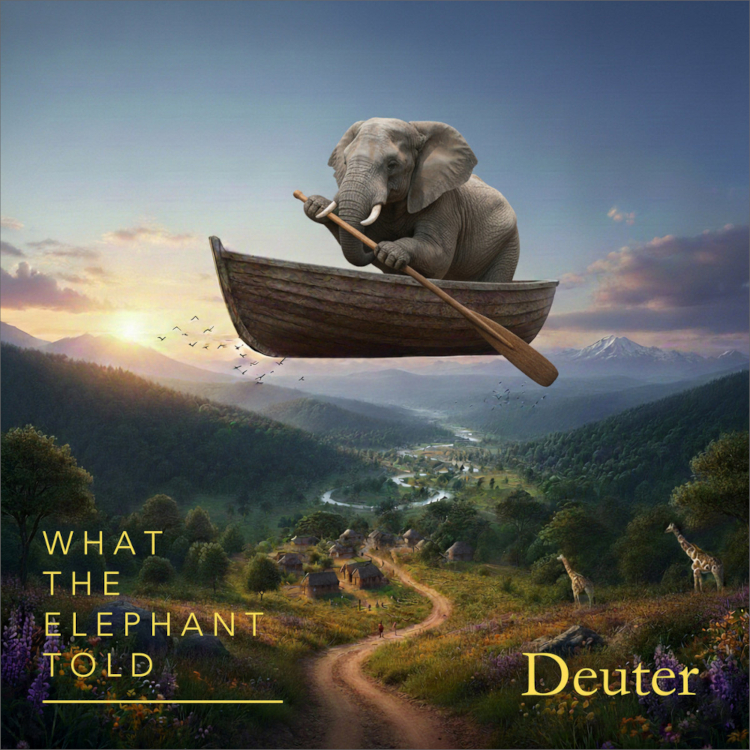
What The Elephant Told by Deuter celebrates the work of the Sheldrick Wildlife Trust and provides his well known consistent instrumental sounds. The feeling is serene, organic, and deeply meditative, blending gentle acoustic instruments into soothing electronic soundscapes that glow with a special warmth, creating an ideal background for yoga, massage, deep sleep, or quiet personal reflection. The cover art by x pulls it all together with a delightful fantasy feeling, an amusing anthropomorphic elephant calmly paddling along, somehow flying in the air. The spacious and flowing melodies move slowly and gracefully with no sudden shifts, letting the listener drift and unwind, giving the electronic and ambient layers an emotional touch. There are no African beats or instruments used here, what you will hear is the blending of gentle acoustic instruments, ethnic flutes, and soothing electronic soundscapes with warmth, creating a peaceful atmosphere meant for relaxation and healing, with a special sense of celebration for the important work of the Sheldrick Wildlife Trust and all the rescued animals living there now.
What The Elephant Told is available on Curve Blue.