





Rudy Adrian’s Along the Coppermine Ridge unfolds like a breathtaking, slow-motion film of New Zealand’s high-altitude wilderness, where ethereal synths, haunting piano, and sparkling chimes illuminate windswept peaks, mist-shrouded valleys, and the timeless pulse of nature itself.
Ethereal soundscapes of Alpine majesty
Rudy Adrian‘s latest album, Along The Coppermine Ridge, offers a slow, dreamy exploration of high-altitude New Zealand wilderness. Can music portray something of the essence of landscape photography in sonic form? Perhaps the music functions as an aural complement to the stillness of nature photography, creating a timeless soundscape that brings frozen moments of the wild to life. Adrian‘s signature style utilizes vintage synths to craft a rich, comforting, and yet vast sonic environment. Imagine slow dreamy high altitude vistas, all slow keyboards with an occasional emphasis on piano and plenty of chimes, evoking an untouched wilderness of mountain peaks, fiords and rainforests which supports a rich array of bird and marine life, including crested penguins, fur seals and bottlenose dolphins. The album is characterized by slow, ethereal keyboards, often featuring a sparse, ghostly simulated piano texture enhanced with liberal use of reverb, sustain, and shimmering chimes, adding an extraordinary electronic glow. Somehow he finds a way to deftly manage to ground in natural earthiness and yet elevate those elements into an entirely different realm.
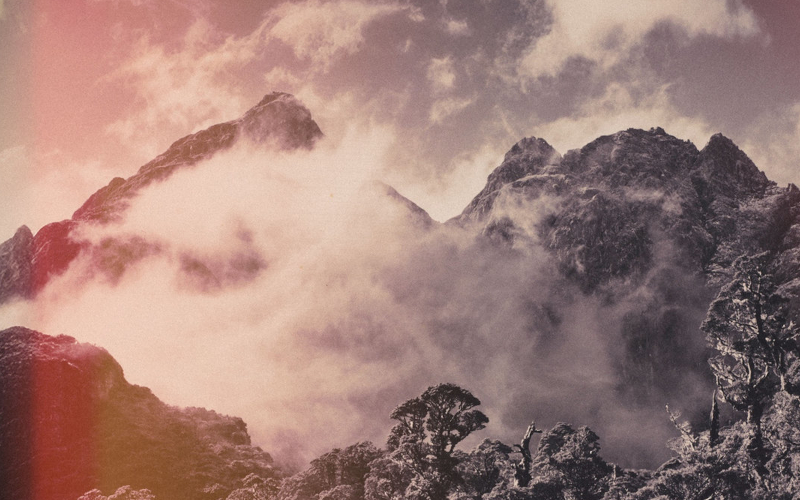
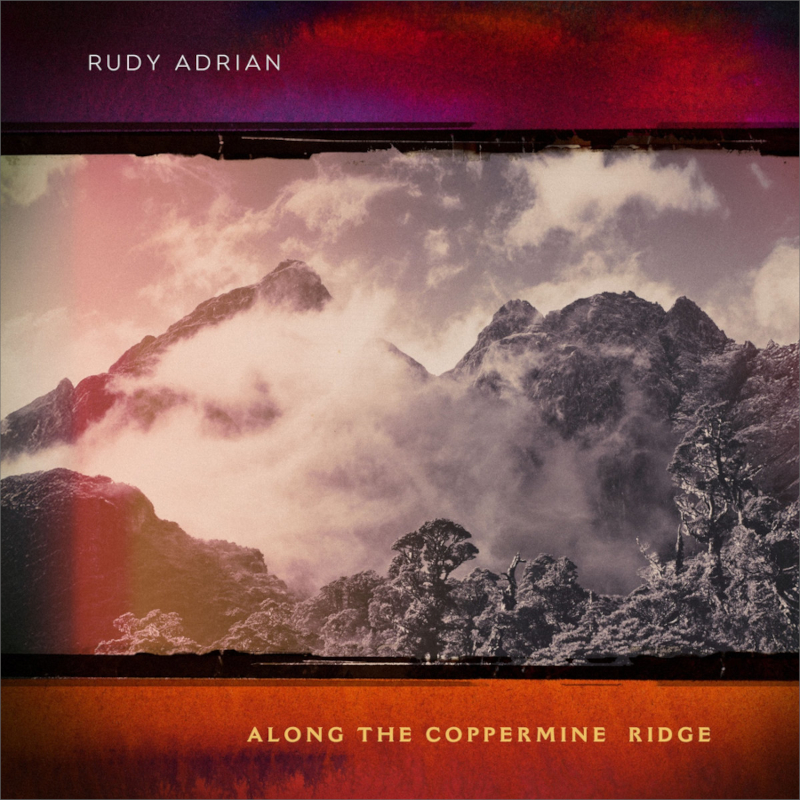
The album cover is a photo from the late 1960s by British-born New Zealand photographer John Henry Gerard Johns. Along the Coppermine Ridge is a tribute to one of Adrian‘s favorite photographers — someone whose work was admired by Ansel Adams back in the day. Like the music here, mountain weather can shift from clear skies to severe conditions very quickly. I think that photographs show a captured moment, the sound is from inside that moment, still and timeless, hear a photograph of dense forests and dramatic mountain crests, breeze-buffeted snowdrifts and swirling cloud formations of quiet reflection. I find it hard to describe the feeling but it is so rich and authentic, a new level of experiencing the music in one space. Very powerful. I find a comforting, liquid music, evoking the image of sun and water sharing their bounties by pouring down on the ancient rocks, highlighting nature’s cyclical, life-giving power.
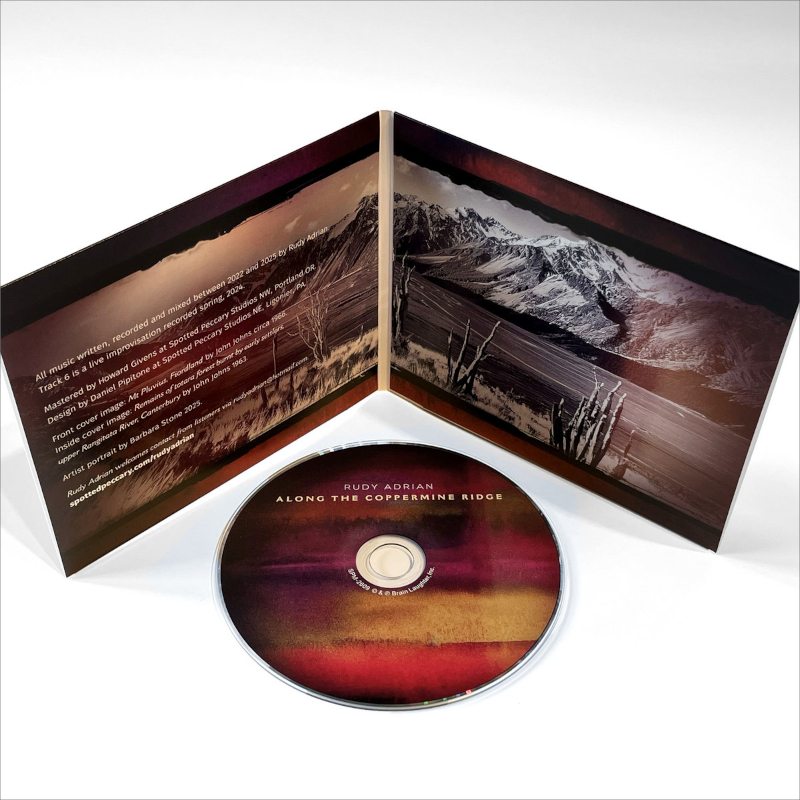
Along The Coppermine Ridge is not so much about evoking the experience of hiking along a hilltop, but more to conjure the feeling of looking through a book of landscape photography, specifically The Forest World of New Zealand by John Johns (photographs) and C. G. R. Chavasse (text) which was published in 1975 by A. H. & A. W. Reed. New Zealand’s national museum has kindly granted permission for two of Johns’ images to be reproduced for the album cover, the front cover features a photograph of Mount Puluvis in remote southern New Zealand, whilst the inside album image is of what New Zealanders call “high country” — heavily burned forest turned into grasslands where sheep occasionally graze in summer.
A photograph by John Johns that is not featured on the album’s cover was titled Silvermine Valley Catchment — which sparked the imaginary title of a Coppermine Ridge.

“The album isn’t named after any specific Coppermine Ridge,” says Adrian, “I was looking for a title that evoked countryside dotted with a few little prospector’s diggings from 150 years ago.” Adrian says that there’s a mountain bike trail for high speed racing, but he is not a fan of that kind of cycling, so he called it Coppermine RIDGE, not Coppermine TRAIL (which is the bike track). I imagine that he will probably go for a walk there later in the week.
Adrian‘s familiar vintage technical set-up consists of an Apple Macintosh from 1984, a Yamaha SY77 from 1989 and a Yamaha Montage from 2016, adding background ambient effects such as synthesized bells, shakers, atonal effects to capture the remote mountains and rivers of the country’s backcountry. His usual studio method is laborious, overdubbing tracks of MIDI information and then painstakingly adjusting the velocity data and placement of the notes on a computer screen.
The first track, “Castle Rocks” (3:12) introduces a theme with grim, jarring piano notes against the dark sound of the wind, setting a tone of dread and dramatic awakening on high cliffs. Slowly the mountains are revealed in the darkness, a whistling windy mountain peak, I immediately remember the major drama and shock of death and awakening in a strange place, the clouds flow to reveal the faces of the stone cliffs, the feeling of dread with jarring piano notes used intentionally to announce the wilderness theme and the idea of a rock outcrop in the elevations. Castle Rocks is a real place in the wild hills behind New Zealand’s Abel Tasman National Park. The principal sound here is a Yamaha SY77 piano, but pitch-bent up an octave, to make it more harp-like. And that’s what Adrian will often do with sampled sounds. If they don’t sound very authentic, he might make them even more unrealistic and (hopefully) mysterious.
Mystical and mysterious “Ridgetop Clouds” builds a strange, on-edge atmosphere with long, sustained tones and strange harmonious sounds, emphasizing the frightening scale and eternal nature of the mountain environment, clouds are soft and the edges are uncertain. This track feels semi-improvised, just slowly drifting through a few suspended chords, the bass really helps to create the rootless, suspended feel in this piece, suggesting swirling clouds and mists. My lingering doubt slowly transforms into geological weather, my icy water is washing the rock face, my skin crawls at the peculiar creaking sound, probably an insect, it chirps or purrs or something. Perhaps this is the dark, it comes from darkness, it stays dark. Now we realize how big this all is and it is frightening. Here the mountains are eternal and the vapors flow over the rock face, gaining focus steadily never quite resolving.
Now we are in the snow up here following the musical signs, “The Higher Path” (3:40) maintains a slow, dreamy pace with shimmering, sparkly ringing tones. I might hear sun-dappled chimes under a pulsing heartbeat, the cold breath of snow-bright evergreens, drones like gusts of wind through grassy plains—before a bright chime shines through like a sunbeam, accompanied by the tinkle of new chimes and the presence of odd whistling creatures. We are ascending but the physical dimensions make progress seem minimal. “Where the Skylarks Sing” (2:56) uses the grand, echoey piano effect to evoke a spooky, wide-open sky and swirling memories, respectively, the light slowly growing brighter.
Dreaming through New Zealand peaks ::
I love the idea of the ripple effect that this beautiful music will have out in the world, a piano-like theme with the wind slowly swirling around and around through the memories, a soaring solemn wind that fades slowly, “Memories of Thursday” (5:12) features many slow delicate and fragile moments floating and coiling, and so are the birds, they have returned to take over. I was sad when it ended . . . but then, we went right into this next piece.
The title track, “Along the Coppermine Ridge” (6:31) was recorded as a live improvisation one spring morning in 2024, and acts as a prelude to sparkling sunshine, representing the slow emergence of light at a great altitude, everything happens slowly, the mountains are before us and the light is growing. This feeling has been coming in from a long distance and getting closer slowly, strange bells ringing, hard to find hidden in the mists and fogs that flow around us, “Moorlands” (5:46) hints at nocturnal insects, drone winds, now the ghostly piano brings floating slow single notes hanging in the air, the invented sound of rolling reeds riding the winds, odd whistles hidden out there, black air rushing through the foliage, overcome by the drifting electronic wind.
The longest track, “Serpentine River” (10:01), perfectly reflects the album’s concept, moving slowly through rippling flickering notes, offering glimpses into the void, capturing the feeling of being inside a photograph, lit by sparse piano reverberations, and this takes forever but that does not get in the way. By night the first stars after the sunset are just there always, everything is precious, every moment, traveling from lightness into the darker realms, all is slow and we are inside a photograph, becoming aware of the constant flow of the waters which have been here forever.
We spend the new day discovering and exploring a small lake high up in the mountains, “Alpine Tarn” (4:31). Here the water is clear and soon the new sky will be huge with stars, whooshing sounds rise above, sounds of wind up there with no wind here, mineral crust formations and trees with a view inside a still photograph of the wind breaking from the sky and flowing over the mountain top, and from there to fade into forever.
Sparkling in the dark high above the clouds ::
I can “feel” the snow slowly swirling around as it settles, long sustained ringing tones vibrate mirage flows, more bells and cold windy ringing, “Autumn Snow” (4:31). Winter is indeed coming. Winter inspires a lot of compositions and improvisations, frozen flickers and cold, the world is covered with so many individual crystal flakes, the world has every color but the snow brings one color and the play is the thing.
The album closes with “Showers in the Ranges” (7:18) where building rain sounds, just a few sprinkles then the rain rolls ringing rattling beads on cymbals chimes ringing metal transforms into a backdrop of life’s sorrows that ultimately offers a message of hope and quiet shelter, sparkling in the dark high above the clouds. Sometimes we are soaring and looking down at the low clouds where the rain is, as the focus persists on the greys we watch the transition from void into color. The water sounds are appropriate for the weather, the keyboards an endless horizon in a mirage of texture, sparkling in the dark. A number of people like the dark.
Along The Coppermine Ridge successfully evokes an untouched wilderness of mountain peaks and high-altitude vistas. The music is an introspective, soaring experience—a profound blend of sound and scenery. It highlights nature’s cyclical, life-giving power by using enhanced electronic details and gentle chimes to capture the sounds of wind, water, and far-off creatures. The album’s greatest strength lies in its ability to simultaneously conjure feelings of deep isolation, vastness, and ultimate spiritual renewal through its consistently slow, dark, and exquisitely sustained sonic texture. Rudy Adrian takes the listener on a breathtaking, slow-motion journey through the re-imagined eternal mountains of New Zealand.
Along The Coppermine Ridge is available on Spotted Peccary Music. [Bandcamp]

Related posts ::
 Rudy Adrian :: Reflections On A Moonlit Lake (Spotted Peccary Music)
 Rudy Adrian :: Beyond the Sleepy Hills (Spotted Peccary Music)
 Rudy Adrian :: A Walk in the Shadow Garden (Spotted Peccary)
 Rudy Adrian :: As Dusk Becomes Night (Spotted Peccary)
 Craig Padilla & Zero Ohms :: To Sleep On Stellar Winds (Spotted Peccary Music)