



Spencer Clark’s Typhonian Highlife project transforms dreams, occult lore, extraterrestrial encounters, and experimental electronics into otherworldly soundscapes that blur the boundaries between music, mythology, and the hidden dimensions of imagination.
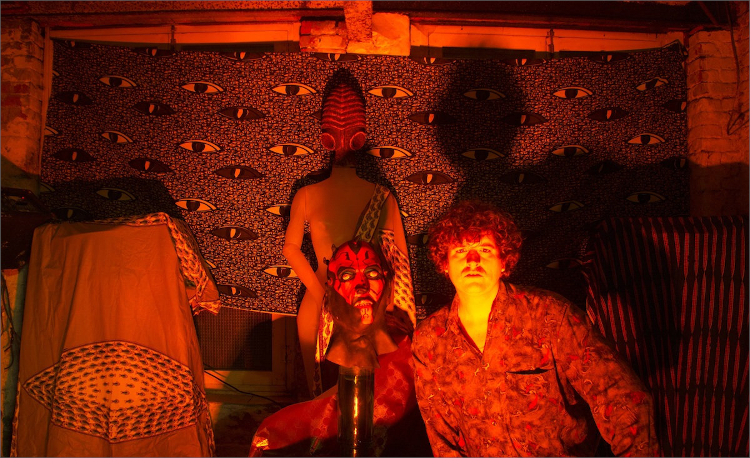
Inside Spencer Clark’s dream world
Spencer Clark’s work represents its own very peculiar zone of thought. One might even call it a “mauve zone” after the work of the British occultist Kenneth Grant, whose subtle influence permeates Clark’s creations. Grant conceived of the mauve zone as a place well beyond the physical realm, a place that could be accessed through outer gateways into a hidden dimension outside the circles of time. It is in this place that magicians, mystics, and importantly, artists and sorcerers have accessed knowing or unknowing over the span of countless aeons. It is from a place such as this that Clark produces his perceptual sound hallucinations, brought to listeners live, or captured as reified artifacts in the form of his prolific recorded output.
I got the chance to chat with Spencer recently in relation to his recent work under his Typhonian Highlife moniker. He makes records under myriad project names, each reflecting a distinctive aspect of his highly personal musical gnosis. With James Ferraro he is one half of The Skaters, the legendary experimental noise duo, which began in 2004. Clark’s creativity and energy have not flagged since, as a quick skim through his discography will show.
Sumerian Star Creatures is one of his latest albums, released on the ever-fruitful Psychic Sounds label.
We conducted this interview over email. When I asked him if email would be okay, he said, “Yes, email is best, I talk like a valley girl, might cause panic.”
All of this just might give you some sense of the kind of freewheeling discursive energy when Clark makes music and spills out words.
The album itself is rather storied in its world-cosmic artistic connections. The music on this one goes back to 2017, when it premiered as part of Clark and Xavier Garcia Bardon’s Imagineers in the Underworld Film Series. Typhonian Highlife joined up with Corum to create this slithery soundtrack that they used as musical segues between stories from South Africa’s former National Laureate, Credo Mutwa.
Mutwa himself was a really interesting character, and his early work forms a magical catalog of the folk history of the Zulu people. Later he started merging these traditional African tales with stories of extraterrestrial beings and encounters. Mutwa was a sangoma, that is, a traditional healer and diviner, along with being a highly talented writer, sculptor, and muralist. The film show in Clark and Bardon’s series sees Mutwa surrounded by his sculptures and murals, detailing stories of experiences with the Chitauri, the alien creatures that inhabit South Africa. After a story, the screen would go blank and Typhonian Highlife’s silhouettes would light up as they performed a musical response to Credo’s stories of the “Alien Nasty Boys.”
The music on the record reflects the inspiration received from Credo Mutwa, as well as Clark’s own longstanding interest in beings of praeter-human intelligence. This record is an organic electronic soundtrack to the history of Mutwa’s people intermixed with the parallel history of the non-human entities that inhabit his land. The rich sounds create a soupy electroplasmic atmosphere suitable for cultivating your own alien relationships.
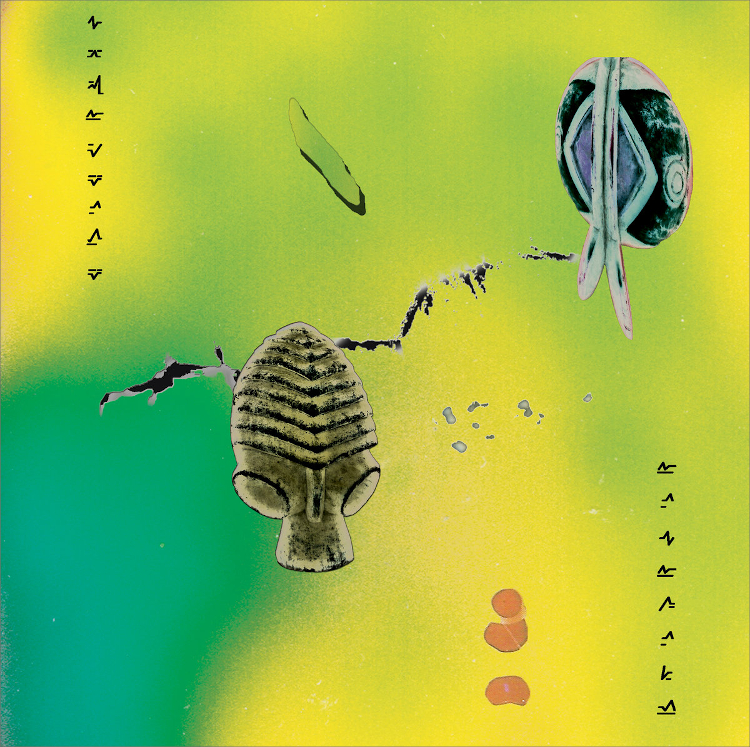
Dreams, aliens, and electronic mysticism ::

Justin Patrick Moore / Igloo :: What was the genesis of Sumerian Star Creatures?
Spencer Clark :: Sumerian Star Creatures came out of a series for BOZAR (Centre for Fine Arts Brussels) called “Imagineers in the Underworld.” I curated four films and musical performances. The first film played H.R. Giger’s Necronomicon, a movie where owners of Giger’s artwork talk about his art and he makes them Swiss pizza, and in the second part they show him making the set of Alien. After the showing of the movie, a Congolese guitarist played live a series of compositions by J.D. Vandroegenbrukke made as library music for H.R. Giger’s world.
The second in the film series was called Unarius Foundations, where a movie by a San Diego UFO cult called Crystal Mountain Cities was shown, but beforehand, as an introduction, the artist Bear Bones, Lay Low played the Ecco the Dolphin video game as a choreographed sound-effect collaboration with a cello player.
The third film was Sumerian Star Creatures, and Grant Corum and I made compositions to play in between the fantastic stories of Credo Mutwa. The music on the record is me redoing those compositions in the studio.
The fourth movie shown was the private movies of Amy Roselynne Faust.
When did you first start working with Grant Corum?
SC :: Grant joined my Monopoly Child Star Searchers Band in Portland, Oregon, while I lived there. And he was kinda the only one in town who could go three to four movies deep a night. I had some big cellar and there were, like, VHS movies in there, and we would just go pick ’em.
Besides H.R. Giger, these other personalities and people aren’t exactly household names. How did you get started in film curation and get to know these folks?
SC :: I guess through the human grapevine people realized how much movies had influenced my work, and I had so many friends and fans with jobs or access to institutions in Belgium that were adventurous and willing enough to let us free-wheel.
There seems to be a bit of a through line on the subject of aliens, UFO contactees and experiencers, the interdimensional and extraterrestrial beings that Credo Mutwa wrote and made art about. Was that an intentional development in bringing these things together or were you just following your own interests in these topics? Or are there “contacts” between these people in that they know each other or are part of a scene at all?
SC :: I had definitely never met anyone who knew Credo Mutwa until recently, and they were a poet who studied in South Africa, where Credo Mutwa is considered one of their national laureates, so to speak. For me the world of UFOs is a streamline into dream technology, and I think Credo manifests this so much by vividly speaking about such experiences and making murals and sculptures and artifacts to go along with his stories.
How has the lore surrounding such experiences influenced your work as a whole and the music you made for Sumerian Star Creatures?
SC :: The imagery of Credo’s stories, such as seeing snake-like creatures appear and disappear through portals on the tops of mountains, or seeing a shaman eat the flesh of an alien, directs immediately to other places of interest, namely the writings of Kenneth Grant, who, while being interested in OTO magick, is also open to the indirect initiation of artists or thinkers who stumble upon similar themes by their own private investigations.
Ahhh! You bring up the OTO. So, tell us about the name of your project, Typhonian Highlife. To me the first thing it conjures up is the work of the late British occultist Kenneth Grant and his group the Typhonian OTO, the TOTO or Typhonian Order. Grant frequently wrote about extraterrestrial encounters in his strange and eccentric amalgamation of Aleister Crowley’s Thelema, Austin Osman Spare’s system of magic, all while incorporating elements of Lovecraft and his mythos. How does all this inspire your work?
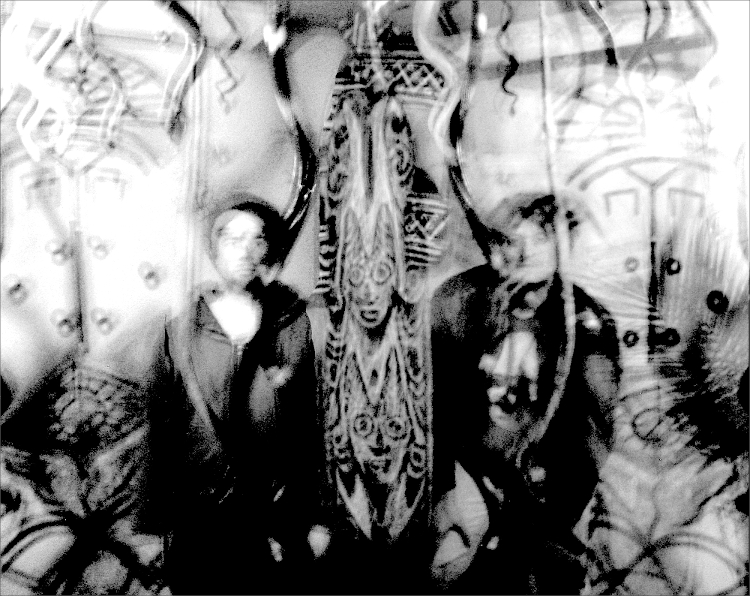
Occult frequencies and alien dreamscapes ::
SC :: Yes, it’s directly related to first Kenneth Grant, who was first revealed to me on the bookshelf of David Keenan in Glasgow, with James in the year 2006 when we played our first Euro festival as The Skaters. After that I got a bunch of his books, and then arrived at Credo Mutwa’s stories, and decided to make music in the tradition of being in contact with foreign intelligences by way of learning and respecting older ways of focusing. And for me I want to describe the experiences I have from heaven and from underneath.
So you have had extraterrestrial experiences yourself. Do you care to share anything about them?
SC :: Yes, for sure! There was a moment in my life when I was working tirelessly to create a new sound, and during this time, while late watching movies, dehydrated and cocooned while being excited for the next day’s recording, I saw on the wall next to me a figure 8 drawn, and then in the center an eye appeared and winked at me. I guess that is one sign that I have got to continue my fantasies in the real world, but I think at every measure of the day when you’re focused in real life, there are points where reflection or critical imagining should take place, always to remove you, if at least for a second, from the World of Shells as Kenneth Grant puts it, or, yes, to get a pause from the slave master’s version of reality. So if you’re constantly adapted to step outside, then at times you might be only outside. And I think there it’s sort of more dangerous, but kind of endless as far as what you might bring into your mental vision. And I think it’s probably best to say one more thing about—
Speaking of James Keenan and The Skaters, I guess that gives me my next question. What are your own thoughts on the term “hypnagogic pop” coined by Keenan for the music you did then, and the perhaps related or adjacent genre of vaporwave?
SC :: For me the terms that get us to where we need to go are important. The terms themselves for me are not considered when I’m making music. The terms from critics go to a certain bar, and the terms for artists another. My own terms, or terms of my peers, matter to me the most. That being said, DK was always on a level, and was an equal for most of us. His hypnagogic term applies directly to me even, in that we were reading on a lot of the same stuff. I came from the P.D. Ouspensky realm, not the Gurdjieff stuff, but The Fifth Cannon, Tertium Organum, that book, which was related to being in the SFMOMA catalogues of interviews with my favorite painter, Roberto Matta. That was his book, so when I heard that I made it my book.
As for vaporwave, that term has more to do with the net, and I just don’t really identify with a lot of stuff from it, but if the term takes me where I need to go, with all pleasure. Keep making the genres and you will keep finding the people who just rise above that shit and obliterate it.
Are these aesthetics something that interests you at all now? I see and hear trace elements of vaporwave in some of the imagery you use and some of the sounds, but very different, tribal and noisy.
SC :: I think the level of your fascination with temples or any other imagery that is widely used is proof in the music. How deep your love is is just up to your peers and people who listen to music… I could go on about how my cover art represents a real fascination and not a tacit one, but that would be too low-level vibes. The deepness of the connection also depends on the listener and/or critic, where oftentimes critics or listeners would question the authenticity of the involvement in, so to speak, mystic topics. And that sort of cynicism comes directly from people who, in my mind, are themselves limited and cannot imagine that someone would give themselves up to a divinity of any sort.
But I often go back to when I started trying to escape my surroundings and find a higher world. Any reference from music or books or paintings I could get, I would investigate. So if that can happen still now from my works, please. But I think with Kenneth Grant and Crowley being influences, it stands as pretty clear that you appreciate actively seeking involvement in the hidden world, rather than simply referencing it.
What is the origin story behind your Pacific City Sound Visions label?
SC :: Pacific City is a city in Wong Wong where The Skaters recorded one of their records. It’s the place where the music comes from. It’s a place in my mind that is a word that unveils to my memory the aesthetics that are where I come from. It’s like this hazed-out tropical underneath world that my brain lives in.
Who are some of the other artists you’ve worked with or released on the label?
SC :: Roope Eronen, Egyptian Sports Network, Tarzana (with Jan Anderzen of Finland), Orphan Fairytale, James Ferraro, Lieven Martens (Dolphins into the Future), Miles Devens (Ignatz), Elemental Orrery (with Ambassador Dulgoon), Mondo Riviera and Keith Fejeran, to name some newer artists. And the names left out are basically all mine.
What is it about Kowloon City that captivates so many people’s imaginations?
SC :: For me Kowloon is freedom in the mind. Like, I had a recurring dream for so long that I would go back behind this organ amphitheater in Balboa Park in San Diego, where I am from. Behind the park, I would go and find these stores with all these objects and curiosities that were objects of inspiration in my dreams. I was holding the essence of my creativity in dream form. Later I went back to the place from my dreams where I am from, to actually bury an album of mine, to give back to the dream world, and when I was there I discovered the place I went in my dreams was real. It was an international community complex, like a shack for China, a shack for every country.
Kowloon is a similar operation. The ancient Kowloon City is this long-lasting, never-ending place that is autonomous from the city, but inside the city. It doesn’t want to escape altogether, but it does want to be aside, over there, sort of in the dark places. I built a shrine, that’s pictured on the record. Using this shrine, I attempted to go into rooms in the ancient Kowloon City and find objects of curiosity, and then at some point, place an object as a gift in return. It’s a give-and-take on the astral tip. I also hear about the King of Kowloon, an old Chinese guy who does calligraphy saying that the British stole his family land. He writes it all over the city to state a claim of reality, and the cops follow him around and erase what he writes right after he does so. To me it means a lot, his vibe. For him to be there, to stay there and protest. I am not as strong as him; I left San Diego as fast as a cartoon character.
Your album Kowloon Spider Temples references time-traveling spiders and frogs (in some traditions known as the leapers between). How does music act as a vehicle for astral time travel in your opinion?
SC :: Writing and drawing are visual, and sculptures are tactile, and what’s so weird about music is how much it changes because it goes directly in your head live. There are parts you remember in your soul that enliven it, and then there are parts that change and are hard to remember. I used to fall asleep every night in high school listening to a Christoph Heemann/Merzbow record (The Sleeper Awakes), and I would constantly literally wake up in the middle of the music, and that feeling was so strange, ’cause I didn’t have to wake up and look or touch. So music is like simulated reality automatically. That fact is totally insane. It’s built to refract reality no matter what it is. Music can slip into the other world of your brain and stay there. With an image in sigil magick, you focus on it and take it to your dreams. But, like, music goes in there anyway. Or so it feels.
Christoph Heemann doesn’t get enough respect these days! Thanks for mentioning him! I hardly hear of him at all anymore, but he remains an important visionary in sound. So, in what other ways have dreams inspired your music, or music inspired your dreams?
SC :: My dreams basically solely are the inspiration. The list and the stories are pretty long. One of the main ones is around the time my mom died in 2011. I moved to San Francisco and joined a baseball team to not be around the zone where she passed away. In SF I had, like, a series of intense fever dreams, maybe just, like, four days in a row. In the dream I was inside a metallic hot room, seated like a disciple on the floor. The heat was so intense that it was like torture. In the room was a small golden-tinted tiny ball. It would hover around the room and read my thoughts. Then it would say messages, but in Pinhead’s voice. The messages were about the new dawn of humans. It was about us being liquidated but accepting it. Like, for me, it was to accept that things would change, but there was something more. It was in my mind, engaging me to interact with the message. I guess, well, it was to decide whether I should accept the change of the new digital world or deny it. During this time in 2011, with my mom dying, maybe my psyche was afraid I would radically change. Instead of coming to a conclusion, I just made an album where I put Pinhead (the voice) and other monsters from his world in the Renaissance, and freed them from their polluted world and let them live in another time. I think this act explains everything for me. It shows me that deciding things on the material plane, making big life decisions, is overrated, and being in the moment and reflecting whatever comes is the grand choice.
Sound as a portal elsewhere ::
Is that album with Pinhead being freed available for listeners still anywhere?
SC :: Yes, it’s called Fourth World Magazine 2: Pinhead in Fantasia.
Have you studied any schools of dreamwork or interpretation?
SC :: I mean, yeah, for sure, but, like, mostly Jungian, like C. A. Meier’s Healing and Dream Ritual. But I like the Kenneth Grant vibe, of just meeting the monsters at the Stargate and just joining in. Like, I think interpreting your dreams to yourself is even how the universe grows.
(But yeah, if there are any recommendations, please.)
I’ve been thinking of the late blogger, magician and genuine freak Gordon White of Rune Soup who passed away a few months ago. In his interviews the first question he always asked people was, “Were you a weird kid?” I thought I might ask you the same…
SC :: In the reverie of analyzing how one was as a kid, you get a magic sensation, like in the Proust books, where you can begin to re-become, like being a character in a drama, and you can evaluate this inner light that is revealed. And that light is actually an energy that is not wholly yours; it is universal energy from the nature of being born and yet uncorrupted. But while you analyze, you have to then think that you are corrupted even to analyze. And then the answer, so to speak, is revealed: that without analytical, experienced thinking, when you act, it is a mystery, and in that mystery there is, I think, the universal power. So instead of using reverie to highlight one’s initial reactions, I think there is a power in removing the analytical part in the brain now, and that just takes working on busting up that ego and letting go in order to be the sensation, not the memory. Because the sensations are the stuff of nature, and those can be carried forever.
What music were you into when you were a kid and did you come from a musical family? What were the sounds that came to influence you during your youth?
SC :: Really, there was almost no music. Just country while my single mom drove me to school in the morning. My favorite was “Queen of Hearts” by Juice Newton, as there was this, like, crazy narrative that I forcefully tried not to understand and make up a version all my own. My parents didn’t really listen to music except for in the car on the radio… but my dad did have a book by John Cage in his bookcase, Silence. And I would sit on the couch staring at that book for years and years without ever opening it, and eventually, when I was in high school, I opened it, and really I think I understood nothing, but kept reading it and reading it for years. It was super weird; it was like an alien text.
Sumerian Star Creatures is available on Psychic Sounds. [Bandcamp]