


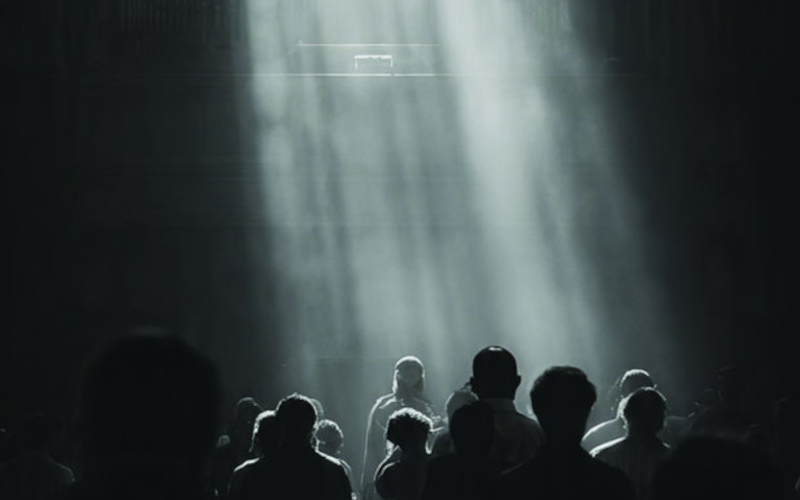


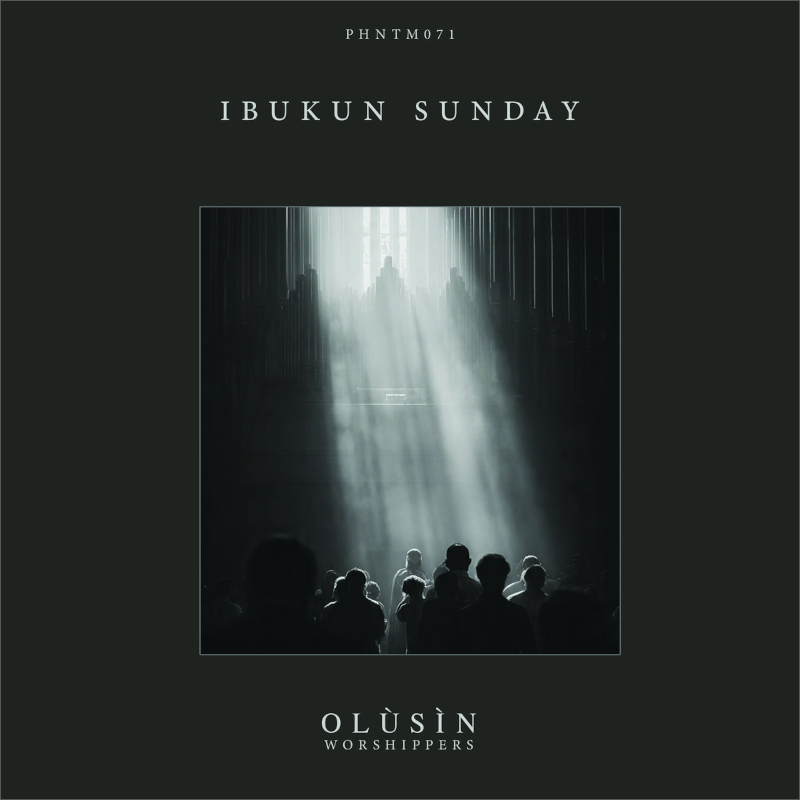
Olùsìn [Worshippers] moves with the gravity of a procession seen from a great distance: slow synth masses, vocal apparitions, soft percussive grammar, low harmonic pressure, field material absorbed into the body of the music.
A personal idea of music as spiritual perception
Lagos born, North London based violist, sound artist and electronic composer Ibukun Sunday has slowly shaped one of the most singular languages in contemporary Afro ambient music. His path begins in classical discipline, with viola study from childhood and ensemble experience across chamber and orchestral settings, then opens into field recording, live electronics, noise texture, synthesizer sound and a personal idea of music as spiritual perception. Earlier releases for Phantom Limb’s Spirituals imprint, including The Last Wave and Mantra, placed him in dialogue with philosophy, apocalypse, Vedic thought and Nigerian memory; Harmony / Balance, issued in 2024, carried that research into a wider frame, where drone, melody and existential inquiry moved as a single organism. Olùsìn [Worshippers] now gives this practice its most concentrated form.
The album is presented as a devotional ambient work rooted in West African rhythmic tradition, and the definition is useful only as an entrance. Sunday is dealing with faith as vibration, with praise as a form of breath made audible. The record moves with the gravity of a procession seen from a great distance: slow synth masses, vocal apparitions, soft percussive grammar, low harmonic pressure, field material absorbed into the body of the music. Everything advances through recurrence. Motifs return as if memory had learned to sing in circles. Rhythm rarely asks for attention directly; it glows under the surface, ticks inside consonants, gathers in small pulses, then expands into a shared heartbeat.
“Rhythm rarely asks for attention directly; it glows under the surface, ticks inside consonants, gathers in small pulses, then expands into a shared heartbeat.” ~Mirco Salvadori
What makes Olùsìn [Worshippers] so persuasive is the way Sunday refuses decorative spirituality. The music carries devotion through craft. The choral tones are gauzy and spectral, yet their placement feels almost architectural. The bass frequencies hold a stern calm, the upper harmonics shimmer with a pale organ light, and the voices seem less like singers than traces of people gathered in the same act of listening. At moments the album approaches the suspended radiance of church music, at others it returns to earth through grain, breath, thud and sampled speech. The sacred quality comes through pressure and patience, through the decision to let each sound reveal its weight.
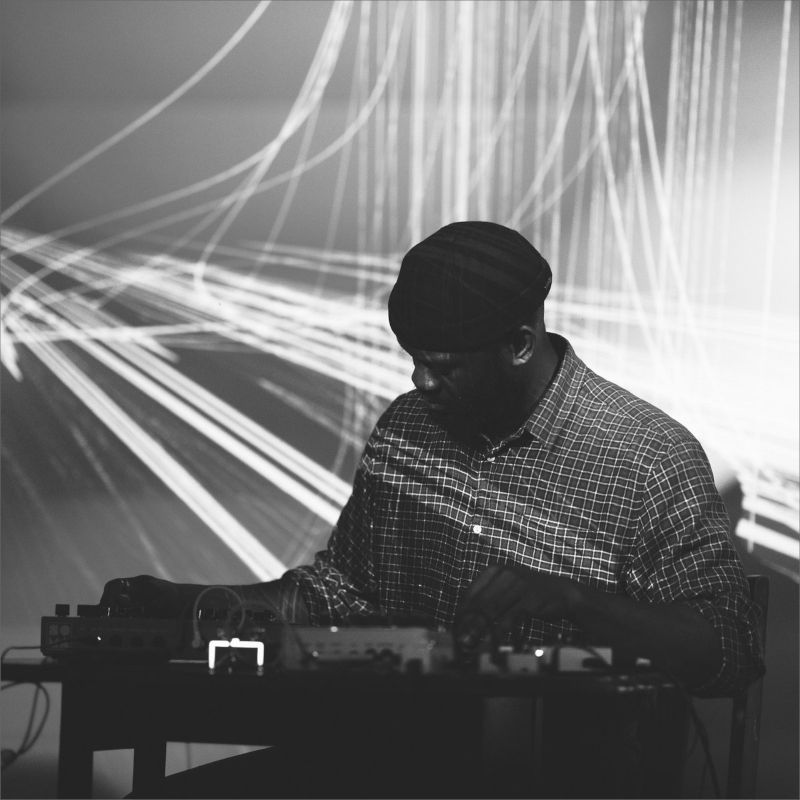
A record of rare poise: luminous, grounded, inwardly ecstatic ::
Across the eight pieces, Sunday treats the studio as a vessel for collective energy. The titles suggest elemental conditions: whisper, echo, amen, breeze, ages, devotion, hill, edge. They function as points in a wider rite of perception, each one carrying a small emotional temperature. The opening half favors deep resonance and vocal haze, with melodies rising like thin beams through the darkened density of the drones. The central section grows warmer, richer, almost tactile, allowing the listener to sense the body behind the electronics. Toward the final stretch, plucked synthetic figures and trembling harmonic patterns introduce a sharper contour, as if prayer had become a lattice of light.
“Amen,” already chosen as the first public signal from the record, offers the clearest key to Sunday’s method. A vocal fragment, full of sibilant motion and West African cadence, becomes rhythm before it becomes meaning. Around it, the synths swell with organ like solemnity, and the piece turns into a compact ceremony of ascent. Edge, near the end, works through Karplus Strong pizzicato logic, its plucked particles layering into a bright, nervous mesh. These moments reveal how Sunday thinks: he begins from pulse, timbre, oral memory and instrumental knowledge, then lets technology behave like a devotional instrument. The machine serves breath, fingers, choir, dust, air.
“For an American listener trained by the genealogies of minimalism, gospel resonance, fourth world drift, post Eno ambient and contemporary sound art, Sunday’s record opens a different line of descent.” ~Mirco Salvadori
There is also a quiet severity in this album. Its beauty arrives through restraint. Sunday’s classical background is audible in his sense of proportion, in the way he allows harmonic fields to bloom, fade, gather again, and in the discipline with which he keeps the palette reduced. Many ambient records seek immersion through endless expansion; Olùsìn [Worshippers] achieves depth through measure. It feels carved from a few essential elements, each one placed where silence can give it force. The percussion is subtle, the voices are veiled, the field recordings are folded into the fabric, and the melodic cells move with the humility of repeated prayer.

For an American listener trained by the genealogies of minimalism, gospel resonance, fourth world drift, post Eno ambient and contemporary sound art, Sunday’s record opens a different line of descent. Its center is West African, diasporic, devotional, intimate, communal. It carries the discipline of the violist, the patience of the field recordist, the concentration of the producer and the listening ethics of an artist who has spoken of sound as a soul language. Olùsìn [Worshippers] asks for attention as participation. It turns worship into acoustic matter, praise into frequency, solitude into chorus. In doing so, Ibukun Sunday has made a record of rare poise: luminous, grounded, inwardly ecstatic, and quietly radical in its faith that sound can still carry human presence beyond explanation.
Olùsìn [Worshippers] is available on Phantom Limb. [Bandcamp]








![[2View] Xurba :: DFTSKZ-V333 & The Dexadream EP’s (Electric Studios)](https://igloomag.com/wp/wp-content/uploads/2026/09/xurba-dftskz-v333-the-dexadream_feat-75x75.jpg)