



Most ingredients are well known, but it’s the ingenuity with which they are married into one homogenous alloy that makes Anemoia not simply a standout IDM piece in terms of production proficiency and storytelling, but an important milestone in the history of modern electronic music in general and, for me, a present and future classic.
Sonic royalty draped in mastery
I first “met” Ruxpin in the crevasses of a mixtape given to me by my good friend and techno DJ Katia in Zurich sometime in the late summer of 2005 or 2006. She had quickly become a stalwart for deep musical discovery at a rate that would still beat any music search algorithm today. She was especially passionate about a small niche of Icelandic producers who were little known on the European mainland, but who were presenting a very consistent, high-quality output, spreading their goodness on such acclaimed labels as Mikrolux (an Electrolux sub-label) and Uni and the like. I, on the other hand, being ignorant of Ruxpin, was instantly taken, and the intricate sonic layers made a deep impression on my then-IDM-obsessed self, which was chasing abstruse and more involved electronic tunes that sought to make an effort of transgressing the hyper-abstract polyrhythmic lore that had become so en vogue.
This impression was deepened when I decided to spend New Year’s of the same year in Iceland with an old college friend and actually met Jonas, aka Ruxpin, in person at what can only be called one of the most random parties of my lifetime. Jonas instantly struck me as a young man with almost suspicious humility but a very clear, ingenious edge, who could not really be bothered with high acclaim and was instead completely focused on channeling his music from a deeper place.
Iceland is a territory of particular wild beauty, but never more so than in the depth of what seemed to me like a winter of prehistoric dimensions. A lot has been said about how environments shape artistic output, and while I agree that this seems to be the case, I don’t think that this holds true to the content of the art, but merely to its form and modality. And Jonas’ music bears testimony to this suspicion.

This 13-course meal is meant to be savored in its entirety ::
2003’s Magrathea and Elysium, which followed three years later, are not cold by nature, or bare like the outskirts of Reykjavík, even though a first listen might mislead one into becoming stuck with this impression. While they relate the image of technology-driven sonic narratives and insular grit, there is always a tender spark present. Just as I recall Jonas to be a warm and outspoken true artist who chooses his instruments to support his vision and not to become it, there is an undertone of extreme humaneness and delicate embellishment that sets him apart from the IDM predicament of static technocracy.
The sub-genre “melodic IDM,” chosen by a variety of digital platforms to index him, is in my view a deceptive misnomer. To me, a more fitting category reads “emotionally intelligent dance music,” and I would largely award Ruxpin the entire category, as such a combination is as rare as common sense in American politics nowadays.
As the news of a new full-length Ruxpin album titled Anemoia stumbled into my inbox, I was not only hit with extreme nostalgia and anticipation, but also met with slight terror. Because, as we all have experienced, many good things of former days have shown a tendency of undoing themselves. But just as Jonas had proven the quote “never meet your heroes” wrong, he also dismantled the suspicion that an IDM career cannot be successfully maintained without the loss of identity and quality over such a long period of time. Anemoia is not only a successful continuation of his lineage; it stands on its very own solid feet.
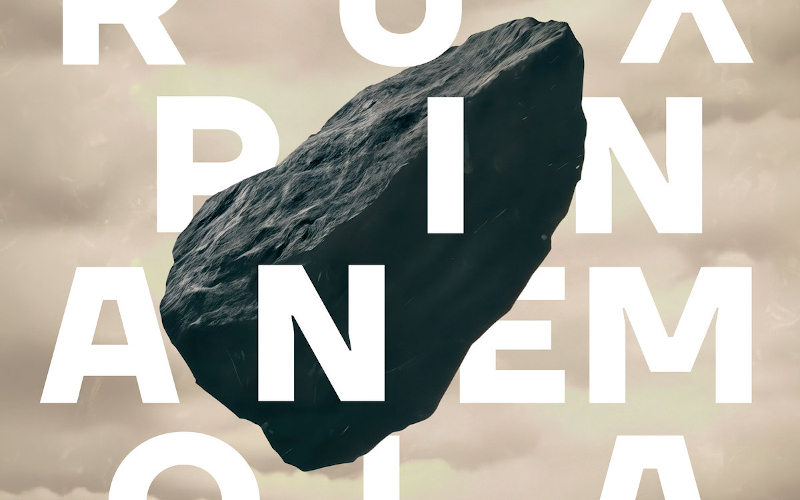
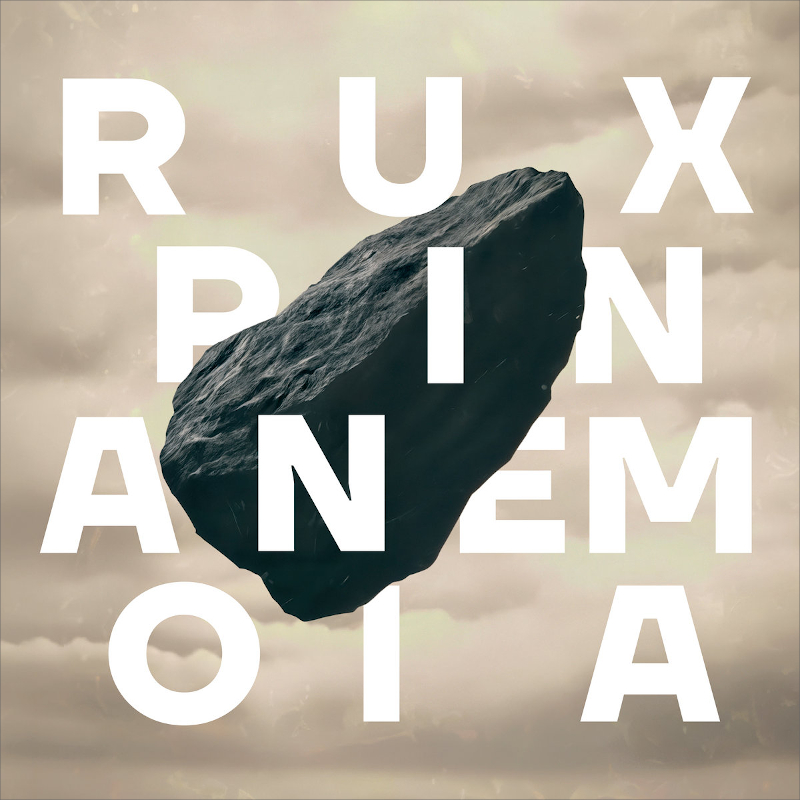
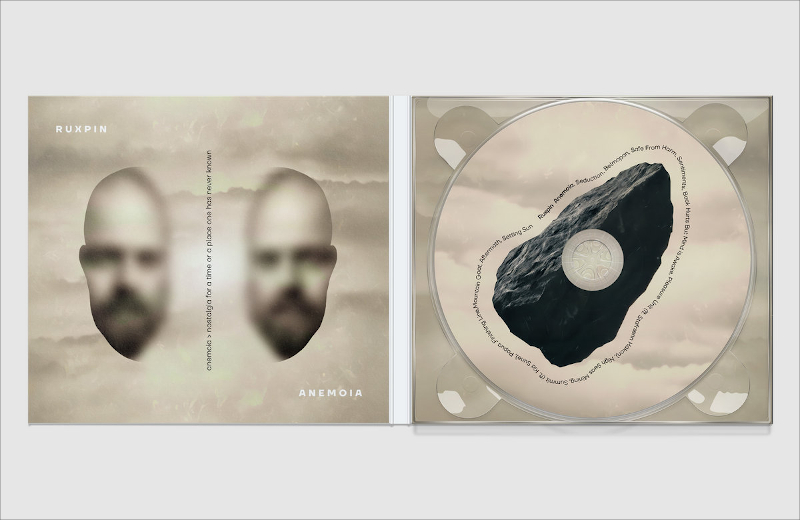
At 13 tracks and just under one hour of runtime, this is no lightweight, but the music presented here defies gravity and weight measurements altogether. As a conceptual thinker, I like to attach my sense of an album around a central image. The one I would choose for Anemoia is that of abstract weightlessness, of a heavy landscape that stands suspended, not only in space but also in time. There is a sense of complementary opposition between heavy rolling beats and lofty pads that pervades all the tracks.
The magician the world needs him to be ::
Yet another observation must be made. One that is not specific to Anemoia, but to Ruxpin in general: this is a closed-off, integrated and wholesome oeuvre. Breaking it down into individual tracks and noting their individual ingredients and how they stack up against each other is not only doing it a grave disservice, it’s misunderstanding Ruxpin. This 13-course meal is meant to be savored in its entirety, with only brief interruptions to permit one not to lose themselves completely.
But even so, this is a canon of high specificity. It is unlike what Jonas presented before, even if his penmanship is clearly identifiable behind every single one of the clearly intentionally designed sounds. These tracks speak of maturing, of a coming of age, and of a homecoming of an artist who has survived the archetypes of warriorship and martyrdom and who is finally the magician the world needs him to be.
There are clear traces of inspiration all over this. Crunchy hip-hop beats and even groovy house chords are spun around delicate arpeggios and staccatos that are well known to the IDM crowd, but in their execution, they seem oddly fresh and renewed, reinterpreted in a form that goes far beyond slinging your drum sounds through a 12-bit sampler or an SP-1200 DAC and calling it a day.
No, this is about the conscious use of space and how to fill it. Jonas is a master at filling the canvas without overdoing it, at making density seem empty, at giving gas a weight, and turning time into a volume.
While many IDM tracks are burdened by the “all buttons in” obsession, Anemoia remains easy without becoming anemic. Glitches and ratcheting never overtake, but are neatly tucked into a mix that has reached masterclass level.
A master at filling the canvas without overdoing it ::
Particular mention must be given to what has become a standout sound in his productions: the snare drum, or rather the sophisticated modulation thereof. Snares are difficult sounds that lesser experienced producers treat with a criminal lack of attention. On Anemoia, snares seem to carry much of the load and take on much of the duty usually attributed to the kick drum or entire percussion groups. Ruxpin does so effortlessly, but obviously with very great care, and one has to pay close attention to hear how these sounds take on a life of their own over the course of a track.
In line with my sentiment that one should not discuss Anemoia as a collection of tracks but as a closed opus, I cannot identify a favorite. All of it seems relevant to the multi-tiered journey. To the point where I would fear that if one was to do the modern thing and only drag one track into their playlist, they would lose 80% of the essence contained and thin the momentum to a mere trickle.
What might be a disadvantage to the modern music consumer seeking a quick fix between heavy compression algorithms and heterogeneous, anonymous track lists is a strong selling point for those interested in listening to bodies of work that are woven around storylines that contain the author’s essence and speak of their obsessive despair in rendering an inner vision into a DAW timeline.
Yet none of this is to say that the tracks don’t contain life on their own. On the contrary. Just like any good movie scene must move the plot forward, everything is indeed in its right place, and Anemoia convinces with a very effective way of building, sustaining and eventually dissipating energy within every single track, at the microscopic as well as the macroscopic level.
For example, “Seduction,” the entry into the album, as well as the two tracks “Aftermath” and “Setting the Sun” leading out of it, are the only ones that don’t greet the listener with an immediate swell of sizzling beats, but instead rely on signature chord stabs and bubbling pads. And “Pleasure Unit feat. Stafraenn Hakon” anchors the LP in its middle with a decidedly stomping march beat that comes as close to being an earworm as Ruxpin will permit.
A common sphere of universal musical wisdom ::
There are moments within the journey that are reminiscent of “documentary braindance” and which evoke Boards of Canada-esque nostalgia, relaying a distinct Ektachrome feel because they hit the human brain in the exact same spot. Perhaps another reason why I was so quick to fall in love with its color palette.
In a Jungian sense, this album relies, consciously or not, on the existence of artistic archetypes or mood boards, which it shares with other representatives and which take those attuned to it into similar distant terrains. All of this is much more a testament to Ruxpin’s ability to paint with a variety of synesthetic hues than a reductionist approach that borrows out of lack of originality.
Akin to my own perspective on what art is, he seems to carve out of a common sphere of universal musical wisdom, rather than create from clay.
Most ingredients are well known, but it’s the ingenuity with which they are married into one homogenous alloy that makes Anemoia not simply a standout IDM piece in terms of production proficiency and storytelling, but an important milestone in the history of modern electronic music in general and, for me, a present and future classic.
This is sonic royalty draped in mastery.
The eclectic electronic producer Ruxpin is one of the leading figures in Iceland’s contemporary electronic music scene. Widely associated with iconic labels such as n5MD and Elektrolux, Ruxpin has stayed true to his roots while continuously evolving his interpretation of melodic IDM, integrating soul and innovation into his music.
Now based in Estonia, the artist was born and raised in Kópavogur, Iceland, and became involved in the electronic music scene at an early age. His first release came when he was just fifteen, followed two years later by his debut album on the Icelandic label Uni Recordings. The album received critical acclaim and caught the attention of German label Elektrolux, where he subsequently released his next four full-length albums. Since 2009, Ruxpin has released his work on Móatún 7, Sound In Silence, Ravekjavik, OMNIDISC, Sun Sea Sky, and n5MD. His latest release, however, comes courtesy of Martin Boulton’s Touched Music label.
Anemoia is dedicated to Futuregrapher (RIP).
Anemoia is available on Touched Music. [Bandcamp]


![[2View] Koho / Koskenlahti, Mark Reid Bulatović & Simone Spampinato / Fredrik Rasten (Isthmus)](https://igloomag.com/wp/wp-content/uploads/2026/08/koho-kos-mark-reid-2view_feat-75x75.jpg)