


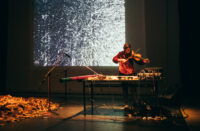

Euan grew up in a mostly quiet, non-musical household where records were scarce and music lived mainly in car rides soundtracked by Fleetwood Mac and Whitney Houston—until a childhood Walkman and Lionel Richie cassette sparked a lifelong, deeply personal connection to sound.
The accidental beginning of everything
Euan Alexander Millar-McMeeken’s relationship with music didn’t begin in a particularly musical household, but in quieter, more personal moments—car rides soundtracked by Fleetwood Mac and Whitney Houston, or a childhood cassette of Lionel Richie playing on repeat. From those early, unassuming beginnings, he gradually carved out his own path, moving from tentative piano lessons and abandoned guitars to a deeply intuitive, feeling-driven approach to sound. What emerged is an artist shaped as much by absence as presence—someone who found music not as a given, but as something to hold onto and build from scratch.

Justin Partick Moore / Igloo :: Growing up, what kind of music did you hear playing around the house? Were your parents musical or into music?
Euan Alexander Millar-McMeeken :: My upbringing wasn’t especially musical. Our house felt fairly quiet in that sense. We had a hi fi, but the record collection was limited—mostly ABBA and a handful of classical albums. I don’t remember music being a big presence at home. It mostly happened in the car. My dad loved Fleetwood Mac and had a soft spot for Whitney Houston, so those were the soundtracks of most journeys.
Despite not having much music themselves, my parents did buy me my first Walkman and cassette when I was about six—”Dancing on the Ceiling” by Lionel Richie—and that was really where my love of music began – I can vividly remember singing along to Ballerina Girl. My mum could play a bit of piano, though not especially well. My dad didn’t have a musical bone in his body. He couldn’t sing, but he seemed to enjoy trying.
You grew up in Dundee, Scotland. What was the music scene there like and were you involved in it?
Euan :: No, I was never part of that scene. I left Dundee in my early twenties, and it was really in Edinburgh that my musical adventures began in earnest. I was playing shows at a time where the Scottish scene was buzzing with bands like The Twilight Sad, Frightened Rabbit, Meursault, Withered Hand and Broken Records all creating a bit of a stir. In Dundee, some of my school friends—one of whom later played with me in The Kays Lavelle—did get a bit of attention in the local scene when we were still at school. But if I’m honest, the most successful musician to come out of Dundee from my era is Andrew Wasylyk. Everyone should check him out. His new album Irreparable Parables is out now, and I’d highly recommend giving it a listen, then diving into his beautiful back catalogue.
Do you have any formal training or study in music? If so, has that helped you, or has it been something you’ve had to unlearn to find your own creative directions?
Euan :: Yes, I started playing piano at the age of five and made it to Grade 6 before quitting—mostly because I disliked my teacher and had grown bored of classical music. I also played guitar when I was younger, but eventually gave that up too because I lost patience with practising. So I do have a grounding in music and music theory, and I genuinely believe it helped shape the musician I am today—though never on its own. Like most creative disciplines, it’s useful to understand the rules of the world you’re working within if you intend to break them.
At the same time, I’ve always felt that music is fundamentally about feeling. As both a musician and a listener, the first reaction I have to music is physical—how it resonates in my body. When I’m creating music, I can follow all the rules and conventions of my formal training and feel nothing, or I can let the music pull me in whatever direction it wants to go and simply see where it leads. An artist friend once told me to push things until they break — only then do you know you’ve gone too far. And that, to me, is the beauty of making music today, especially when you’re working in your own time and in a DIY way.
You can break things, rebuild them, and push ideas in all kinds of unexpected directions. You can construct, deconstruct, and reconstruct as many times as you need. There’s a freedom in that — a permission to explore without worrying about perfection, and to let the music evolve into whatever it wants to become.
That said, understanding the formulas of music can certainly help steer you toward success—pop music is a perfect example. People who are deeply into music often dismiss pop, but I’ve always felt that if three billion people listen to your song on Spotify, there’s something incredibly powerful in that connection. And for me, that’s ultimately what music is about: connection.
Are there any foundational musical influences for the project you care to share or give a shout out to?
Euan :: The artist I always come back to is Sparklehorse. I’ve been a little obsessed with the DIY ethos of his early work for years. His later albums are much more polished, but Vivadixiesubmarinetransmissionplot still feels like the perfect lo fi record to me. A lot of how I treat vocals comes from Mark Linkous and Jeff Tweedy — both of them show that a voice can be just another texture in the mix rather than a pristine, front and centre performance. I’ve never been drawn to the conventional “pure” vocal. I can admire it, but I’m far more interested in how a voice shapes the overall atmosphere of a track.
That’s why artists like Grouper resonate with me so much. Her voice is extraordinary, but she often buries it intentionally, letting it blend into the soundscape instead of rising above it. Evelyn Gray’s distortions — I’m drawn to the fragility, the weariness, the moments where a voice sounds like it’s about to crack. I like the dirt and the husk. I don’t want vocals that are too clean or too crisp.
When I hear a new song, I usually know right away from the first vocal line whether it’s going to stay with me or not. The voice is what I’m listening for first — not perfection, but character.
I listen to so much different music that it’s tricky to narrow down my influences. One thing I’ve realised, though, is that when I’m creating vocal tracks I usually end up listening to instrumental stuff, and when I’m writing instrumentals I flip back to vocal-heavy music.
Who have you been listening to this year so far?
Euan :: This year has been completely wrapped up in music as usual. I’ve been spending a lot of time with Nora Brown’s banjo playing, Gwenifer Raymond’s incredible guitar work, and David Moore’s beautiful minimalist compositions. I’ve also had Mandy Indiana, Oh Yoko, Evelyn Gray, and Courtney Barnett in steady rotation, and I’m absolutely in love with the new Bill Callahan record.
I’m also really looking forward to what’s coming next. New albums from The Notwist and The Twilight Sad, and Haunt, the upcoming record from Welsh artist a.murphy, which is shaping up to be something special.
How did the Glacis project itself start?
Euan :: Honestly, it all happened by accident. My band had split, and suddenly I found myself living alone in this house in Edinburgh with not much around me except my piano. So I just sat with it. I played, I wrote, mostly to fill the silence. And that was it — that’s how it started. Nothing planned, nothing strategic. Just me, a quiet house, and a piano becoming something to hold on to.
From stillness came a soundtrack ::
You have a bunch of different aliases and projects that you used to make music under besides Glacis, which seems to be the one you are putting a lot of effort into now. Can you share these projects and what differences between them are?
Euan :: So, Glacis is my instrumental project. It actually started out as something very piano focused, but over time it’s shifted into this blend of piano and… well, “ambient” is probably the closest word, even if it doesn’t totally capture it. Alongside that, I’ve ended up working on quite a few collaborations. I made four records as one half of Graveyard Tapes with Matthew Collings, and another as one half of Gallowglas with Johan G. Winther from Barrens/Blessings. Both of those projects came out through Lost Tribe Sound. I also put out an album with LTS as Civic Hall with Craig Tattersall (The Humble Bee), and we’ve actually got a second Civic Hall album coming later this year.
Beyond that, there’s an album under the name The Dead Bell, which I made with The Green Kingdom, and another project called Bird Battles that I do with American sound/visual artist Jesse Narens and my friend Vanessa Farinha. I’ve also recorded a release with German drummer/composer Katharina Schmidt under the name Rats of the Capital. And the most recent thing is a collaboration with the wonderful Japanese artist Satomimagae — we’re called Yoal, and our album Gloaming comes out on Lost Tribe Sound in May.
All of these projects feel different for different reasons. Glacis is usually just me on my own, or me collaborating one to one, but it’s always instrumental and usually built around the piano. Graveyard Tapes was much more experimental, and a lot of material came from Matt — though honestly it was probably a pretty even split. He came from a noise background, which made the combination of our styles really interesting.
Civic Hall is its own strange and lovely thing. Most of the credit there goes to Craig — I send him all these fragments, half ideas, little moments that don’t really belong anywhere, and he somehow shapes them into full records. It’s kind of magic. With Jesse in Bird Battles, the process flips again — he usually writes the core of the track, and then I come in with vocals and extra layers. And with Rats of the Capital, most of the music came from me, and Katharina brought everything to life with drums and percussion.
For Framed Insects and your previous album you used your name, but for other music, you have used different aliases or project names. What prompted the use of Euan for these two records?
Euan :: I’d always wanted to make solo records completely on my own, but it took me a long time to feel brave enough to actually do it. For years I hid behind project names or collaborations because it felt safer. There’s comfort in sharing the weight of a piece of music with someone else or with an alias. Putting something out under my own name meant being a lot more exposed, and I wasn’t quite ready for that for a long time.
All The Weather Of The Human Heart was the first time I felt able to step into that space. I reached a point where I wanted to see what I could do without leaning on anyone else, and I wanted the music to reflect that kind of honesty. That record and Framed Insects come from a more personal place and releasing them as “Euan” feels like acknowledging that. It was a slow process, but in the end it felt important. Almost like proving to myself that I could stand on my own creatively.
How did you hook up with Satomi of Satomimage to go on tour with her in Japan this coming June?
Euan: The relationship actually started because I’ve been a fan of Satomi for years. I originally contacted her just to see if she’d be up for remixing a glacis track for the Interpretations album. She said yes, and from that point we gradually became friends. That friendship evolved into us making this album together, which has now opened the door to our tour of Japan in June.
That tour will be Yoal (our project) alongside solo sets by both me and Satomi.
What do the technical logistics look like for you going on this tour?
Euan :: It’s mostly straightforward. For my solo sets, it’s just piano and laptop. The complicated part is the project with Satomi. We made our entire record over the internet, so we’ve never actually played or sung together in the same room. I arrive in Japan on 1 June and our first show in Tokyo is on the 3rd, which means we’ll have basically a day or two to pull a set together.
It should all be fine in a practical sense — the music is there — but the daunting part is singing in front of people, and even more so singing in a room with just one other person. There’s something quite exposing about that. So a lot of the “logistics” are really about me getting over my own inner fears.
If an interested reader wanted to start diving into your discography now, where would you send them?
Euan :: I’d point people to my most recent work first — Framed Insects, my forthcoming solo record, and my collaboration with Satomimagae under the name Yoal. Those are really my main focus at the moment. Of course, it depends on what someone prefers musically. If instrumental music is more their thing, then glacis is where I’d direct them.
Maybe it’s just how my mind works, but I usually start with an artist’s most recent work and then move backwards. So I’d say start with Euan Alexander Millar-McMeeken and Yoal, and then explore the earlier material from there.
Your lyrics are very poetic, emotional and literary. Are there any writers or poets whose works have influenced your aesthetic?
Euan :: It wasn’t really intentional. I just read a lot. I’m not sure any of it feeds directly into my work, but I’ve always loved the writing of Willy Vlautin, Hari Kunzru and Donald Ray Pollock. My poetry tastes are much more wide ranging.
You keep busy with recording and writing new material? What can people look forward to next from Glacis or your other projects?
Euan :: I actually have a glacis record out at the moment on Whitelabrecs — We Gape and We Are Healed — which I made with cellist Henrik Meierkord. That’s available now. There should also be a second collaboration with Adrian Lane appearing this year on Oscarson, plus a release with James Osland (who runs Elm Records) coming out on Dronarivm. I’ve also finished a record with Kinbrae, friends of mine from Dundee, and I’d definitely recommend giving their work a listen.
Outside of glacis, there’s Framed Insects, my second solo album under my own name, and a collaboration with Satomimage under the moniker Yoal. The second Civic Hall album is also on the way as part of Lost Tribe Sound’s Moss and Melee series. So, lots in motion. I’m working on various other pieces too, though most of those probably won’t surface until 2027 or beyond.
Piano, time, and self-direction ::
You also did another collaboration with Henrik Meierkord recently on album that has yet to come out. Can you tell me how that happened and what the album is like?
Euan :: This album was really an accident. At the start of 2024, I set myself a simple creative challenge: make a new piece of music every week and post it on my Substack. It didn’t need to be a finished composition — just whatever I managed to create in that week. I kept it going for about half the year before life intervened and I became ill, distracted, and busy.
Towards the end of last year, I went back through all these sketches and ideas and realised I had a group of pieces that seemed to sit together naturally. I didn’t think much more of it at first, because I wasn’t sure what to do with them or where they might fit.
Then, at the start of this year, I added spoken word to several of the tracks and sent them to Henrik to see if he might add cello — he’d already contributed cello to my next glacis album. He agreed but asked if he could become a full collaborator on the project.
So the album is now a joint release: Euan Alexander Millar-McMeeken & Henrik Meierkord, and it’s called Darkness Is Just Darkness. It will be released by Audiobulb in September this year.
It’s quite a dark record, musically — shadowed, slow burning, and shaped by the intensity of the year it came from. But like all my work, it holds onto hope. That’s always been important to me. Even in the darkest moments, I think hope is all we have, and the album tries to carry that small light forward.
We met on substack, where you have a very nice newsletter around your thoughts on music, community and other topics. Do you have any thoughts on being a music writer or music writing on substack?
Euan :: For me, writing on Substack is really just an extension of making music. It’s another way of trying to build connection and community because that’s what music has always been about for me. I’m not writing reviews or analyzing anyone else’s work; I’m writing about my own experiences as a musician, and the things that happen around the process of making sound.
Substack gives me a place where I can share that openly and hopefully reach people who feel something similar. It’s like saying here’s what this part of the journey feels like. If someone reads it and feels a little less on their own or sees their own creative life reflected back at them, then it’s doing exactly what I want it to do.
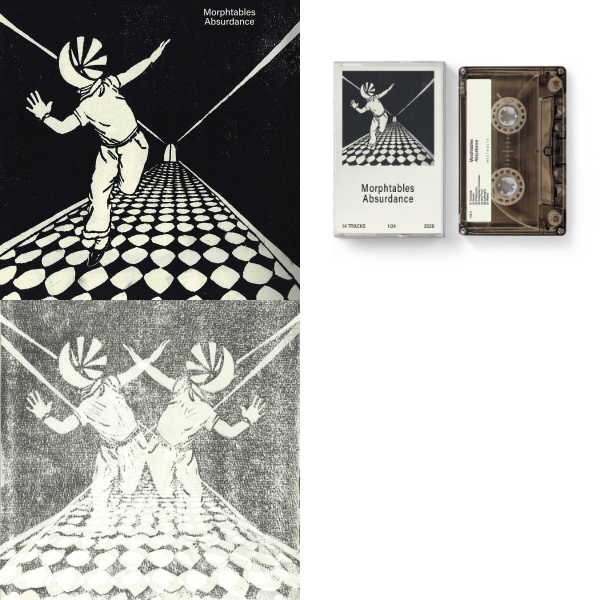
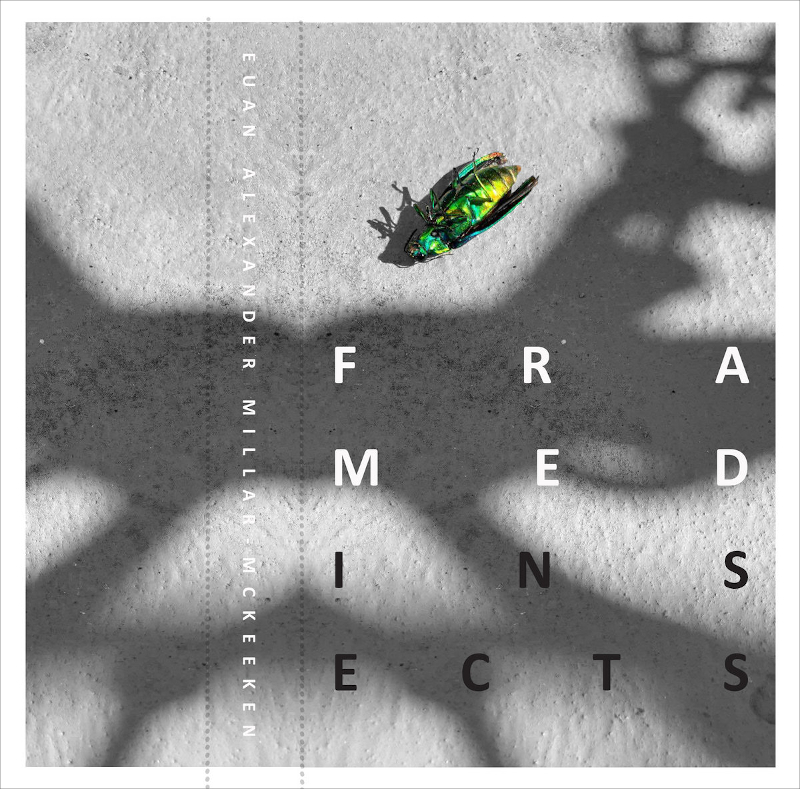
Framed Insects is available on Sleep In The Fire. [Bandcamp]