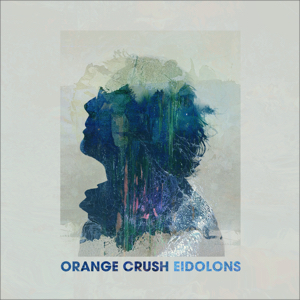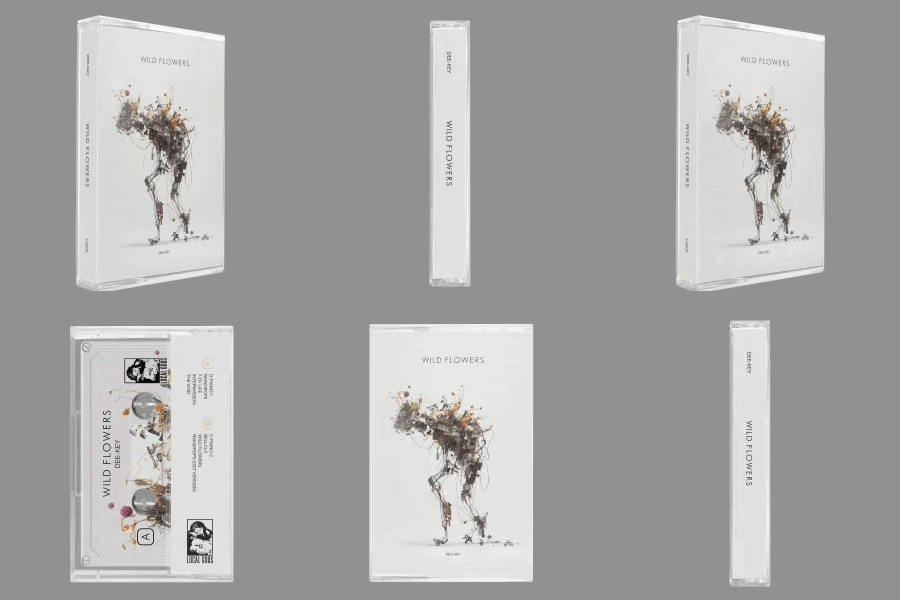



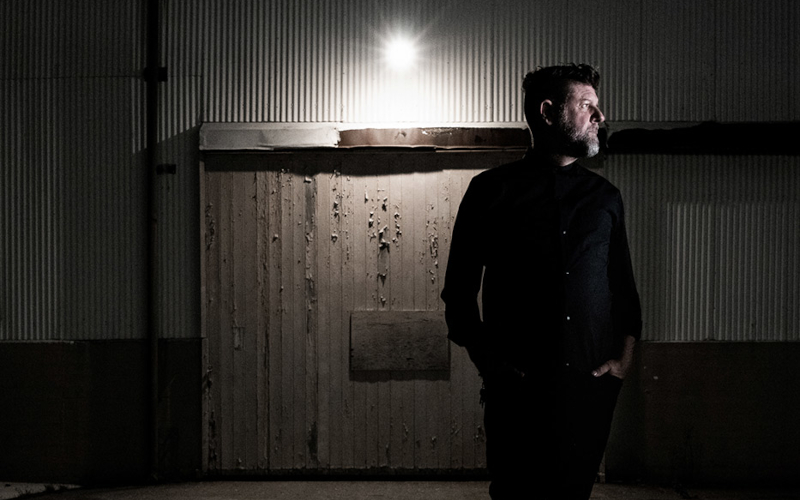


In this deep-dive Q&A, Mike Cadoo’s Dryft project returns with Particle, drifting between tension and release to craft a kinetic landscape where motion, ruin, and raw honesty collide in sound. Original interview in Italian, published on SoWhat — a renowned blog exploring boundary-pushing music.
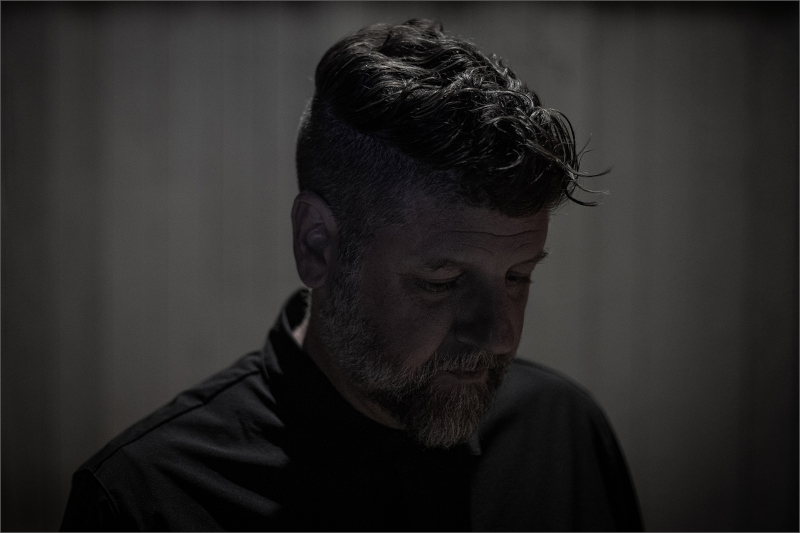
Dryfting through Cadoo’s kinetic landscapes

Mirco Salvadori / Igloo :: Dryft: was this project born to chase motion, or to impose order on chaos, as if drifting were, paradoxically, a form?
Mike Cadoo :: Dryft was originally born out of experimentation outside my work with Gridlock. During the writing of Further, I injected a bit of drum’n bass-inspired two-step into the songs Without and Scrape. This was really just enough so that it wasn’t overtly apparent, but still quite aggressively stanced. I wished to explore and experiment with drum’n bass–and jungle—ideas on my own, so I created Dryft as a means to sort of “hover” or “float” around the main project, Gridlock.
It is an interesting twist, as my electronic work prior to the creation of Dryft was extremely gauzy, soundscape-driven, with lots of reverb and delay on the synths. But Dryft is where motion comes into play in building confidence and creating some form of propulsion. And being as I don’t like things to be stagnate I often added those moments of “chaos” by way of time shifts, degradation and overall expressiveness.
Bitcrush: the name itself already sounds like a sonic gesture. Is it more a poetics of rupture, or a way of extracting tenderness from matter as it breaks apart?
Mike Cadoo :: The name does not really connect with the output. Maybe the first album used some bitcrush effect, but now it is just a name. I do know that I meant it as a sort of love/crush of the bits/bytes. But that quickly didn’t align with where I took it musically. Bitcrush ultimately became a project of catharsis in which I methodically returned to the musical place I was before Gridlock. Having all this knowledge of recording and electronic music that I learned from Mike Wells, I then used it in a very different way, creating a sort of “band” sound that evolved from my time in Gridlock back to my musical beginnings. Bitcrush will always sort of live in moments of turmoil. I need to have something to say that I cannot with words. It has always been from the heart and a form of needed catharsis.
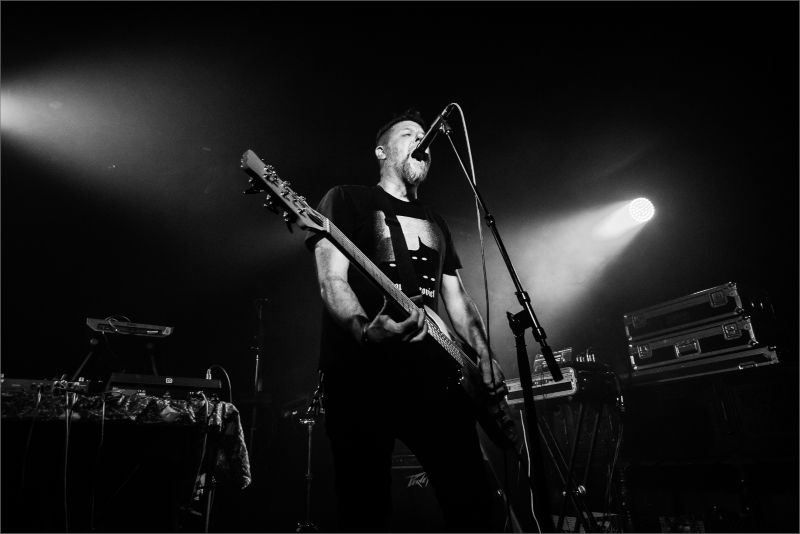
Vague Lanes (with Badger McInnes): a more classic question here. Two left-handers, each holding a bass capable of casting a spell. Tell me what this marvelous descent into the underworld means for you, and how that irresistible blend of electronics and what I like to call a gothic sound came into being.
Vague Lanes came about because my lovely wife Kathleen bought me a six-string bass for xmas one year. I wrote four songs quite quickly using it, a synth, and a drum machine. Just three instruments. It was a very autopilot session in which I really didn’t think much about the style of music I was writing; it just came out that way because of the limited set of tools I was using. I let them sit for about a year, then reconsidered doing something with the project, so I contacted Badger, who I knew was also left-handed and well-versed in the gothic subgenre of music.
Now we needed a singer… I thought about this a lot. My previous vocals in Gridlock would not work. The smaller “head voice” I used in Bitcrush would not stand up to the driving assured nature of the drums. I had in the past used my chest voice very sparingly, singing from deep down with lots of air. It wasn’t something I could do for long periods of time, though. I recorded vocals for “Here :: Now,” and it seemed to work well within the context of the music; however, I now need to train to be able to sing this way for a full live set. I’m able to now, but I don’t think of myself as a singer. Just doing it out of necessity.
Where does it all come from? I love classic stuff in the genre, Red Lorry Yellow Lorry, Cocteau Twins, early New Order, and Lowlife, plus some of the more modern revivalist stuff, like Traitrs, Lesser Care, and Shadow Age, so the creation of the original songs came out with an inspirational nod to all those, yet I wasn’t actively thinking I’d make something in that vein, it just came out in this amalgamous way.
Was there a precise moment in your story when you understood that it wasn’t enough to
choose sounds, you also had to choose “sonic identities?”
Mike Cadoo :: Dryft, was that moment, as a song like “Slalum” would not work in the Gridlock cannon. There is, of course, some overlap; for instance, the first Bitcrush album could have been the beginning of a Gridlock record. Parts of the Dryft album The Blur Vent could be seen as early Bitcrush. And surely my more recent Dryft works could be heard as an extension of my time in Gridlock, but for the most part, things need their own project to focus on a specific ideological trajectory. I don’t think that Vague Lane‘s music would work under any of my previous sonic identities, so these identities serve their purpose nicely.
Have you ever abandoned an idea not because it was wrong, but because it belonged to another era of your life, and no longer wanted to obey you?
Mike Cadoo :: Ah, yes, of course. However, I don’t really abandon them per se. I will, in a sense, finish them. They will end up being lost in time. Moved from hard drive to hard drive. There are countless pieces like this. A good example is a song that will appear on the upcoming Tormentor Radio Show anniversary compilation. Originally written back in 2014, it didn’t fit any specific project at the time and maybe could have felt more at home on an early Bitcrush album. Some of these might see the light of day as the projects evolve, or they will simply be lost due to their disconnection from the moment they are created.
When you listen today to work from the past, do you feel nostalgia, distance, or is it more like a document, something you don’t touch?
Mike Cadoo :: A document, for sure. I would never revisit anything in any form other than maybe reproducing a work live. Even then, repeating it over and over in that way, the document feels as if it starts to lose a bit of its impact. I very rarely listen back to things from the past. I did, of course, have to listen to the Gridlock reissues while compiling them. Those are very strict documents: they show the evolution of something that we had no idea of what it would become. So I guess in that way, there is some nostalgia present when reviewing some of these “documents.”
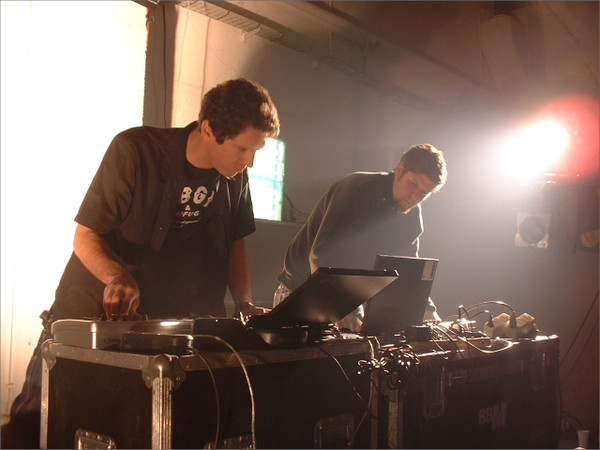
Gridlock left deep marks on many people: artistically, what did it teach you that certain records grow slowly in other people’s hearts instead of exploding right away?
Mike Cadoo :: Gridlock was created in a sort of vacuum. We obviously had our influences, but our focus on exploiting the limitations of emerging technology made us feel people would hate what we were up to, since it was so focused on what we wanted to break, reveal, or emotionally express. There was a collective holding of our breath for each album, in that we didn’t think our fans of the previous album would follow. We were, thankfully, wrong. I think part of the slow burn and growing nature of the adoption of some of our albums is that they were a bit ahead of the curve. We obviously didn’t know it then, but when I listen back to Trace, Formless, or even Further, they still hold up to a certain extent today. Which is amazing and something I never really understood or gave two thoughts about if it weren’t for the vinyl reissues I am doing with Viasonde.
Is there a creative “wound” that has stayed with you for years and keeps returning, disguised, in every project?
Mike Cadoo :: Ah, I see what you did there :). Yes. The answer is yes. I create simply because of this very wound you speak of.
Navigating tension through sound waves ::
Ever since I’ve been listening to you, your sound often seems to hold two poles together: precision and ruin. Do you recognize yourself in that tension?
Mike Cadoo :: I have never thought about it in these terms. There is some precision to what I do, but I always tend to break or obscure it in some manner. I might spend hours on a beat structure only to degrade it to where it loses its original intent. There are two poles, apparently. If I think about it objectively, even with Vague Lanes, some parts are pushed to the very edge of ruin or just before, almost obscured to create a form of modulation, so I do see where you could hear that commonality in my works.
When you compose, where do you truly begin: timbre, rhythm, or an image that isn’t music yet?
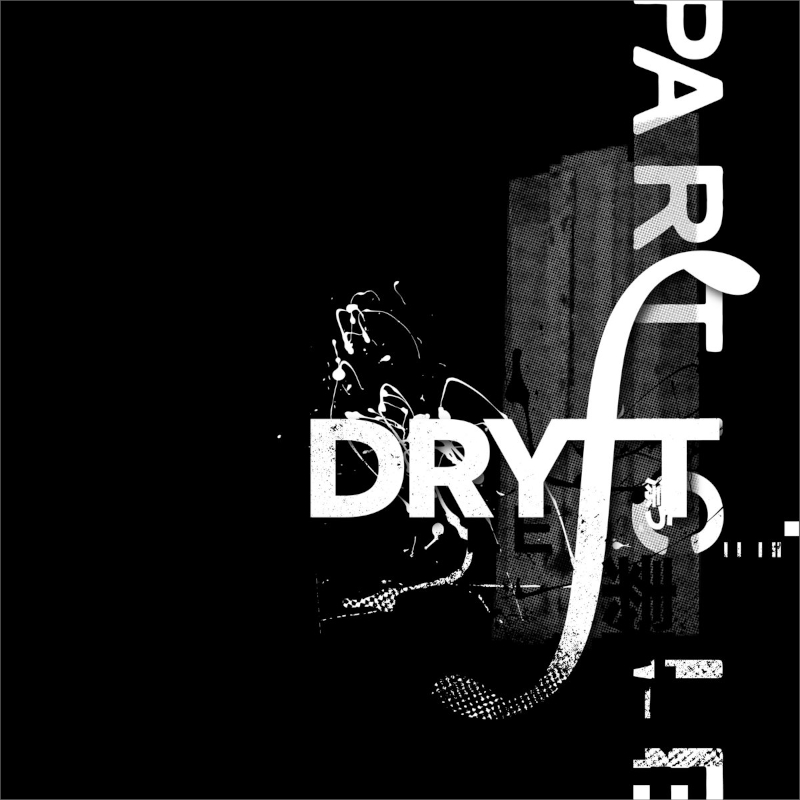
Mike Cadoo :: This varies greatly. There is no set starting point. For the most recent Dryft album, Particle, I set out to make a sound kit prior to writing the songs. This is something we did for the early Gridlock albums. Recording drum hits and various textures to the four-track, pushing the preamps and tape to their limit. I then would record them back into my DAW at various speeds/pitches. In some cases, those sounds would serve as a launchpad for a song. But this would depend on whether the sound had its own rhythm or texture that I could use as a jumping-off point.
With Vague Lanes, there is a core set of instruments at play, which makes creation a bit more immediate. However, any one of those instruments could be the catalyst for a new song. For instance, the newest song is written around a bassline written by the new bassist, Rich Williamson that came together very quickly and quite organically.
How much do technical constraints, machines, formats, limits, matter to you as a kind of discipline, almost traditional in spirit?
Mike Cadoo :: Oh yes, we are currently in a time when you could, without too much effort, have limitless options when creating music. I personally know some very talented musicians who do not get much done, or work with terrible efficiency because they do not limit their tools. So there is a discipline aside from the instrument itself in the creation of music now. Even the myriad distractions from technology outside the creative process itself get in the way.
“No matter what project it is, I really do try to just put myself into it. Music from my heart, no matter the genre or timbre.” ~Mike Cadoo
Have you ever felt that a “new” technology made you poorer—taking away the necessity of choosing?
Mike Cadoo :: I don’t think so, not poorer in the creative sense. I’ve always tried to exploit the flaws of new technologies when it comes to music creation. Or even using a specific tool, say something like pitch correct or bend, in an unconventional way. I would say that in some ways, the advancements in music technology have made my job of exploiting those faults a bit more difficult. Before, I just had to drive something through the audio interface so hard it clipped and ducked. Now I have to clip it with a plug-in, then add ducking with a compressor to achieve the same effect, and it is still not 100% the same.
If you had to name one thing you’ve never stopped pursuing, record after record, what would it be: intensity, clarity, truth, or something else?
Mike Cadoo :: Honesty. No matter what project it is, I really do try to just put myself into it. Music from my heart, no matter the genre or timbre.
On the label side: when did you realize you didn’t just want to release music, but to build a home for a certain idea of music?
Mike Cadoo :: After some time of being on Pendragon Records, with Gridlock, I later began working for them as a graphic designer. I would discuss music with Colm all the time, new bands, new signings, new genres. We would trade mixtapes, and I would tip him off to new bands I thought were worth a listen. He even asked me at one point whether I had even considered running a label. I gave him a ridiculously arrogant answer about how I would run it differently than he runs Pendragon, by signing on more experimental, forward-thinking artists. I still keep in touch with him and later found out from him that this was a sort of job-interview question I had completely fumbled, as I might have ended up managing Pendragon. He rightfully sold the label instead.
Fast forward a couple of years, and I get my first MiniDisc player. I would make mixes to listen to on my commute into San Francisco. Tracks I would find from mp3.com, or buy on 12”s or CDs. One morning on the way into work, I wonder whether it would be possible to manufacture a compilation on MiniDisc. That day at lunch, I researched and found that Sony Austria pressed retail-ready MiniDisc’s. Later in the week, I reach out to a few people who have been on my personal compilations. Arovane, Spark, ML, and EU, to name a few. Uwe (Arovane) was the first to say yes, and pretty much with that one “yes,” n5MD was born.
n5MD: what did that abbreviation mean to you at first glance, and what is the label’s first unwritten rule, the one that never appears in press releases but guides every decision?
Mike Cadoo :: No Fives, Mini Discs. In reference to the size of a CD. The problem was that Minidisc’s quickly became outdated, Sony stopped manufacturing them, and I had to decide whether to stop or move forward without the namesake format. As far as the unwritten rule that guides every decision? I have to connect with the music, first and foremost. While the label represents many genres, and all the artists have distinct styles, there is a common, unidentifiable connective tissue that holds them together. This, I assume, is what people have referred to as “the n5MD sound.”
In your role as a label owner, what is harder: saying “no” to a good record, or saying “yes” to a risky one?
Mike Cadoo :: I hear a lot of good albums. But if they don’t truly fit within either label’s sound, then I have to say no. I do say yes to risky ones all the time. I try my very best to get listeners to see/hear the artist’s perspective / ideas just as I do. I don’t always succeed in that, but I do try my best. So I’d have to say that saying “no” to a good record is probably a lot easier for me. As it’s usually an easier decision.
Echoes between chaos and clarity ::
What makes you think, “this belongs on n5MD” even when it isn’t immediately recognizable by genre?
An artist who is capable of of conveying heartfelt emotion through their means of creation. “Heart to hands” is what I often used say. This is the only underlying theme or thread.
A label can be a personal taste, or a pact with a community. Where do you place yourself and how do you hold those two things together?
Mike Cadoo :: If I connect with it on an emotional level, I ask myself a question: Does it fit? Will it resonate with fans of n5MD’s output, or will it be too far out of the scope of what n5MD releases? So it is really both a pact with a community and my personal taste; they are not exclusive.
Have you ever released something that didn’t resemble you, but that you felt needed to exist, almost out of cultural responsibility?
Mike Cadoo :: I don’t think so. I don’t know that I ever think about my cultural responsibility. If I connect with it. I want to help the artist get their music out to other people who may also feel a connection to it. Maybe that is some form of cultural responsibility, but I don’t really think of it in that way.
How has your approach to A&R changed in an era where everyone releases everything, all the time, everywhere?
Mike Cadoo :: Ah yes. I had for nearly a decade actively discouraged demos. I opened them up for n5MD only recently. The one thing I am hearing quite often is that people are not fully realizing their visions; demos arrive seemingly unfinished, usually with a caveat that they are not mastered yet, which will not help the composition in any way. I still look for new artists on my own and send out offers / contracts.
On the n5MD side, I have not officially announced it yet, but we have planned an Access to Arasaka release and an album from Glasgow ambient artists Yulyseus. The former I reached out to after he released his most recent EP, and the latter sent in a very nice demo, which we then worked into a really stellar album that I am excited for everyone to hear. So the approach is somewhat similar to what it has always been; however, as things progress, I have had to be way more objective and discriminating.
Do you still care about the idea of a catalogue as a long narrative, a thread running through the years, or does the single release matter more today?
Mike Cadoo :: I think of each release as part of a bigger picture, for sure. A label is an outpost, where people can go to hear a specific style, feel, or quality. Single releases do matter, and each one lives and breathes outside of the label’s catalog. If someone told me they really loved the new Stray Theories, I wouldn’t immediately send them to review our entire catalog. Not every Stray Theories fan is going to be a Suumhow fan and vice versa. And while the catalogue does work as a collective sum, the single releases are what make it what it is.
Physical format: is it merely a medium for you, or a ritual? And what do we risk losing when that ritual disappears?
Mike Cadoo :: This is a tough question, as listening to a physical format can feel like a ritual. Vinyl, especially, requires time and effort. You might need to clean it before you play it, and you’ll surely have to flip it over halfway through. Having the art, liner notes larger is a form of ritual as well. I personally have not owned a CD player for over 20 years, but I can remember listening over headphones, reading the liner notes, which again is a form of ritual. When you strip away the physical format, the ritual might simply change, depending on whether you want to be more informed about who created the music. Say you are listening to a streaming playlist and a song comes on that you love by an artist you are not familiar with? You then go out and research this artist, learn all you can. This could be seen as another form of ritual in the age of content on demand. This ritual might depend on how much you want to learn.
When you oversee artwork, mastering, packaging, are you refining a product, or protecting an intention?
Mike Cadoo :: Artwork: I might be refining a product if the artist does not have a clear vision of what they want the visual representation of their work to be. But usually it is just a protection of the artist’s intention. The packaging, I try to keep things ecologically minded as much as I can. I try not to make the packaging anything frivolous or that adds zero value to the music. I’m probably going to get shit for saying this, but I see releases with “art books” or “prints” included, and this not only seems somewhat ecologically irresponsible but also forces the listener into a greater visual context with the release. I completely understand that there is meaning behind the artist’s work; however, I feel that more often than not, a release will resonate with the listener in a completely different way than intended.
Adding extra context through packaging may over-explain the context visually; it should be about the music first and foremost. For mastering, my philosophy has always been that the artist is hopefully sending it to me as they intend it to sound. So, I very simply, and as delicately as I can, enhance it to a level and spec that it can be properly replicated on vinyl or streaming. Very rarely do I try to add “color” to an artist’s sound, but I just enhance what is there. As a coloring, it would ultimately be adding something the artist did not intend to their music.
As a mastering engineer, where does craft end and interpretation begin: do you feel more like a restorer, or an invisible co-author?
Mike Cadoo :: I think I am just someone who is preparing an artist’s release for a specific format on a professional level. Nothing more, really. There are odd times when some restoration might need to be done, click removal, fix phase, but for the most part, I just want to get the artist’s sonic vision to translate to the various formats it will be released on. This happens very rarely, but if I hear anything in the work(s) that needs additional mixing or might not sound right, I will ask the artist to revisit their mix. Use it as a learning experience rather than trying to wrangle some frequency with multiband compression or eq.
Resonance, rupture, and quiet power ::
What is the most common “modern” mistake in the demos you receive, and what does it reveal, not technically but culturally, about how we listen today?
Mike Cadoo :: I do think that modern times foster an always-on mentality, and that musicians often feel forced to become content creators; in some cases, their music might suffer from this spread of focus. There has to be a balance between social media and music creation, and to me, the music really has to be the primary focus. I’m not saying that social media is why I receive bad demos, but, technologically and culturally, we are at a point where everyone wants a constant stream of on-demand content, and that pull can have less-than-optimal effects on creative output.
I think I touched on what is lacking in demos already a bit. The completion of the works. I receive so many unfinished ideas, good ideas, but unfinished. Things that lack drama, thought, or worse yet, emotion. I’ve had brief discussions with artists, especially the hardware-driven ones, about post-production editing in the DAW to add variance and drama to the music. It doesn’t lessen your hardware cred to do so, which is quite a silly idea, and a whole other discussion unto itself. Such post-production edits could possibly yield a whole other strand of creativity that you couldn’t conceptualize with your hardware setup.
If you could teach a young producer a single ancient virtue, patience, measure, listening, sobriety, which would you choose, and why?
Mike Cadoo :: A single one? Oh, probably Patience. You will need patience to finish something. Patience when you revisit that thing you thought was finished, that time told you it was not. Patience to take the time to really make it work in a way that is 100% true to you. Patience to find out who that “you” is. Patience to finalize that thought. Patience to find an audience for your music. Patience when seeing your streaming numbers. Patience when it feels as if no one gives a shit about this art you set out into the world. Patience is sobering. Patience requires measure. And Patience always requires that you listen.
Looking ahead: what do you want to remain, twenty years from now, of your work? Not in terms of fame, but as a human imprint: a sound, an ethic, or a way of doing things with care and truth?
Mike Cadoo :: As I get older, I have started to look around me a bit more. To think about what my legacy will be? was never something I entertained as a thought. It is my hope that, in the music community, I be remembered as someone who was fair, ethical, and who championed artists who really needed a boost into greater recognition. As an artist, who knows, I am already aware of the legacy of some of my projects, and I have begun to accept and embrace it, but I am far from done. You’ll have to ask me about that again in twenty years.
Particle is available on n5MD. [Bandcamp]





![[2View] Maps and Diagrams’ beneath still stars (handstitched*) & returning light (Home Normal)](https://igloomag.com/wp/wp-content/uploads/2026/10/maps-and-diagrams-returning-light-beneath-still-stars_feat-75x75.jpg)