



Metanoia: Music From Therapy marks an important step in Circuit3’s development. Fitzpatrick’s electronic music retains its connection with a clearly defined tradition: analogue machines, sequences, emotional minimalism and synthetic soundscapes. Here, however, that tradition is used to confront something deeply personal.
When machines still seemed capable of suggesting possible futures
Circuit3 is the project of Dublin musician Peter Fitzpatrick, an artist who for more than a decade has pursued a distinctive vision of retrofuturist electronic music, shaped by analogue synthesizers, synthpop memory and a fascination with that period between the late Seventies and early Eighties when machines still seemed capable of suggesting possible futures. From 2015’s siliconchipsuperstar to The Price Of Nothing & The Value Of Everything, and on to 2022’s Technology For The Youth, Fitzpatrick has developed a recognizable language: melodic, emotional and closely tied to the song form.
Metanoia: Music From Therapy radically changes the point of view. The voice almost disappears, the pop structure dissolves, and what remains is sound, space and memory.
The album’s origins help explain this transformation. On 17 November 2023, Fitzpatrick and Mat Smith, who runs the Mortality Tables label, attended Vince Clarke’s first solo concert in London, built around Songs Of Silence. After the show, they walked through the rain looking for somewhere to stop. Eventually they found a pub opposite Smithfield Market called The Hope. That evening they spoke at length about therapy, difficult relationships, trauma, mental health and the need to restore some kind of order.
For eighteen months, Smith had been keeping words and short phrases written down after his therapy sessions. When they read them together, those notes began to sound like song titles. Metanoia grew out of that conversation.
“Analogue machines become a means of processing experience, almost a second language. This is the heart of the record: eight tracks constructed like interconnected mental rooms, each with its own temperature.” ~Mirco Salvadori
The title itself refers to a profound shift in perspective, a transformation that takes place through acceptance. Fitzpatrick translates this idea by almost completely giving up words. The personal material is not narrated; it is transformed into frequency, duration, pressure and silence. Analogue machines become a means of processing experience, almost a second language. This is the heart of the record: eight tracks constructed like interconnected mental rooms, each with its own temperature.
“Cracked Eyes” opens slowly, with a fragile sonic substance that seems to emerge from something that has already happened. The title points back to childhood and to memories whose meaning can change when viewed from a distance. The reference to Pat Ingoldsby’s Beautiful “Cracked Eyes” also belongs to this area of personal memory. The music unfolds through discreet layers, with synthesizers that seem to breathe rather than move forward. There is no need for a dominant theme. The persistence of a few notes, and the way they slowly fade in colour, is enough.
Details emerge and disappear naturally ::
Mood compresses everything into just over two and a half minutes, with the character of an interruption, an emotional state caught in the act of changing shape. “Imperfect” opens the space out again. The sequences become more prominent, while details emerge and disappear naturally. Fitzpatrick uses repetition as a perceptual tool, allowing small changes to alter the meaning of what came before. The result retains a distinctly physical quality. The synthesizers do not feel like perfectly polished surfaces; they have grain, friction and weight.
With “Burnout,” a sharper tension appears. The title refers to the point at which trauma and life events eventually collide. The track conveys that sense of saturation through accumulation. The movement remains controlled, almost restrained, and it is precisely this restraint that makes the sense of exhaustion tangible. “Where Are We Going?” introduces acoustic piano and immediately changes the light of the record. Barely two minutes long, it works like an open-ended question. The gesture is simple, almost stripped bare, and creates one of the album’s most delicate passages. “Shielding From The Past” moves back into electronic territory with greater depth. Over six and a half minutes, protection, automatic responses and memory seem to translate into successive layers. It is one of the most fluid moments on Metanoia, able to preserve an ambient dimension without becoming purely contemplative. The title “What If Everything Goes Right?” already contains a decisive shift. The question is no longer concerned only with what might go wrong. The opposite possibility appears, almost difficult to articulate after everything the album has passed through. The music gains air, and its movement becomes more relaxed. Hope remains cautious; it has not yet taken the form of a solution.
“Notes accumulate, rhythmic figures become more insistent, and the harmonies seem to rise slowly from the depths. Time stops being simple duration and becomes material.” ~Mirco Salvadori
An album concerned with the traces left by the past ::
Then comes “The Hope,” an eleven-minute piece made with Vince Clarke, an acknowledged influence and an inevitably significant presence in Fitzpatrick’s musical history. The title takes its name from the London pub where the whole project began. Conceived as an equal collaboration, written and produced by both musicians, the track closes the album with a landscape of melodic drone that holds darkness and openness at the same time. Clarke works from within the album’s own language. Notes accumulate, rhythmic figures become more insistent, and the harmonies seem to rise slowly from the depths. Time stops being simple duration and becomes material.
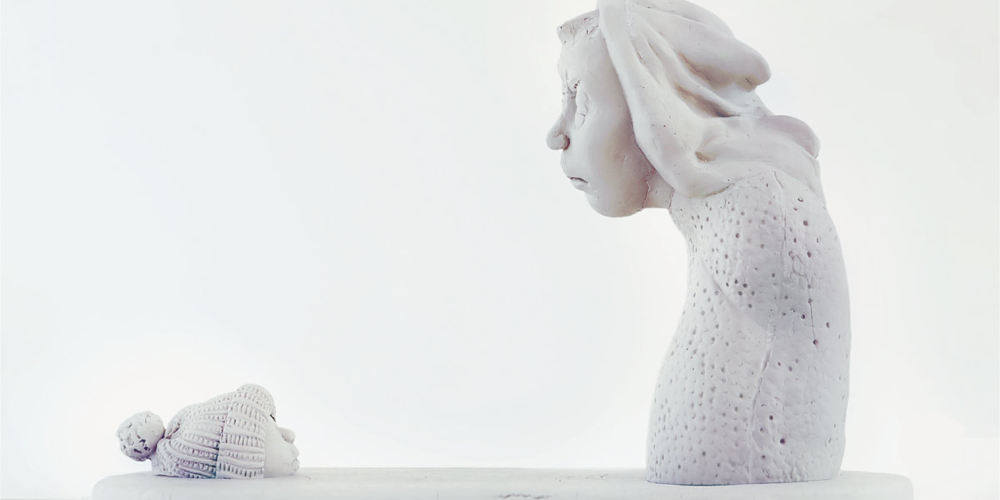
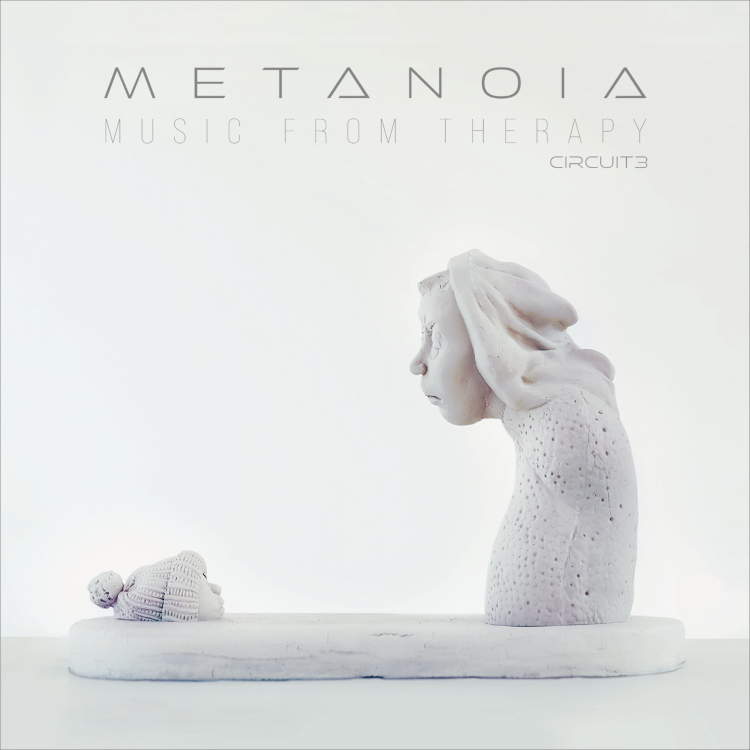
The cover image also contributes to this feeling. The Foundling, a jesmonite sculpture by Jackie Hudson Lalor, photographed by Jenny Callanan, shows an adult figure bending towards a small body lying down. The almost total whiteness removes every distraction and leaves only distance, vulnerability and care. It is an image perfectly suited to an album concerned with the traces left by the past and with the possibility of looking at them without being completely ruled by them.
Metanoia: Music From Therapy marks an important step in Circuit3’s development. Fitzpatrick’s electronic music retains its connection with a clearly defined tradition: analogue machines, sequences, emotional minimalism and synthetic soundscapes. Here, however, that tradition is used to confront something deeply personal. What remains are the compositions themselves: their silences, their inner tension, and the feeling of moving slowly through areas that took time to become real. The result is intimate, dense and surprisingly physical: a true plunge into electronic density.
Metanoia: Music From Therapy is available on Mortality Tables. [Bandcamp]