


Breakcore has a reputation as music for people who want to be overwhelmed. Tetsudō makes the case that it’s also music for people who pay close attention. Every pass reveals another hidden edit, another snare flipped backward, another melody tucked under the noise that you swear wasn’t there yesterday. It rewards the listener who leans in rather than the one who just turns it up. Though, to be fair, turning it up helps too.
Complex breaks, twisted metrics, melodies that keep surfacing through the chaos
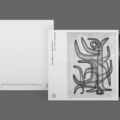
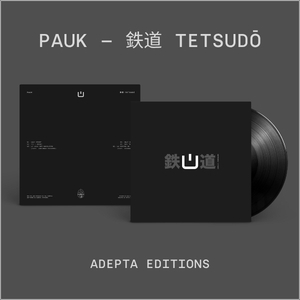
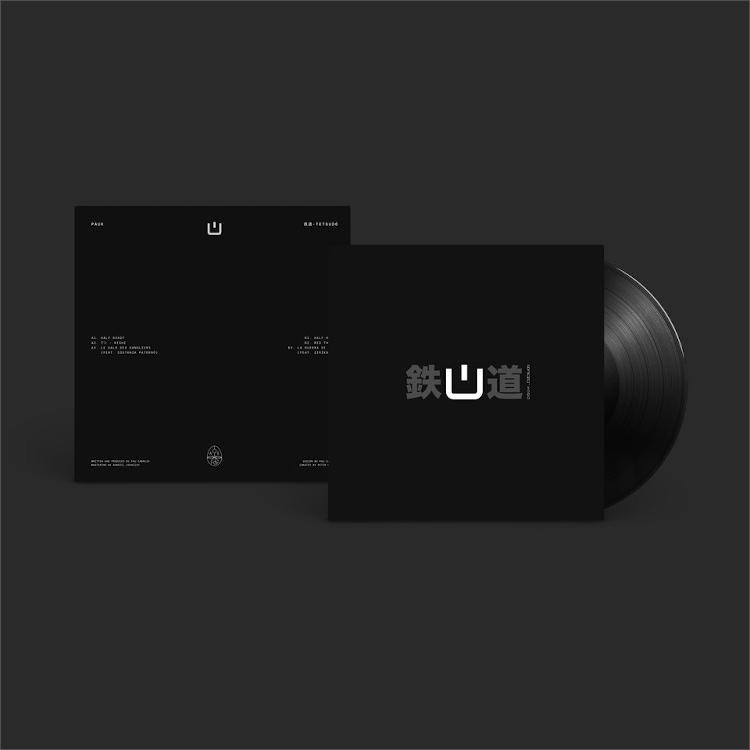
Pau Cabruja has been making electronic music for more than twenty years, most of it from Girona, and most of it at speeds that make other producers sweat. As Pauk he’s played MIRA Festival and Sónar, but by his own account he’s happiest at raves and free parties, the places where nobody cares how a track was built as long as it hits. Critic Javier Blánquez once called him “the Catalan µ-Ziq,” and the comparison holds: complex breaks, twisted metrics, melodies that keep surfacing through the chaos. 鉄道 Tetsudō, Japanese for railway, is his arrival on Adepta Editions, and it’s more than a new release. It launches Fuori/Serie, a parallel line at the label where the artist shapes both the sound and the visuals entirely from the inside. Cabruja designed the record himself. Catalogue number AE/FS-01. A first stop on a new line, fittingly.
The genre here sits where breakcore and acid collide, and Pauk wastes no time proving it. There’s no warm-up, no ambient runway. The glitched transitions between break sections recall Ruby My Dear’s way of making drums stutter forward rather than loop. “Keshi,” which means poppy, adds operatic vocal chops, and there are sweet overtones floating over the top of all that violence. Pauk stacks styles here, breakcore, acid, something almost classical, and the impressive part is how little they crowd each other. Every element gets its own lane.
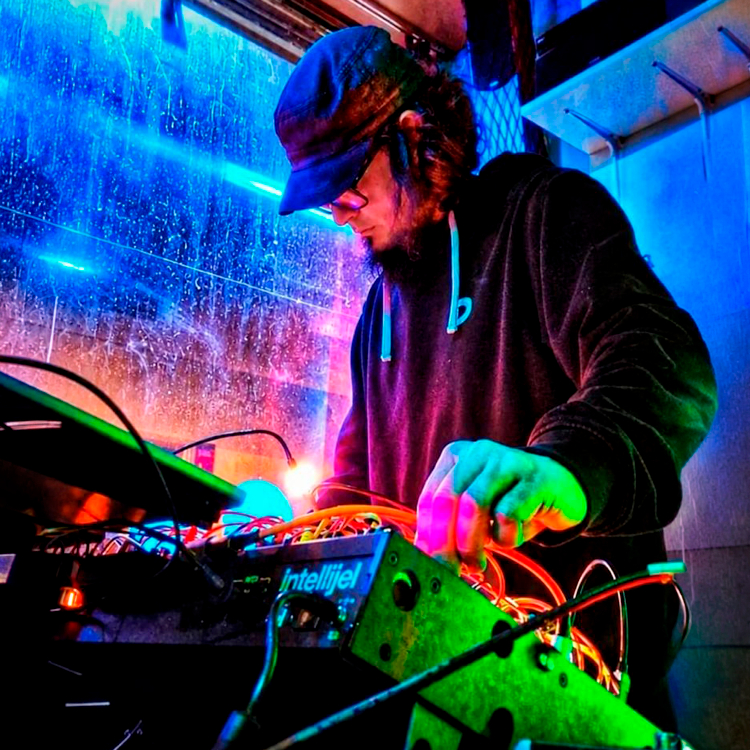
The break editing is where Pauk’s two decades show most. He rarely lets a break play as a loop. Instead he slices it into short fragments, sometimes just a single snare or ghost hit, and resequences them so the groove keeps shifting under you. Listen to how often a pattern gets cut off right before it would resolve. Those are his gated transitions: a burst of drums, a hard stop, then a new pattern landing on the downbeat as if the silence was part of the rhythm. It’s a technique that depends on tight volume envelopes and exact timing, because even a few milliseconds of overlap would smear the cut and kill the impact. On “Half Robot” and “Keshi” he stacks these edits so fast the ear stops hearing individual breaks and starts hearing a single shape twisting in real time. The kicks underneath are pushed hard into distortion, which thickens them enough to anchor all that cutting. Without that weight, the edits would sound like a showcase. With it, they hit like a dancefloor.
“Le Vals des Sangliers,” the waltz of the wild boars, featuring Costanza Paternò, starts like it might be a chill break, and then the build kicks in and you realize the calm was bait. “Half Human” mirrors the opener in name and flips it in spirit. It’s airy, one of the more melodic and emotional moments on the record, while still loaded with breaks and distorted kicks. The gated drum transitions, those flared bursts that cut off abruptly and slam into the next pattern, run across every track like a signature, and here they sit against melody instead of noise.
“Red Thread” is the standout. It opens differently from everything around it, melodies and atmosphere complementing each other in a rare moment of peace, before Pauk rushes the drums back in. The acid is still raw, but the arp play on top is clearly fun to him. You can hear him enjoying the pattern, nudging it, letting it skip. It’s the track where his technical side and his rave side shake hands.
Every pass reveals another hidden edit ::
The acid lines follow the classic 303 vocabulary, resonant filters, accented notes that bite harder than their neighbors, and slides that glide one pitch into the next, but Pauk treats them as rhythm as much as melody. “La Guerra de Mamá,” with Zirikatus, closes the record and returns to the energy of the first two tracks. A child’s voice drifts through, half-buried, words too faint to make out. Then a rush of analog drums arrives and gradually pushes toward faster, more distorted breaks. That move, building an entire rhythm section from analog machines before any recognizable break appears, is a trick Venetian Snares leaned on in his more hardware-driven work, and it never stops being thrilling to hear the speed creep in.
Breakcore has a reputation as music for people who want to be overwhelmed. Tetsudō makes the case that it’s also music for people who pay close attention. Every pass reveals another hidden edit, another snare flipped backward, another melody tucked under the noise that you swear wasn’t there yesterday. It rewards the listener who leans in rather than the one who just turns it up. Though, to be fair, turning it up helps too.
鉄道 Tetsudō is available on Adepta Editions.