







Morning Glories is strongest when it allows this material to breathe without forcing it towards the sublime. bvdub knows his own vocabulary extremely well and at times exposes it to its limits. The more accessible melodic openings give the album a different kind of light, occasionally close to a pop sensibility, always absorbed within durations and structures that belong to another logic.
A moment capable of exposing both what remains from the previous day and what is about to begin
When the light of dawn arrives, it brings shapes, edges and folds into view, making readable what remained indistinct through the night. Morning Glories seems to begin from this simple, rather severe idea. Brock Van Wey returns to quiet details fifty catalog numbers after Days of Gold, with nine tracks and more than seventy-six minutes of music. Enough time for every element to lose its initial outline and begin to transform.
bvdub has worked for years within an immediately recognisable language. Expansive ambient, traces of dub techno, voices reduced to presence, deep bass, pulses moving in and out of focus. His past in the Bay Area rave culture remains important in understanding this music. Even in his sets, the beat could disappear for long stretches while everything surrounding the rhythm moved to the centre. In a recent conversation with quiet details he reiterated another crucial point: the titles come before the music, and the work begins as an attempt to give form to episodes from his own life. For Morning Glories, he described morning as a moment capable of exposing both what remains from the previous day and what is about to begin.
“The Rain Knows” enters without preliminaries and establishes the album’s grammar. Masses of synthesizers, suspended voices, strongly present low frequencies, percussive movement. These are also the coordinates identified by the label itself, arranged here with an almost physical sense of depth, as the parts slowly overlap. One of Van Wey’s strongest qualities emerges immediately: his ability to make music seem mobile even when, on a distracted listen, it might appear static. Changes happen inside the sound, through variations in pressure, density and distance. It is a technique that has accompanied bvdub for a long time, with elements evolving gradually while the surface appears to remain still.
With “Skies of Seven,” the duration moves beyond eleven minutes and the scale widens. Repetition alters perception. A phrase remains in place long enough to become an environment, then something shifts at the edges and draws attention back towards the centre. It is a familiar process within bvdub’s discography, used here with control. Van Wey has always defended extended durations because, in his view, each track needs enough time to complete its own course.
“They Said Love” introduces a more exposed melodic area. For years, bvdub’s voices have functioned as traces of human presence, filtered until they almost entirely lose their semantic weight. Van Wey himself has explained how closely the choice and transformation of vocal fragments are connected to the emotional function they are meant to assume within a track. Here the melody comes close to a kind of pop immediacy, particularly in the clarity of certain harmonic openings and in the ease with which a vocal fragment remains in the mind. It is a useful opening, offering a point of contact within very long structures without shifting the album towards song form.

Ghosts of the past ::
“Time in Space” brings movement back to the foreground. Rhythm in bvdub rarely exists simply to mark time; it acts as a memory of the club, a force moving through much broader ambient surfaces. Van Wey has described the beats in his more ambient work almost as ghosts of the past, something resurfacing from an earlier musical experience. This relationship between stasis and propulsion keeps Morning Glories away from purely atmospheric ambient. Even when the sound stretches outward, there is still the impression that something underneath continues to move.
At the centre, “Three Nights Ago” carries one of the album’s more delicate traits: the ability to suggest a memory without turning it into a narrative. The titles indicate a direction without providing a plot. This leaves genuine space for the listener, in keeping with Van Wey’s idea that once a work is released it begins to change according to whoever encounters it. The autobiographical element remains visible without becoming illustrated confession.
“Let Go Slowly” lasts just over three minutes and feels almost like a rupture within an album built around much longer spans. Its brevity gives it weight. After the previous accumulation, it prepares “Almost Home Now,” ten minutes in which even the title carries a precise tension. Being “almost” home means approaching a destination without having reached it. The material accompanying the album also insisted on this uncertainty of arrival. Morning Glories often works within this sense of proximity, around something that appears ready to resolve only to be set in motion again before closure.
This is also where the album’s possible limitation begins to surface. bvdub’s emotional vocabulary is so well defined that it inevitably runs the risk of self-reference. Vast pads, distant voices, layered crescendos, deep bass and melancholy can become a comfort zone, particularly within such an extensive discography. That risk is already apparent in the consistency with which his sonic vocabulary has remained recognizable over the years. Morning Glories does not entirely avoid it. In some passages, the intensity seems to arrive already loaded with meaning, almost recognizable before the track has had time to construct it. The sequencing still prevents the most obvious kind of automatic repetition by alternating expansion, acceleration and subtraction.
After so many years and a body of work difficult to summarise, Van Wey continues to work around the same question: how long can an emotion last before it changes its nature? Morning Glories keeps that question open long enough for the listener to enter it. ~Mirco Salvadori
“Rise to Fall” concentrates the energy before the final stretch. The title already contains an upward movement that reverses itself, and the album seems to find a natural synthesis there: ascent, saturation, collapse, space left open. “Light That Blinds,” at eleven minutes and forty-five seconds, closes the record without searching for an overly neat conclusion. The light in the title is excessive, almost painful, far removed from any reassuring idea of dawn. It is a fitting ending for an album that treats beauty as something exposed, crossed by friction and pressure.
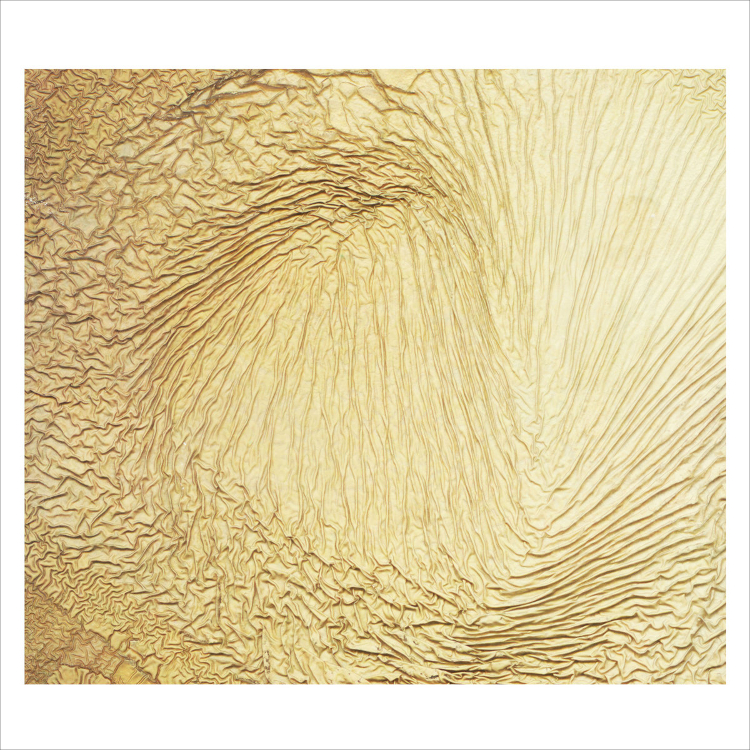
The physical edition also emphasises continuity. The CD includes a long uninterrupted mix; the six-panel package and separate print continue the visual work that began with a photograph by Van Wey, then rephotographed and processed using analogue methods at the quiet details studios. The cover, with its golden surface marked by folds and grooves, resembles a material that has retained the passage of something. It suits music that treats memory less as an archive than as a process of gradual deformation.
Morning Glories is strongest when it allows this material to breathe without forcing it towards the sublime. bvdub knows his own vocabulary extremely well and at times exposes it to its limits. The more accessible melodic openings give the album a different kind of light, occasionally close to a pop sensibility, always absorbed within durations and structures that belong to another logic. After so many years and a body of work difficult to summarise, Van Wey continues to work around the same question: how long can an emotion last before it changes its nature? Morning Glories keeps that question open long enough for the listener to enter it.
Morning Glories is available on quiet details. [Bandcamp]