



With the completion of this trilogy, we acknowledge our part as a remote viewer of Dean’s life over three decades. Salvaging The Future—perhaps more than the prior two albums—is a restless collage, yet it is so well mixed that it lends itself to uninterrupted full-album listening. This listener is tuning in about 2x per day at the moment. Despite the challenges these decades have wrought, the trilogy’s close with “Our Story Survives Collectively” leaves us with a sense of hope. This is music for visioning.
Revolutionizing the human listening experience
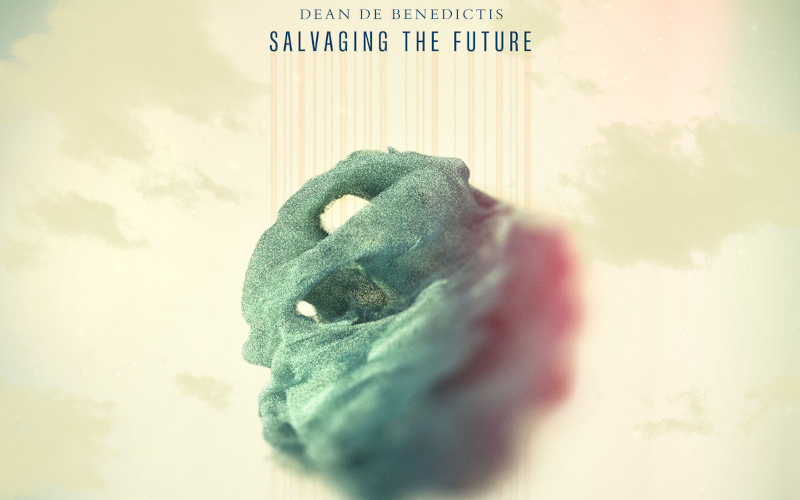
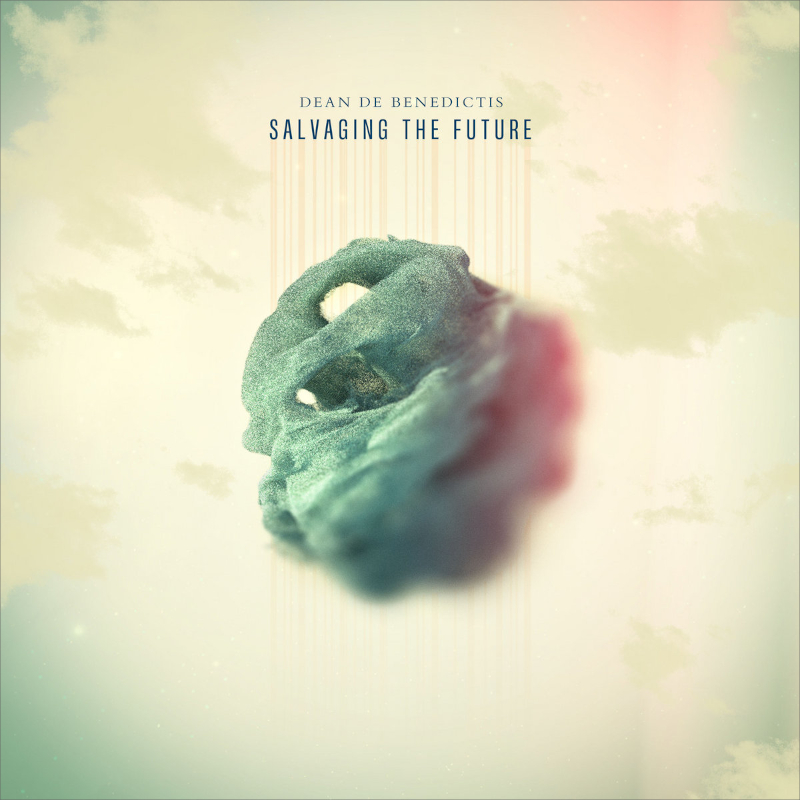
Salvaging the Future utilizes electronic mastery alongside sparse traditional acoustic instruments and vocals to revolutionize the human listening experience. There will be no undisturbed sleeping, only optional vivid, deep-set dreaming. Music that completely upends your expectations can feel like a sensory assault on the first spin, but the feeling soon becomes mostly energizing and sustaining, including a wispy blend of limitless and beatless space signatures, as well as beat inspired enchantment. This is Art, intending to allow the unconscious mind to somehow express itself, often resulting in the depiction of illogical or dreamlike scenes and ideas. “Moving forward with mindfulness would quite literally mean salvaging the future,” offers De Benedictis. We may expect The Future to bring about profound changes in our listening arts through universal joyfulness, mindful that nothing is forever. As for dancing, that is up to you. I seek a collage shifting into every new world imaginable, or mostly never before imagined.
Southern California-based artist Dean De Benedictis has delivered an absolute masterpiece for your collection of auditory journeys that completely bypass conventional reason and transport your mind into uncharted, supernatural territories. He is widely recognized in the electronic ambient community as Surface 10.
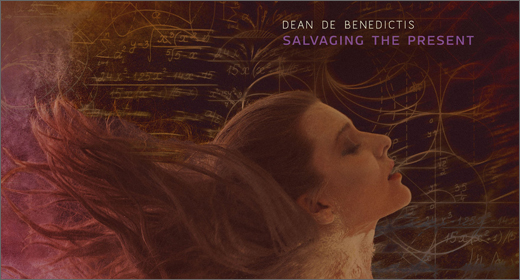
Surface 10 has a long history with performing at galactic electronic music festivals as well as releasing his solo and collaborative recordings internationally, such as on the DiN label, Hypnotic, Space For Music, as well as some self-released works. His previous work with Spotted Peccary Music includes a collaborative project called Desensitized, with Deborah Martin (Hemispherica Portalis, 2020, and Chaos In Premonition, 2022) as well as two solo albums, Salvaging the Past (2005) and Salvaging the Present (2016).
Only optional vivid, deep-set dreaming ::
Salvaging the Future presents an attempt to conceive and apply a good degree of futurism to every aspect of its creation. From sound design, to instrumentation, to compositional production, perhaps one way to see it (or hear it) is as an illusive combination of progressive and contemporary influences that all “tap the future on the shoulder” or if nothing else, maybe exchange a hat-tip to that which is to come. Additionally, the obvious suggestion that humanity’s future may still have hope for survival and even thriving; that we may somehow redeem and persevere not by forgetting or dismissing our weight of the past, but acknowledging and accounting for life experiences as a strategy for our progress ahead.
“Aside from representing phases of my life, the Salvaging series began as one idea, and ended as another,” confides De Benedictis. “The musical style of Salvaging The Future follows the suggestion of its inherent theme: a wild departure from most past and current genres, diving head first into hyper-forward approaches, perhaps in some ways “of the future.”
“I would produce and perform music in harsh desert planes, steep canyons, mountainsides and summits, windswept shores and forested wilderness; I would work in abandoned buildings, housing construction, airplane flights, cafes, hotels, museums, libraries, or while staying with friends, family, or indeed at home, which was most of the time even if not by far. I tended to do a lot of re-synth types of methods, so found sounds combined with both customized sample libraries and Apple libraries were yet again the main source of instrumentation on Salvaging The Future, much like Salvaging The Present.”
Also, like Salvaging The Present, there was an immense amount of processor stacking and automation, mountains of hardware, on every instrument track. “Featured on both albums was also a customized library of drum hits I created in 2014, in which each hit captures the reverb trail-from a note (or harmony) that was sung just before it. This hit library formulated a fairly unmistakable signature-sound in most of my work that followed. I still use that custom-drum-hits library to this day. However, unlike Salvaging The Present, which was completely produced on only one laptop, Salvaging The Future was composed on my first two laptops as well as my first tower. It was all old Apple gear and software, but for some reason that still sounded better to me than some of my newer gear and software, so I decided to just accept the old-system setbacks and finish the album on those devices regardless.
A wild departure from most past and current genres ::
“It almost broke me. I had to deal with endless system complications on every device, prompting constant work-arounds with Logic and Ableton, but the sound made it worthwhile for me.” De Benedictis continues his long, internationally recognized history of stripping ordinary objects of their normal significance to expose deep psychological truths. By tying an essential common thread between opposing genres, he has created an abstract, emotionally rich masterwork that demands to be heard for fans of avant-garde electronic exploration.
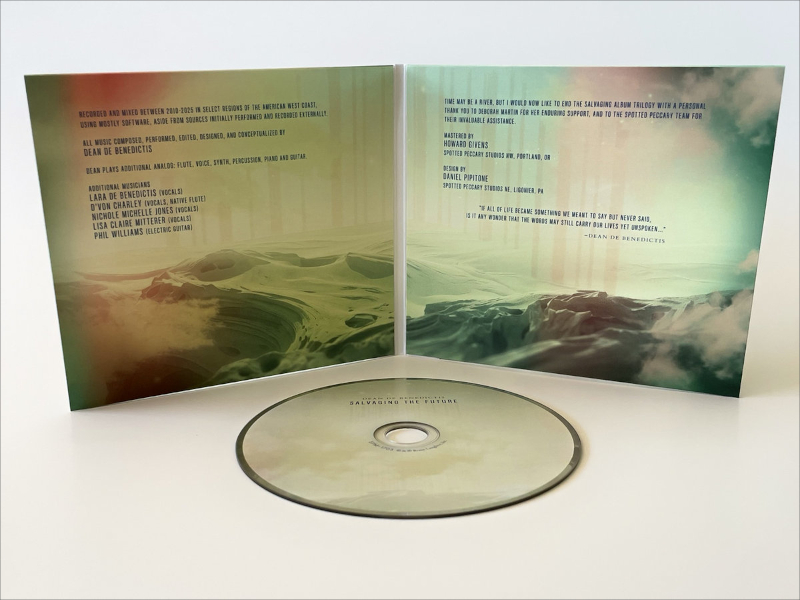
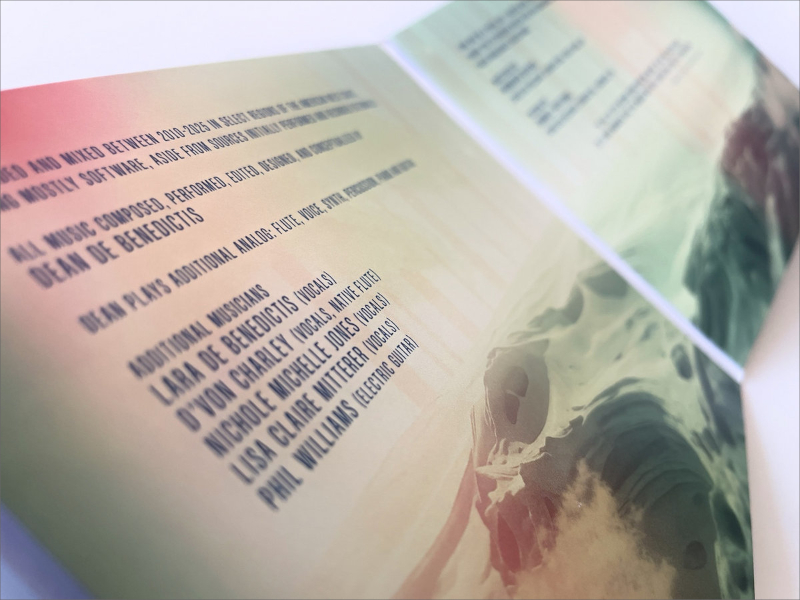
Salvaging the Future was composed, performed, mixed, edited, designed and conceptualized by Dean De Benedictis between 2010 and 2025, using mostly software on laptops. His additional instruments were flute, voice, piano and guitar. Production locations were scattered throughout the US west coast but based primarily in Thousand Oaks and Santa Monica, CA. Contributing extra recorded musicians, in addition to Apple loops, include: Lara De Benedictis (vocals), D’Von Charley (vocals and native flute), Nichole Michelle Jones (vocals), Lisa Claire Mitterer (vocals), Phil Williams (electric guitar), and various ASMR artists. ASMRtists.
Autonomous Sensory Meridian Response (ASMR) and Ray Kersweil’s futurist theory of the Singularity are two unrelated ideas I came across while researching this music, both have been popular but I have never before heard of them, so kudos. ASMR seems to explore some of the physical psychology of sound. The Kersweil concepts are set in the future, during the coming singularity, and all planets and celestial bodies are now shifting and morphing and changing as that same singularity.
This revolutionary sonic journey begins abruptly with “My Love Is An Extinction Event” (6:10), a track whose song title invokes the concept of a rapid, widespread drop in biodiversity. Here things come together and things come apart and sometimes this happens at the same time, spinning and bouncing, falling and transferring velocity, which feels bizarre, unbelievable, dreamlike and leads into very strange restless ear-born images. The kind that will change your life. At one moment the mood goes from feeling frenetic to feeling incredibly alive and layered. This unexpected salad of situations, places, or emotional moments that seem detached from everyday reality or logic all feel pretty good, the intimate links between freeing imagination and the mind, and liberation from repressive and archaic social structures.
In the beginning, deep space has no beat. Welcome to “The Outer Links” (6:31). Coming from an intentionally beatless expanse designed to liberate the imagination, giving the listener the sensation of flying through colorful lights, and maneuvering deliberately to liberate the imagination. We are flying along at a more rapid speed now. The feeling is all about bright stars and a sense of transit. Soon everything is almost flying apart and the beat is going at a fast clip. As the album progresses, we encounter “Voca” (3:35), where small pieces suddenly click and morph into a fast-paced, jamming run driven by a sexy bassline and seasonably hot drum tones. Perhaps the tempo is a bit fidgety but always rich in tone and interesting in context, jumping into many places to tell the story. I do not understand the punchline, but even real life itself can be strange and even uncomfortable when seeking sustenance.
Music for visioning ::
I think the fourth track starts in a calm memory palace illuminated with tall marble columns, with big bright halls and stairways. Soon a beat contraption comes together and the vocalists start to arrive. “They Fought To Sway” (7:18) is my personal favorite here, the vocals reach a place I have never heard before, and I like that. “Urband Glacier Fund” (6:27) is probably holding a hidden message, leading to speculation about that extra d in Urband. Hidden portals bring delight, I think that we are in outer space coming upon some new life forms, our synthesizers are carefully subtle and fully capable. Now a new beat arrives and takes over, a new darkness has surrounded the cabin. Are there glaciers in outer space? The flute is here to take us along, with amazing high energy.
Now we encounter a big cinematic sly beat and things are happening all over the place, very exciting. “ASMR Tragedy Lines” (6:44) seems to take place down in a very deep tunnel or cavern, robots are building things quietly, except for this one guy. It gets extremely quiet out here, where we are in the cavern. The perception distorts, morphs, and transforms ordinary objects and forms into strange and uncanny variations of themselves. Down there something is always sparkling. Now the whispers in the darkness take over. I keep straining to hear what the voices are planning next.
The imaginary narrative shifts beautifully on “Salvaging My Story” (7:12), a track full of radiant stars, choirs, and unexpected juxtapositions that exercise the grand element of surprise. Let’s go out into the fields at night where the space ships will land, be sure to keep an eye out. There are steam powered machines running, there are crickets and I expect to find the children of the night out here. Soon there is a change. There is a shy melodic tune lingering in the caverns along with the choirs and radiant stars. Soon all of the details start coming into focus, this is a big story with plenty of flying at night. Away we are going, exercising the element of surprise, unexpected juxtapositions and non sequitur. It works. This leads right into the slow-burning sunrise of “Future Incandescence” (6:32) which unfolds like a long slow transit in deep space. Now the pace is slower and the feeling is starker, disorienting, with the hallucinatory quality of a dream. There is a language of fragments that flow together and make the whole sound. We are still on the ship, snug inside a safe metal box that is still moving, the closest star is emerging from an eclipse, there are emotions and suspense, there is tension building.
The natural world takes a surreal turn on “All The Wild” (4:27), where there are strange gumblings coming from animals that I cannot see. We are all probably back in the big cave again, at night. This time with strange recordings of birds and wildlife playing in the darkness. The variety of strange sounds increases as new species come floating into our range. There are a lot of creatures heard here, such as birds or lizards cooing, insects clicking and humming. I think I hear a synth glowing, perhaps a swan, with pianos and choirs and sustained tones echoing about. Some loons explode or just fly ahead, and there are more new strange creatures. There are whales in our cave here, along with the strings and wings. “Born Of Flight” (7:09) starts in quiet secrecy before combusting into a galloping drum kit that soon clicks like a flying train, keeping the listener in a state of perpetual, blissful motion. We love our cave, it goes on forever. By the end we are clicking like a sleeping railroad carriage, always feeling motion, until we gently float into the close.
The album concludes with a magnificent nine-minute epic, “Our Story Survives Collectively” (9:15), and to start we are following our guide into the well lit tunnel or hallway, there are echoes and lots of space above. There are interesting odd vocals, some with a trilling vibrato. Now for me there was suddenly a grand design to the whole program. I could see that there are complimentary combinations of elements and a thriving life force, and we are all together.
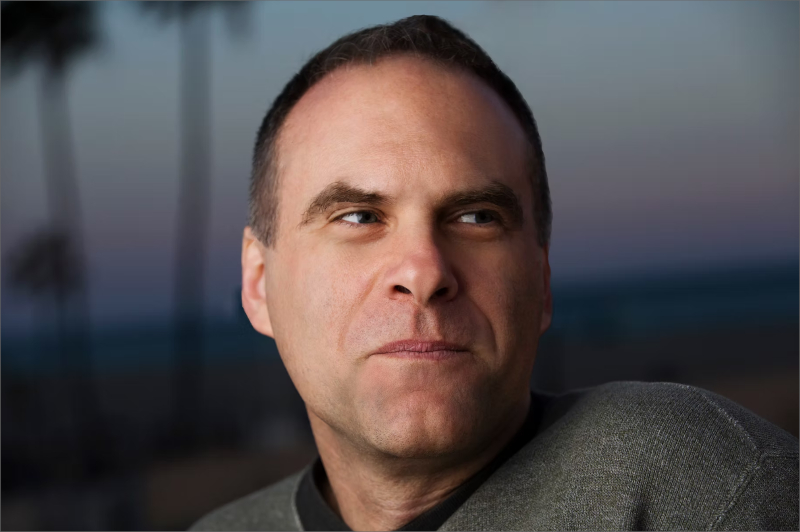
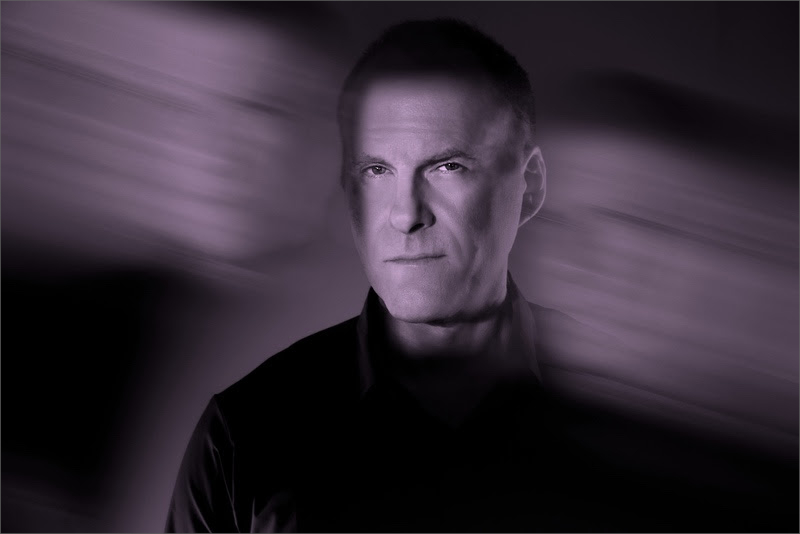
Dean De Benedictis is a Southern California-based artist who has always utilized his interest in a variety of styles and cultures to enrich the quality of his musical expression. He aspires to communicate a similar functionality for the experiences of his listeners. Deans’ music is the result of his will to tie an essential common thread together between opposing genres and mentalities, as well as draw from them a natural sense of emotion, expanse and mystery. Sound exposes psychological truth; stripping ordinary objects of their normal significance, to create a compelling image that is beyond ordinary formal organization, in order to evoke empathy from the listener, with a combination of the depictive, the abstract, and the psychological.
Driving into the complex, shape-shifting worlds that De Benedictis creates is always a magnificent adventure. He juxtaposes those frantic, glitchy granular textures against massive, cinematic spaces, sometimes he drops a rogue flute solo or harmonica right into a heavy electronic beat. It’s the kind of music that feels less like a collection of songs and more like a living, breathing, possibly dangerous ecosystem; De Benedictis has created an abstract, emotionally rich soundscape universe that rewards the listener.
“My Salvaging trilogy of albums was a sincere and perhaps far-flung attempt to tie a form of common thread between the periods of my life and the electronic music I never released during those periods. Naturally, the reoccurring concept and eventual theme of ‘salvaging time’ manifested into the project. I basically have boxes filled with music like this, built up through decades. As such, my Salvaging trilogy was only one of many projects with a similar goal – to salvage works of the past – but the Salvaging Trilogy itself might be my most qualitative among them.
“There are some very clear differences in style and approach contrasting each of these three albums, but it’s really the difference between the first album and the two albums following that one where the contrast is most visible. My first Salvaging album in 2005, Salvaging The Past, was a collection of work created throughout the ‘90s in my home studio, where I was surrounded by physical synthesizers and racks of outboard gear. Sometime between that album and the next one, Salvaging The Present, I acquired my first laptop and lots of appropriate software (more laptops would soon follow).
“This changed the game, and my life, in ways that I couldn’t have imagined years earlier. I was already a traveler and an outdoorsman, so suddenly having the power to virtually access an entire studio within a little portable box was very liberating, conceptually and literally. I ended up travelling far and wide with the music, albeit mostly within US borders, but still found myself creating spontaneous productions in some of America’s most extreme natural environments. Over a period of about a decade-and-a-half, I lived a separate little lifetime of fair adventure with these devices, even including some uncomfortable brushes with death.
“This spanned the length of both concurrent albums after the first one, I endured to keep creating through massive amounts of life changes and personal upheaval; through each new home I found, whether on-the-road or stationary; through broken alliances and rock-and-jazz-band breakups; through family drama and harddrive thefts and accidental overdoses, and of course a pandemic. Even through it all, my personal standard of innovation-balanced-by-emotional-sincerity never faltered, which probably explains the long lapses between Salvaging albums.
“My desire to musically attempt going where no man or woman had gone before, both sonically and musically, remained. Everything from my sound-design methods to my processing methods to my performing and editing methods, was all totally signature, through every twist and turn and every new resolution. I suppose that’s what’s most noticeable and even distinguishable about this last and final album of the trilogy, Salvaging The Future; it’s the one with the biggest complexities and most contrasting styles, because my desire for balance between cutting-edge method and emotional sincerity were still unwavering through even the most tumultuous period of my life.”
It is only natural, after all, to keep pace with scientific and industrial progress as well as follow the lure of pure psychic automatism, to stand for transforming the alienation which many people feel in the modern period, combined with the sense of reaching more deeply into the psyche, to be made whole with one’s individuality.
With the completion of this trilogy, we acknowledge our part as a remote viewer of Dean’s life over three decades. Salvaging The Future—perhaps more than the prior two albums—is a restless collage, yet it is so well mixed that it lends itself to uninterrupted full-album listening. This listener is tuning in about 2x per day at the moment. Despite the challenges these decades have wrought, the trilogy’s close with “Our Story Survives Collectively” leaves us with a sense of hope. This is music for visioning.
Salvaging The Future is available on Spotted Peccary Music. [Bandcamp]






![[2View] Nekomachi/no wonder • なるほど & tsubai/ilulissat (Perceptual Tapes)](https://igloomag.com/wp/wp-content/uploads/2026/10/nekomachi-no-wonder-tsubai-ilulissat-tapes_feat-75x75.jpg)