

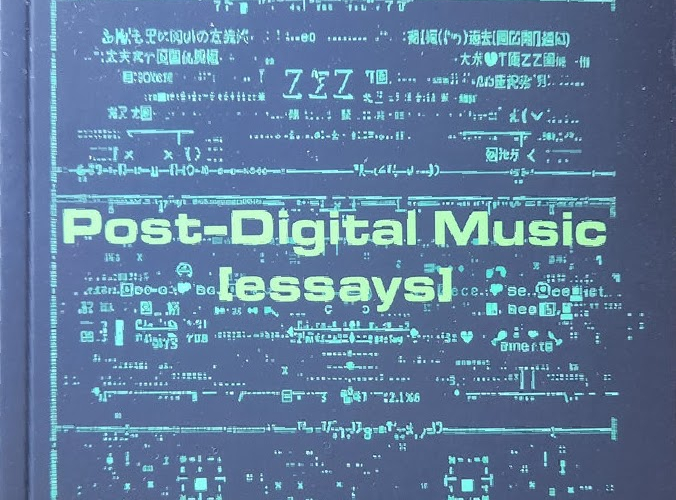

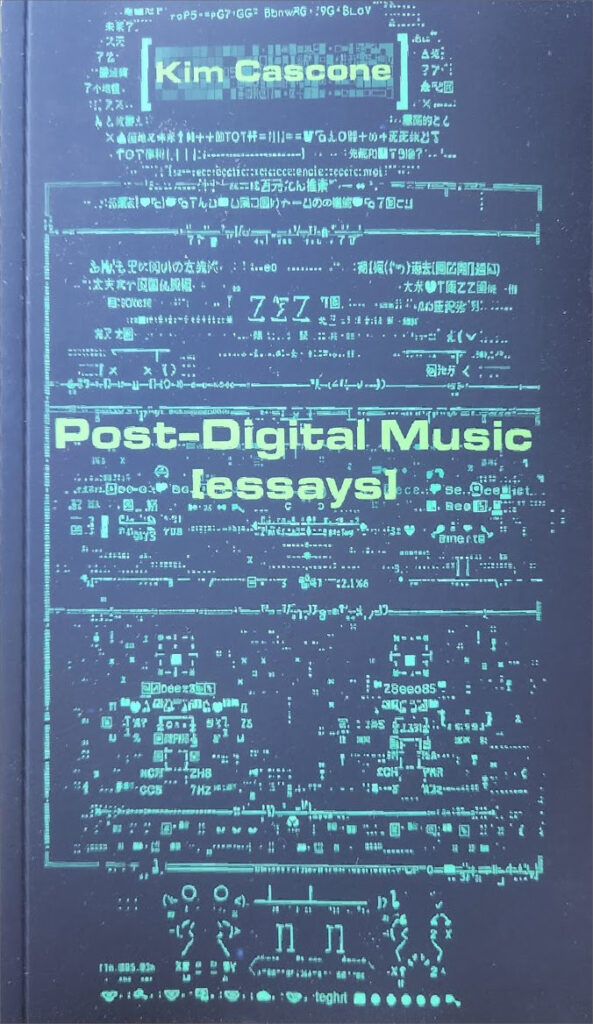
Kim Cascone’s book Post-Digital Music gives sound artists the conceptual thought tools that help open up connective valves between the unconscious and conscious minds, stimulating the growth of imagination. This collection of essays is also essential reading for the continued critical discourse around issues of electronic music production and reception.
Beyond knobs, plugins, and technique
Some books about music making take a very materialist approach. They look at sound as a purely physical phenomenon. They look at art making as just a matter of sliding the right dials and turning the right knobs (and they love to turn knobs). They ignore the subtle side of being a musician, the synchronistic clues that align to tell an artist they are on the right path of creation, the inner knowing of when to start on a certain project, when to halt on another one, and when it might be good to revive a work left behind. There are enough books that focus on the hardware and software of music making, even as they ignore the realware of imagination. Without imagination such tools mean little or nothing. Kim Cascone’s book Post-Digital Music gives sound artists the conceptual thought tools that help open up connective valves between the unconscious and conscious minds, stimulating the growth of imagination. This collection of essays is also essential reading for the continued critical discourse around issues of electronic music production and reception.
Electronic music isn’t about having a stylish set of tools, a modular set up that looks good on social media, or a digital studio with all the latest plugins. The tools won’t accomplish much without a musician who has grown what Goethe called “new organs of perception.” This is a phrase Cascone uses throughout his writing as a way to convey the necessity of training intuitive skills, skills at noticing the subtle, skills that can help an individual create pieces resonate with the interior life of their prospective audience, rather than just regurgitate shiny audio baubles whose sounds never reach beneath the surface.
None of this is to discount the training and skill set needed to develop as a musician, songwriter or composer on the material level, but it has been shown again and again that people without the traditional pedigree of talent and virtuosity can make compelling music, while the works of virtuoso’s can be lifeless and boring. Technical chops are only half the battle. If it was all about technique, Hollywood movies would be a lot better than they are and so-called B-Films from the past would suck, but I’ve found the opposite to be true.
A mind and spirit keyed in to the imaginative side of the world allows an artist in any medium to tune their own subtle senses to act as antennae for incoming seeds and ideas. Once transmuted those seeds can then be recast into the field of cultural life. The eighteen essays collected in Post-Digital Music act as a corrective to the material focus prevalent in so much of electronic music discourse over the past several decades.
The essays themselves span the years 1999 to 2026 and show the evolution of Cascone’s mature thought. Many of these pieces have been around in various publications and posted online, and I had read a good chunk of them over the years before this slim volume arrived. It’s nice to have them collected all in one place, and the book can easily be tucked into a laptop bag or backpack to peruse between setting up for different gigs, recording sessions or any other time when an injection of deep thought or intellectual stimulation is required.
Issues that Cascone brings up in the first short essay, “Residualism,” crop up throughout the work and are looked at from different angles all the way to the last essay “0’00” and Vertical Time.” And while they are organized sequentially in the order they were written, I have found that there are about three main topics, along with various interrelated subfields, that the essays flock and organize themselves around.
The first of these topics, and a major overarching theme of his work in general is one many people are afraid to look at: failure. Cascone looks at “The Aesthetics of Failure,” ruminates on “Modulating the Boundaries of Failure” and pokes around into the possibility of failure as a window from which the future leaks out in “Errormancy: Glitch as Divination.” After a few decades of thinking about failure, and working with it in artistic computer music, he still hadn’t extracted or unpacked all that could be gleaned from its study. He included an interview titled “The Failure of Failure,” which goes beyond the notion of working with software at the edges of their prescribed ability, and takes a critical look at the failure of experimental music and art to glitch out the larger system of society.
Perhaps the failure of these genres and subgenres within electronic music to change things in larger society also relates to the continued problems around performing electronic music. His essay “Laptop Music” traces the issues around live electronic music performance, specifically with computers, and it remains just as pertinent as it was when it was written in 2004. He quickly delineates the history of different kinds of music performance in the west, showing how the placing of electronic musicians on stages, and the audience in seats, as in your typical theater situation, upsets our notions of what a music performance is and should be.
By way of example, I had the opportunity to see William Basinski earlier this year, and he played in a theater. He was on the stage with a tape loop, a laptop and a mixing board. I was very happy to hear this music done live, and I sat with my eyes closed for most of the show as the sounds washed over me at volumes levels I would never breach at home. When I didn’t have my eyes closed, I mostly paid attention to his video projections. His adjustments of the mixing board, computer, and loop were all very understated, and the video was in many respects its own kind of visual drone. Yet even as a fan of him, and even as someone who has played electronic music live myself with laptops and other knobby gear, the expectation around of musical performance as a kind of visual spectacle of virtuosity remain in place.
As Cascone put it, “The laptop musician is conceived as a medium conducting a séance, whose tricks of table knocks, wall rapping and spectral voices broadcast from nowhere are orchestrated to feign the effect of authenticity where none really exists. Thus the cultural artifact produced by the laptop musician is deemed a counterfeit, leaving the audience unable to determine a use-value.” There still has not been much a “recuperation of codes that move away from the use of spectacle, that establish aura, and show the audience how to differentiate ‘representation by the machine’ from ‘repetition of the machine.’” Many in the audience relied on the aura of expectation created by Basinski’s albums in the live setting, or on his comedic pre and post show banter as a way to come away from the evening feeling satisfied.
“The laptop musician is conceived as a medium conducting a séance, whose tricks of table knocks, wall rapping and spectral voices broadcast from nowhere are orchestrated to feign the effect of authenticity where none really exists. Thus the cultural artifact produced by the laptop musician is deemed a counterfeit, leaving the audience unable to determine a use-value.” ~Kim Cascone
The other early essays remain just as relevant. The issues Cascone raised, now decades ago, are still with us. Sometimes there has been a bit of mutation along the fringes of the field, but where things have remained static, the major points are still at play. It must be remembered that electronic music is still very young as an art. The post-digital is even younger with its general focus on computer music.
Perhaps a definition of just what Cascone means by Post-Digital is in order. In “Residualism” he talks about how Post-Digital music making is about the “deconstruction of audio by manipulating the prima materia itself” and how this has led to the recognition of the aesthetic value of sonic artifacts that were previously considered to be in the background. The art becomes a matter of subtracting information until only residues are left behind. While this simplifies the theoretical basis Cascone lays out, this approach and its aesthetic ramifications can be considered another core theme of the book. Because those artifacts had often been generated by pushing technology and software to the breaking point, is one of the reasons behind his intense focus failure, and how it can be a gateway into new forms of aesthetics.
Another theme that emerges is a trinity around music, metaphysics and imagination. There is spiritual substance in the book, and in the works created by artists who are tuned in to the subtle fields. Essays in this grouping of include “Subtle Listening,” a text based on the workshops Cascone used to give. (These differ in form and substance from Pauline Oliveros’ work with Deep Listening, though I see the two as complimentary.) He also explores the metaphysical side in pieces such as “The Avantgarde as Aeromancy” and “The Transcenditial Imagination.” Other pieces such as “Organs of Subtle Perception” and “Imagination, Idea, Will, Manifestation” get to some of the core precepts around his percepts.
His essay on aeromancy written in 2013 reflects on the artists relationship to time. Over on the blog at the Silent Records Bandcamp page, Cascone continues to write about time, about the hyper-present and how the effects of the simulacra and our immersion in online worlds pushes us into a vertical experience of time. He distinguishes this sense of verticality, of being removed from the clock-a-day world of linear horizontal time, from the kind of natural verticality we experience in moments of creative flow and time spent outside in nature.
For the artist working on the horizons, at the boundaries, these distinctions are important for the work of tuning into the subtle senses and fishing for big ideas.
In the essay he writes, “The past has become embedded in the future, reducing what we experience as ‘the present’ or ‘now’ -as simulacra, a plastic bauble bouncing upon the infinitesimal fulcrum where two streams intersect. One beckons from the past, the other seduces from the future. The plastic bauble of ‘now’ is all that exists today. All of time is trapped inside of it, containing a chimeric environment constructed from a trick of light, a sleight of hand, a conflation of nostalgic past with a tantalizing future.” And he continues with this salient advice: “For a real avant-garde to exist -again- we need to reestablish a ‘long-view’ perspective, recover from our collective amnesia, and locate ourselves in the larger historical landscape. By moving outside the manufactured environment and allowing the stream of time full passage through our psyches, we can return to an intuitive process of artistic divination.”
“Like the artist, the audience also needs to be able to open the valve to the unconscious. Digital media in its current incarnation works as a firehose blasting the senses. Overstimulation is part of the issue. To tune in, sometimes the first step isn’t turning on, but turning off.” ~Justin Patrick Moore
Now we are even more in the blurspace of the simulacra than we were in 2013. For those of us who wish to see such a return of the avant-garde as Cascone does we need to take regular time for reflection. If one of the tasks of the artist is to give reflection back, gestation periods are necessary, as is frequent time spent outside the outer focused hyper-present world, and inside the inner focused world of imagination. What bubbles inside the cauldron of a new avant-garde may take time to brew. In the world of outer of immediate action where each new piece and release vies for attention with the rest, the long term view tends to get shunted off and replaced by short term commodification, i.e. the market forces that cultivate the hyper-present simulacra for their own harvest. The larger gains that come from time spent swimming in the reflecting pool of imagination are not as apparent, not as immediate, but the long term effects could be much larger than those produced by the shiny baubles of momentary attention.
For every force there is a field, and for the final grouping of general ideas I see in this book is the cluster around these words: aura, grain, and field. Field recordings have been at the heart of many approaches to electronic music for quite some time starting with the academic part of the tradition. Following the explosion of electronica, ambient, and then the plethora of interconnected subgenres, many electronicists began employing field recordings as a way to lend their pieces an organic integrity they sometimes lacked when based purely on digital sources. Ideas around the use of field recordings, and what a field actually is, all get explored at a deep theoretical level that is often missing elsewhere in the discourse.
Along the way we get to learn about Cybernetics and Systems Theory (always fun and always essential) as well as flocks and the swarming behavior of genres, and how they form. All of these subjects tend to get woven into each other, one area emphasized here, another there. Reading them together, it is hard not to feel the desire to get creative. The intellectual stimulation gives me the desire to put more critical imagination into the work of making electronic music and the conversations around the field.
Perhaps the greatest advice to the aspiring artist included in the book is to “lessen ones dependence on digital tools” and his admonition, via Werner Herzog, to “Read, read, read…” he suggests that composers be “voracious readers and keep a physical notebook of ideas and projects. By relying less on digital tools you will gain a valuable context for your work.”
That in itself is very much another kind of Post-Digital framework.
As the book began with focusing perceptions on the boundaries and edges in “Residualism,, so it ends with a piece focusing on one of the great Zen koans John Cage left behind in the form of a musical composition. It is a seldom talked about piece of music that he wrote, 0”00”. It is a work that has no duration, and in many ways, it only exists in the mind. By going back to this ground zero, we are left in a kind of recursive mobius strip, zeroing back in on zero itself. Cascone again cautions against getting too caught up in the speed race of digital acceleration. He also reminds us that the collective suite of digital tools that now exist to make things by command, i.e., AI, while in some ways resembling the chance operations and recombinatorial procedures of the earlier avant-garde expemplified by John Cage, do not in fact resemble the actual facts of his work. Cage did his chance operations in a slowed down way. His use of the I Ching was part of a contemplative artistic process, not just punching in commands at a whim.
As such, until we can regain our composure and pull ourselves away from the immersive grip of the hyperattentive state induced by the constant influx of media and data made possible by what Cascone has often called McGovCorp, it will remain difficult for sophisticated artworks in any medium to find a receptive audience.
Like the artist, the audience also needs to be able to open the valve to the unconscious. Digital media in its current incarnation works as a firehose blasting the senses. Overstimulation is part of the issue. To tune in, sometimes the first step isn’t turning on, but turning off.
Post-Digital Music (Essays) is available on Silent Records. [Bandcamp]