






Ultimately, Arrows of Time serves as a thoughtful reminder that artistic limitations often produce the most compelling results. By reducing options, 1981OCTOBER5 expands expression. By rejecting excessive processing, the artist uncovers remarkable warmth and intimacy.

A series of captured moments suspended in magnetic tape
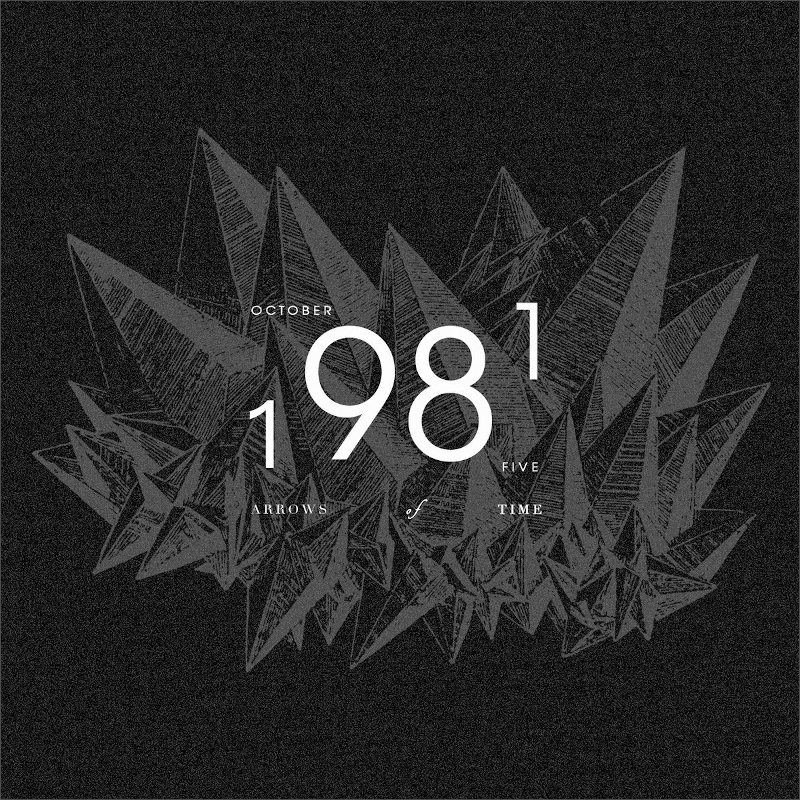
There is something quietly radical about choosing limitation in an era defined by limitless possibility. While modern production offers endless tracks, infinite editing, and pristine digital precision, 1981OCTOBER5 deliberately walks in the opposite direction on Arrows of Time. Rather than embracing technological abundance, the artist strips the creative process down to instinct, texture, and immediacy. The result is an intimate and remarkably human collection of recordings that feels less like a carefully engineered product and more like a series of captured moments suspended in magnetic tape.
The philosophy behind Arrows of Time is refreshingly simple. Each composition on the first side adheres to a self-imposed “rule of three,” employing no more than three synthesizers, three recording tracks, and three effects consisting of tape, reverb, and delay. It is an approach that values commitment over correction. Without compression, corrective EQ, or extensive post-production manipulation, every sonic decision must happen at the source. Filters become equalizers. Performance replaces editing. Tape contributes its own hiss, saturation, and imperfections rather than having them removed.
These constraints never feel restrictive. Instead, they become the album’s greatest strength.

There is an honesty throughout Arrows of Time that is increasingly rare within electronic music. Every synthesizer line carries the subtle imperfections of live performance. Small fluctuations in timing, slight changes in filter movement, and the natural instability of analog equipment become expressive elements rather than problems to solve. The music breathes because nothing has been polished into submission.
Texture is unquestionably the central voice of this cassette. Layers of analog warmth, soft distortion, tape saturation, and mechanical noise intertwine to create environments that feel wonderfully tactile. Rather than presenting immaculate synthesizer tones, 1981OCTOBER5 allows circuitry and recording media to reveal their own personalities. Hiss becomes atmosphere. Saturation becomes emotional weight. The occasional rough edge serves as a reminder that these sounds exist in physical space rather than inside perfectly quantized software sessions.
“Rhythms drift naturally, phrases expand and contract almost imperceptibly, and sequences evolve according to instinct rather than mathematical precision.” ~Don Haugen
The decision to avoid working to the grid gives the music an equally compelling sense of freedom. Rhythms drift naturally, phrases expand and contract almost imperceptibly, and sequences evolve according to instinct rather than mathematical precision. There is an organic pulse that recalls the earliest days of electronic experimentation, when musicians interacted directly with machines instead of forcing machines to conform to rigid timelines. The performances possess an almost conversational quality, as though each synthesizer is responding intuitively to the others in real time.
What makes Arrows of Time particularly engaging is its emotional restraint. The record never reaches for dramatic crescendos or overwhelming density. Instead, it allows subtle changes in timbre, harmony, and repetition to carry the emotional narrative. Small shifts become significant. A slowly opening filter, a delay trail dissolving into tape hiss, or a gently evolving sequence can completely transform the atmosphere without announcing itself. It rewards careful listening, revealing additional layers of detail with each return.
Hiss becomes atmosphere. Saturation becomes emotional weight ::
There is also a remarkable confidence in the album’s pacing. Silence and negative space are treated with the same importance as sound itself. Individual notes linger long enough to expose their harmonic complexity, while reverb and delay create lingering shadows that continue long after the original source has disappeared. The cassette format feels especially appropriate here, reinforcing the album’s tactile identity and encouraging uninterrupted listening from beginning to end.
One of the most admirable qualities of Arrows of Time is its refusal to confuse complexity with depth. The limited instrumentation encourages thoughtful composition rather than technical excess. Every element feels essential because there is simply no room for unnecessary decoration. This economy of means gives the music a quiet elegance. Nothing feels rushed, overcrowded, or overwritten.
Listeners familiar with analog synthesis will appreciate the album’s commitment to preserving the character of both instrument and recording medium. It uses classic techniques to pursue timeless emotional expression rather than retro aesthetics. The recording embraces imperfections because those imperfections communicate authenticity. The tape hiss, subtle saturation, and unpredictable behavior of analog hardware become active participants in the music rather than artifacts to eliminate.
“1981OCTOBER5 delivers a cassette that feels both timeless and deeply personal, proving that sometimes the most direct path remains the most rewarding one.” ~Don Haugen
Ultimately, Arrows of Time serves as a thoughtful reminder that artistic limitations often produce the most compelling results. By reducing options, 1981OCTOBER5 expands expression. By rejecting excessive processing, the artist uncovers remarkable warmth and intimacy. By trusting instinct over perfection, these recordings capture something increasingly elusive in contemporary electronic music: genuine presence.
Arrows of Time is a beautifully realized work of analog minimalism, where simplicity becomes depth and texture becomes narrative. It invites listeners to slow down, embrace imperfection, and rediscover the quiet power of sound created with intention rather than abundance. In doing so, 1981OCTOBER5 delivers a cassette that feels both timeless and deeply personal, proving that sometimes the most direct path remains the most rewarding one.

Arrows of Time is available on Bandcamp.