



While continuing the legacy and wholly unique style introduced in Nekkuja and in 2022’s breakthrough Pripyat (both released on PAN), Dja Dja, her first self-released album, sees a much stronger architecture and development: almost double the length of its predecessors, the album is configured as an epic, and directly inspired by the monomyth of the hero’s journey.
A glorious and visionary testament to the power of craft, dedication over time and trust in the process
At impact, Marina Herlop’s music can be dazzling. But rather than not having much to hold on to and being stranded in an alienating landscape, which is often the case for avant-garde music, the cause of the listener’s surprise is an embarrassment of riches: each component is beautifully shiny, and if your attention is caught by the rhythmic and polyrhythmic elements, it might soon be led astray by a gorgeous melody or a vocal run, or arrested at the interaction of the instruments in their baroque arrangement, or brought back in time by an unexpected refrain. This is most obvious in Dja Dja, Herlop’s new record since 2023’s Nekkuja. While continuing the legacy and wholly unique style introduced in Nekkuja and in 2022’s breakthrough Pripyat (both released on PAN), Dja Dja, her first self-released album, sees a much stronger architecture and development: almost double the length of its predecessors, the album is configured as an epic, and directly inspired by the monomyth of the hero’s journey.
Like in the best of epics, opener “Flor” introduces the tropes of the tale: the quintuplets which establish themselves as one of the most important meters in the album, the dyads quickly descending in parallel by a semitone—one of the compositional features of lead single “Jaque,”—but also “Vas volant”’s main theme, a quasi Bacchae call, a melody of three ascending triplets heralded by flutes and later strenuously sung at the climax of “Los dos lobos” and wistfully in “Average Evil”… Listing all these correspondences and their shapeshifting reappearances in different instruments, speeds, transpositions is beyond the scope of this review (although it would make a great chapter in a musicology dissertation), but even with a less analytical mode of listening they lend the album an intuitive and web-like structure which often becomes even visual: in “ツラ” a counterpoint of ambiguous chirps, whistles, vocals and birds transports the listener straight into an airy jungle (the track seems to sample the same birds as in Björk’s Utopia, one of very few albums that might come to mind listening to Dja Dja), and at the end of “Los dos lobos” a shot, tinnitus tone and heavily filtered vocals will plunge them into the abyss at the aphelion of the journey. These diegetic elements do not mean that the album is soundtrack-like, on the contrary they showcase music’s own narrative powers unaided by other media.

Bigger than life, evading the frame ::
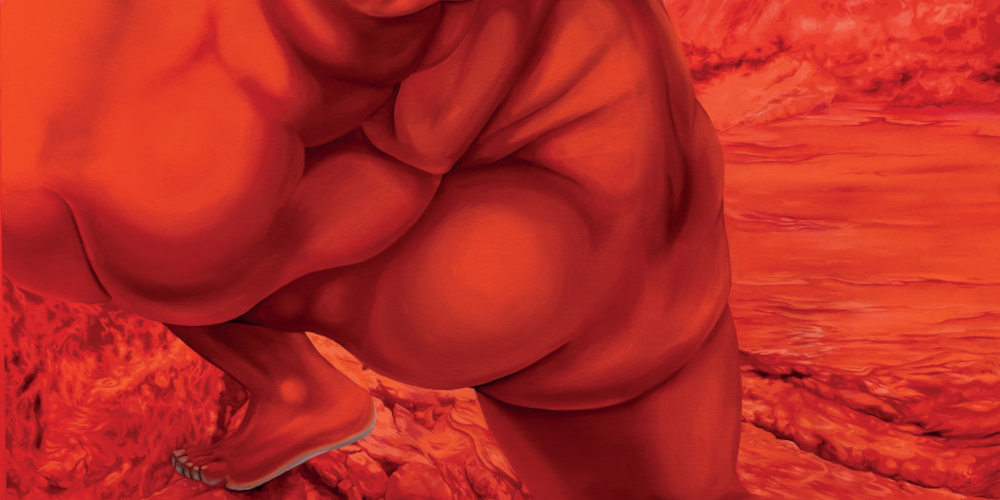
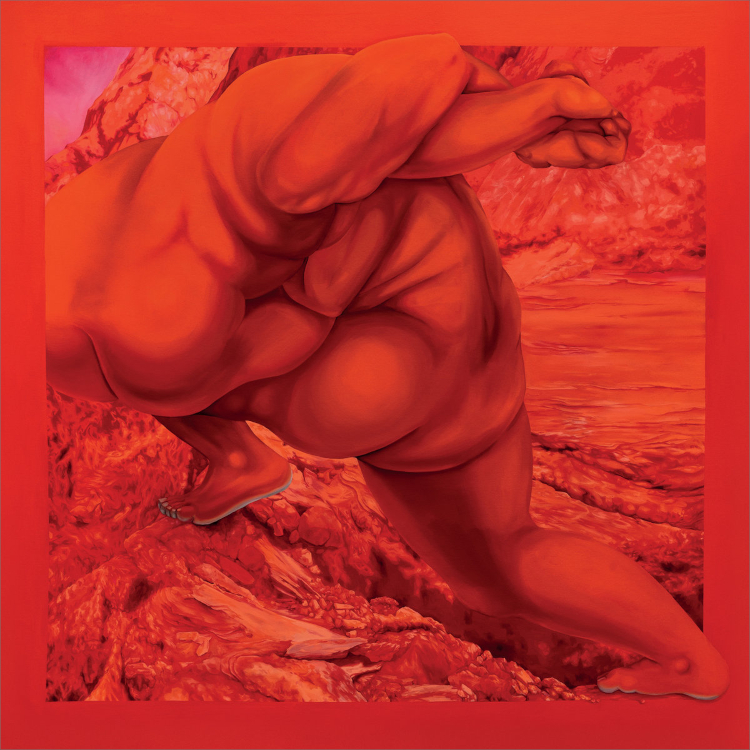
The Hero’s Journey, which served as the initial scaffold to structure the record, describes the chronicle of a hero receiving a call and leaving the world to enter a supernatural realm and, challenged by hardships and temptations, emerging victorious and transformed from the adventure, to bestow a newly found knowledge upon their people. It’s obvious that in Dja Dja a lot of these archetypal roles are taken by Music itself: music is the call, the superhuman force, the toil that one needs to master as well as the newfound power. The cadmium red of the cover painting (“Naomi and Ruth: The Weight of a Curse” by Brittney Leeanne Williams) exemplifies this superbly—a mass of muscle vigorously climbs a hill, its arm somehow twisting and embracing itself, bigger than life, evading the frame. Likewise, this music is urgent, forceful, intensely physical but metaphysical in effect, abstract and symbolic. Vocals are omnipresent and span an impressive range of styles, but the lyrics are sparse and phonetic, and when they come through, they are both tautological and revelatory: “júrame que cantan” goes the refrain of “Bliss”—“promise me they sing,” before a Hammond-led crescendo climaxes in one of the record’s most emotional moments.
If you followed Marina Herlop in the years leading up to this release, you’d probably know the extent of practice and art the album took – from piano technique, to castanets, to purely polyrhythmic and compositional exercise. Everything about Dja Dja is studied in the finest details, and crafted to perfection at all stages—each track is a brilliant composition in its own and, at the same time, synergistic with its surroundings and in its context, making the album greater than the sum of its parts, the allegorical and conceptual framework comes through naturally and unmistakably rather than overshadowing the music, every arrangement is designed to convey a celebratory maximalism while making the single elements shine, the performance is precise and visceral. In an age of shortcuts, Dja Dja is a glorious and visionary testament to the power of craft, dedication over time and trust in the process.
Dja Dja is available on Bandcamp.