



Giulio Aldinucci has made an album that seems acquainted with the unnamed part of human nature, the part that surfaces in sleep or in the few seconds before news capable of changing the course of a day.
Rhythm is felt through changes in pressure
At first there is weight. A quiet, almost geological pressure that arrives before recognition, touching the body before it reaches the mind. Materia begins in that dark place. Sound has volume, temperature, even something resembling a will of its own. It advances slowly and alters the scale of things, like a sudden bank of fog moving in. Sight loses its authority and the ear becomes a larger organ. Giulio Aldinucci has made an album that seems acquainted with the unnamed part of human nature, the part that surfaces in sleep or in the few seconds before news capable of changing the course of a day.
The composer, born in Siena, Tuscany, reaches this point after years devoted to landscape, memory and the voice stripped of semantic meaning. The experience developed under the name Obsil and the chapter that began with Tarsia have shaped a coherent body of work, nourished by field recordings, choral presences and electronic transformations. Borders And Ruins examined the nature of territory; Disappearing In A Mirror and Shards Of Distant Times shifted the tension towards identity and memory; Real sought a personal reality within the excess of digital mediation. Materia, Aldinucci’s fifth album for Karlrecords, condenses that history into an essential gesture: taking a tightly packed mass of sound, carving into it, paring it back and searching for what is already alive inside. The album was released on September 18, 2026.
Here accumulation and subtraction become emotional acts. Aldinucci gathers frequencies as scattered memories might be gathered after years apart, then removes the excess and listens into the space left behind by what has disappeared. Time, too, acquires substance. It is broken into minute units and reassembled according to an order that escapes the familiar pulse. Rhythm is felt through changes in pressure, through inner tides, through the way a distant voice rises from the haze and immediately loses its face. These are slow movements filled with secret life. Their apparent stillness is alive with motion.
The six pieces form a single body lasting just under 43 minutes. Density remains the active principle, capable of changing state while retaining its gravity. The depths below sustain the journey with a telluric continuity. Above them appear distorted choirs, echoes, drifting particles and sounds that preserve a human trace after language and origin have fallen away. The titles sketch a constellation of absence: “Not Here,” the shadow cast by noise, ash and distant waves, the absolute finality of “Never,” evening, then light caught in a dream. The music receives these images and preserves their indeterminacy. Each one works within the act of listening, removed from plot and close to the freedom of involuntary association.
“Materia finds its human center here. The album’s grandeur springs from this dizzying proportion: an immense sound holds a tiny gesture, perhaps a mouth drawing breath, perhaps a syllable worn away by time.” ~Mirco Salvadori
The voice is central. It rises like a collective memory without face or biography, suspended between comfort and alarm. At times it resembles someone calling across an immense distance; elsewhere it takes on the substance of a thought formed in the body before words. Aldinucci understands the power of vocal fragments and frees them from any narrative duty. What remains is breath, impulse, a tremor that reminds the listener of human fragility. Materia finds its human center here. The album’s grandeur springs from this dizzying proportion: an immense sound holds a tiny gesture, perhaps a mouth drawing breath, perhaps a syllable worn away by time.
“Come Luce, In Sogno,” chosen as the advance single, offers a discreet way into the album. The light invoked by its title contains dust and density. It filters through opaque layers and produces figures already moving towards dissolution. Dreaming becomes a mode of knowledge. A detail can expand until it fills the entire field of perception, while an enormous event contracts into a brief vibration. This instability runs through the whole work. Time seems to lengthen; then an almost imperceptible shift alters the landscape. Sound retains warmth and a question that has yet to find words.
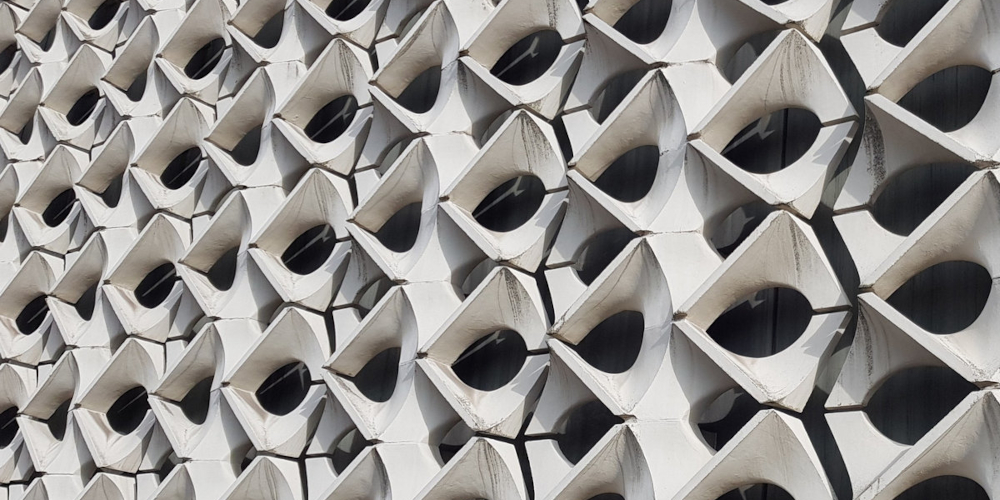
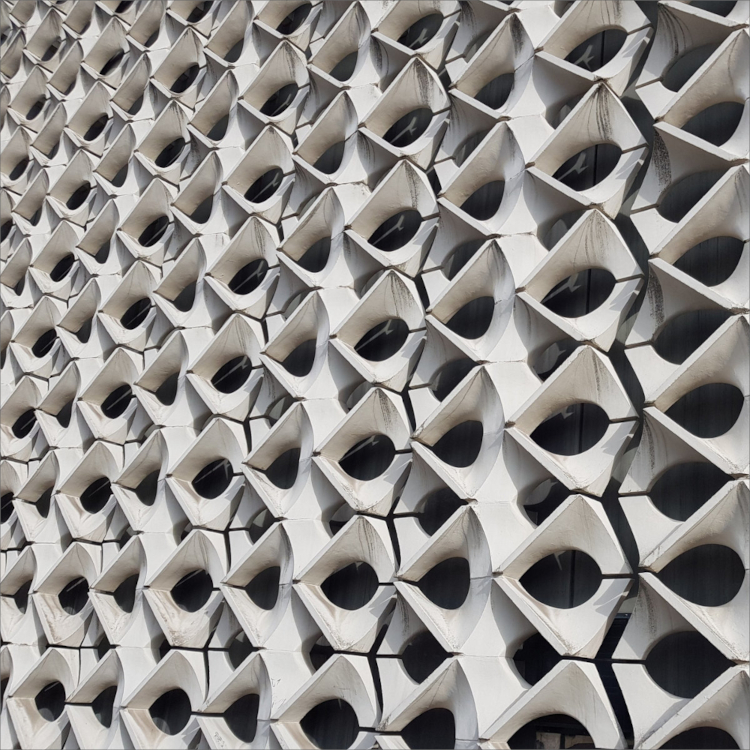
The cover helps reveal the character of the work. A white façade multiplies concave modules, dark openings and curves that look identical only at a glance. The eye finds order, then differences, shadows, stains and minor signs of wear. It is a serial form made vulnerable by time and by the material from which it is built. Aldinucci’s music behaves in much the same way. It turns repetition into change, raises immense structures and allows irregularity to bring them alive. Each surface hints at another depth. No answer comes. The desire to look again grows stronger.
The concentration of the sound demands complete attention. A moment’s distraction can break the spell, and some passages deliberately court saturation. This is an exacting choice. Materia requires time, an appropriate volume and a measure of solitude. In return it offers a rare experience, moving listening beyond taste and into consciousness. Its forms entrust their appeal to a slower force, like the memory of a place never visited. There is familiarity and a faint fear. The unknown takes on an intimate temperature.
“Sound appears as something that precedes its maker and continues beyond its listener, bound to the same matter as bodies, air and thought.” ~Mirco Salvadori
Throughout Aldinucci’s career, recording the world has carried the value of a living archive. A landscape could hold a story; a procession could deliver into the present voices already receding into the distance; an ordinary noise could open a passage through perception. Materia brings this practice close to an elemental dimension. Here substance comes before place and contact before narrative. Sound appears as something that precedes its maker and continues beyond its listener, bound to the same matter as bodies, air and thought.
This is where its power lies. The album speaks of the human condition through feeling. The need to give chaos a shape meets the fascination of whatever resists a final form. Every cut removes part of the original mass; subtraction reveals an unforeseen outline. The music breathes between these impulses, tightens, withdraws and fills out again. At times it seems about to disclose something. Then that something changes substance and becomes pure listening.
Materia is expansive, gathered into a fierce intensity and charged with physical mystery. Giulio Aldinucci reaches one of the most mature expressions of his artistic language and gives contemporary ambient music an album with moral as well as sonic weight. When the final vibration ends, silence feels altered, thicker, almost conscious. Within that silence passes an intuition that cannot quite be held: perhaps the human spirit is precisely this restless substance, seeking form while knowing that every form is temporary. For just under 43 minutes, Materia gives it a body and lets it sing.
Materia is available on Karlrecords. [Bandcamp]