




EPROM‘s Memory Rites distills his unmistakable approach to sound design into an accessible new plugin format, giving producers a direct entry point into one of electronic music’s most influential sonic worlds.
Everything accessible, nothing buried
EPROM‘s stage name comes from the EPROM memory chip—the erasable programmable read-only memory component used by Oberheim Electronics in their early synthesizers. That’s not an accident. Alexander Dennis, the Portland-based producer who’s spent over a decade building one of experimental bass music’s most distinctive sound libraries, has always treated synthesis as archaeology, digging into the memory of machines, pulling out sounds that feel borrowed from a dystopian future or a corrupted past. His 2012 debut Metahuman on Rwina Records announced a producer obsessed with deep sub-bass and deliberate silence. His 2023 album Syntheism leaned closer to Squarepusher-influenced drill and bass. His collaborations with Alix Perez as SHADES and his ongoing acid work with G Jones have solidified a reputation for sound design that is maximalist in ambition and surgical in execution. Fans include Flying Lotus, DJ Shadow, and Questlove—a telling mix that speaks to how far his influence crosses genre lines. He describes his music as “digital dysphoria propelled by dreams of a dead pixel billboard sky.” That description matters when you load up Memory Rites.
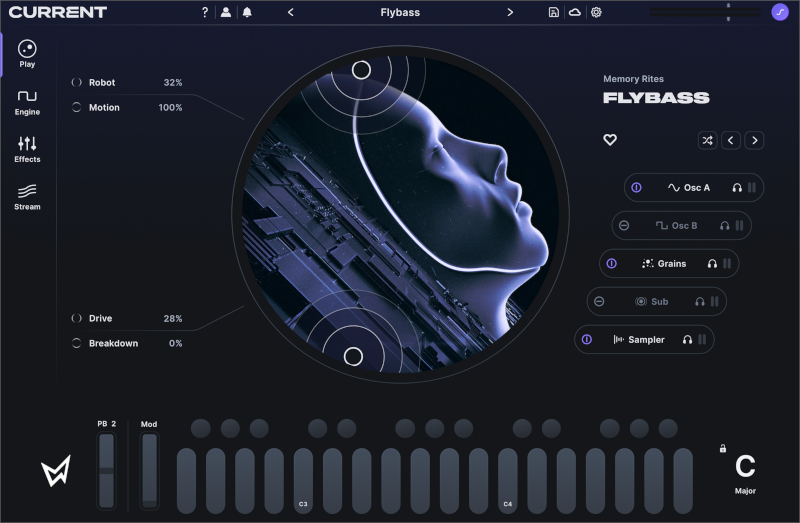
Memory Rites is a collaboration between EPROM and Minimal Audio, the plugin developer behind Current, a flagship synthesizer built around five parallel synthesis engines including dual spectral wavetable oscillators, a granular synthesizer, an additive sub-engine, and a time-stretching sampler. The release serves two purposes simultaneously. It delivers 60 hand-designed EPROM patches built inside Current, and it debuts the Current Expansion Player, a new plugin format that lets producers access artist-built Current expansions without owning the full synthesizer. That second part is the more significant development from a product strategy standpoint. Current is a deep, powerful, and expensive instrument. The Expansion Player breaks the gate down. For $29, producers get the dedicated plugin with EPROM‘s full patch library loaded and ready. Existing Current owners can pull the same presets for $19. The “CURRENT PLAYER COLLAB · 001” designation in the interface header is worth noting, this isn’t a one-off. Minimal Audio is building a series here, and EPROM is the inaugural collaborator. That choice communicates exactly what kind of territory this format intends to occupy.
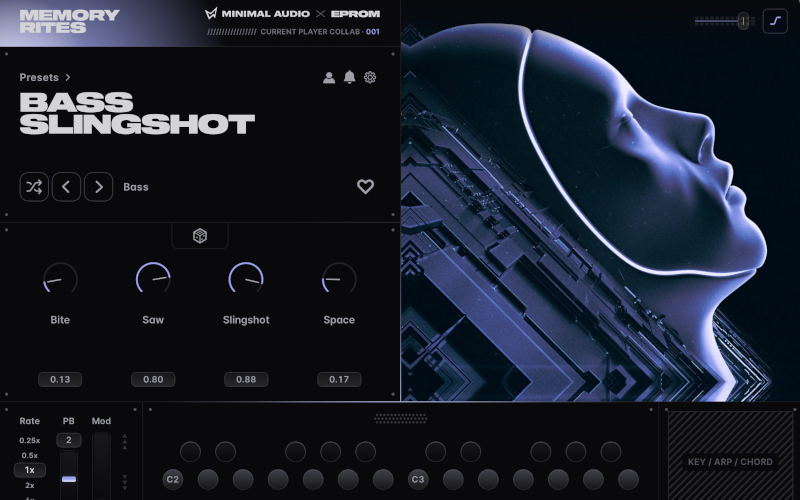
The interface itself is clean, dark, and minimal, which is exactly what it should be. A large animated 3D face occupies the right panel, rendered in deep blue light against architectural geometry. It reacts to note input, subtle movements tracking what you play. It’s not a gimmick, it gives the plugin a sense of presence while you’re working, something that responds rather than just sits there. The branding is sharp: “MEMORY RITES” top left, the Minimal Audio × EPROM header, the “001” designation. The layout is split clearly between the preset panel on the left and a keyboard with KEY/ARP/CHORD controls at the bottom. Global controls for Rate (0.25x through 4x), Pitch Bend, and Mod sit in the lower left. An output limiter lives in the top right. Everything accessible, nothing buried.
Sound design, reimagined accessibly ::
The 60 presets break down as follows: 25 bass, 14 lead, 9 pad, 6 keys, 6 SFX. The bass library is the largest and the strongest category in the pack—which makes complete sense given EPROM‘s background. Each preset loads with four macro knobs mapped by EPROM himself, and this is where the design philosophy of the Expansion Player becomes most apparent. The knob names aren’t generic. They’re not Filter, Cutoff, Resonance, Release. They’re Growl Freq, Fifth, Tail, Growl on “Eight Oh Style.” They’re Zaps, Animation, Speed, Delay on “Laser Keys.” They’re Fx, Open, Data, Breakdown on “Detroit Data.” The year-range knob “1980-2020” on “Aquabahn Speed Limit” is the most interesting UI decision in the entire pack—what it’s actually doing is functioning as a lo-fi degradation dial, a bitcrusher that sweeps through decades of sonic texture from warm analog through digital grit. Calling it “1980-2020” instead of “Bitcrush” is a creative decision that communicates the intent immediately without requiring technical knowledge. That’s a producer making design choices, not an engineer labeling parameters.
The four-knob-per-preset system will feel limited to experienced synthesists who want granular control over oscillator shaping, modulation routing, filter topology, and envelope behavior. That’s a legitimate critique. Current owners get around it by opening the presets inside the full instrument where the underlying architecture is fully exposed. For Expansion Player users, the four macros are the instrument. But that limitation is also a deliberate accessibility decision, one that actually makes sense for how most producers interact with presets in a production session. You’re not rebuilding the patch from scratch. You’re performing it, shaping it in real time, finding where it sits in your track. Four well-named, intelligently mapped macros cover that use case well. The pitch bend range is set to two semitones by default, which is playable and expressive. The rate multiplier (0.25x to 4x) adds movement and tempo-sync options for the patches that already have internal modulation baked in. Most of the stronger presets, particularly across the bass and lead categories—have motion already built into them. They evolve as you hold notes rather than sitting static until you touch a knob.
The “Aquabahn Speed Limit” preset is the immediate standout in the keys category, a detailed, moving sound with the R+7, Fx mix, Crush, and 1980-2020 knobs giving you enough range to take it from clean and present to heavily degraded without the patch losing its identity. “Eight Oh Style” in the bass category demonstrates exactly what EPROM‘s sound design vocabulary looks like under the hood, that growl frequency control sits in a range that’s distinctly his, aggressive without being blunt, weighted without losing articulation. “Detroit Data” carries a different character, grittier, more industrial, the “Breakdown” knob pushing it toward the kind of texture that would sit inside a Shades production rather than a solo EPROM bass track.
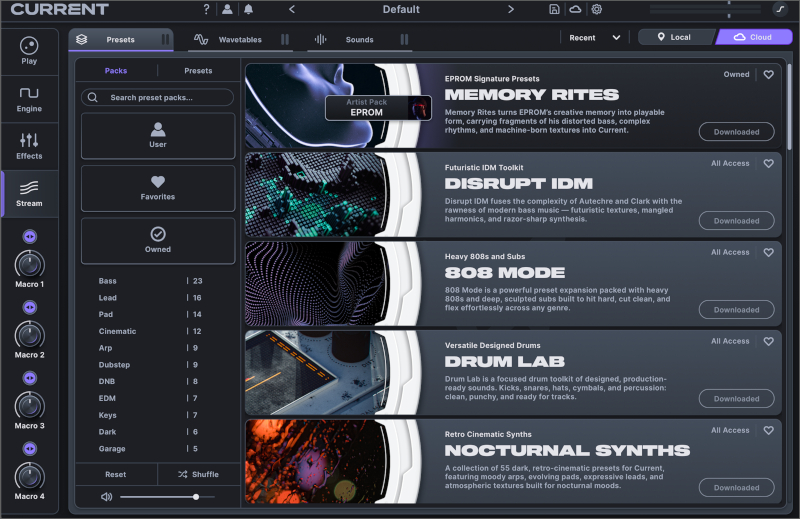
Memory Rites redefines artist presets ::
The honest limitation of Memory Rites is that 60 presets, filtered through four macro controls each, gives you a specific range of EPROM‘s sound design rather than the full breadth of it. Producers who’ve spent time inside the Shades catalog or Syntheism will recognize the DNA but may notice the absence of the more extreme textures—the genuinely broken, barely-functional sound design that characterizes his most experimental work. What Memory Rites delivers is the accessible, playable version of EPROM‘s vocabulary, optimized for production use rather than pure experimentation. That’s not a failure, it’s a different tool than a Reaktor patch or a modular system, and it’s honest about what it is.
For producers working in bass music, experimental electronic, or any genre where heavy sub-bass architecture and evolving spectral textures matter, Memory Rites delivers immediately usable material that sounds distinctly like its creator. For first-time producers, the named macros and reactive interface lower the entry barrier without dumbing down the sounds underneath. For experienced synth operators, the Expansion Player is a focused instrument rather than a comprehensive one, and if you want the full architecture exposed, the upgrade to Current proper is there. The “001” on the header is the most interesting detail in the whole release. If Minimal Audio builds this series correctly, the Expansion Player could become a genuinely meaningful format for artist-specific sound design. Everything accessible, nothing buried. is a strong opening argument for that possibility.
Memory Rites is available on Minimal Audio.








![[2View] Xurba :: DFTSKZ-V333 & The Dexadream EP’s (Electric Studios)](https://igloomag.com/wp/wp-content/uploads/2026/09/xurba-dftskz-v333-the-dexadream_feat-75x75.jpg)