


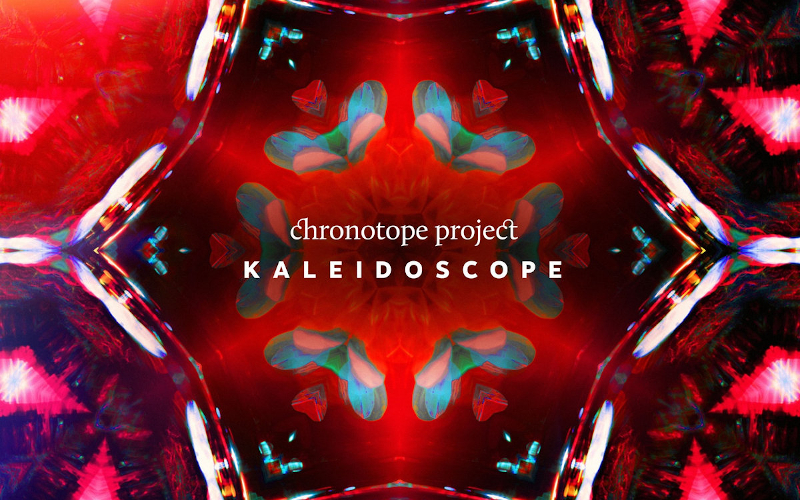
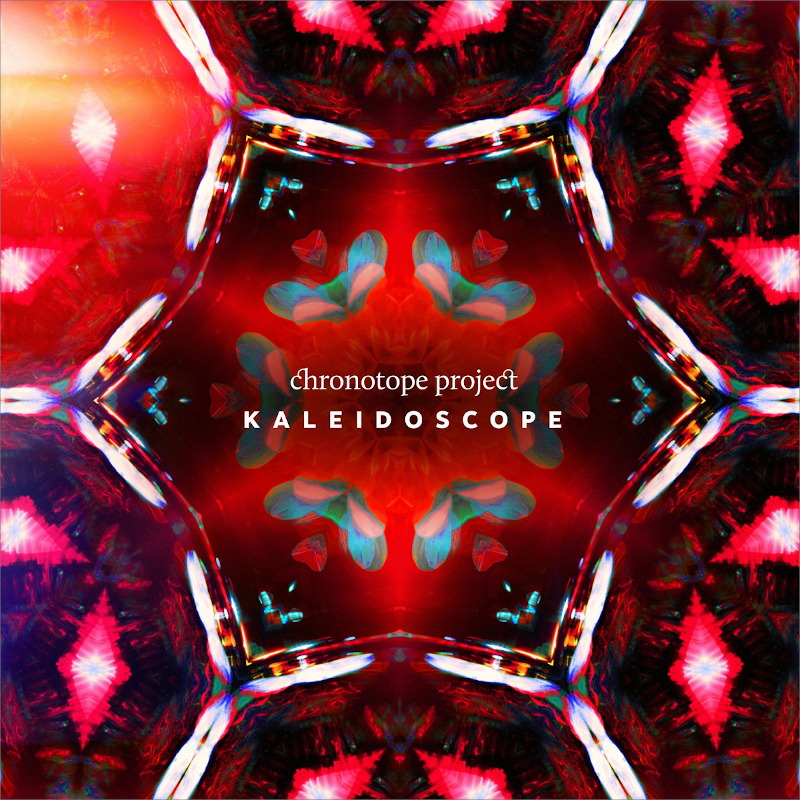
Kaleidoscope reveals more hidden dimensions and interpretations of the marvelous world around us, an autobiographical journey through the creative life itself, cyclical rather than linear in form. The feeling is enriching and complex, more listening unlocks more new territories.
Mystery is part of the beauty
The music of Chronotope Project explores the time-space confluence and invites the listener on ambient journeys of deep texture infused with gentle pulsing rhythms and soulful melodies. Kaleidoscope spans a wide range of musical styles—meditative ambient, art music, progressive jazz, raga, romantic classical, and post-classical minimalism. Chronotope refers to the essential unity of space and time, a concept with numerous expressions in literature, history, physics and the arts, perhaps perfect for meditation, inspiration and ideation.
“My deepest wish is to create music that reveals itself slowly, like light unfolding through layers of mist,” reflects Jeffrey Ericson Allen, visionary of the Chronotope Project. “What is obvious to one ear may be hidden to another, and that mystery is part of the beauty. Each piece is an invitation—to listen again, to listen differently. With each return, new patterns emerge, new colors sound. The music, I hope, continues to open, as the listener’s own listening deepens.”
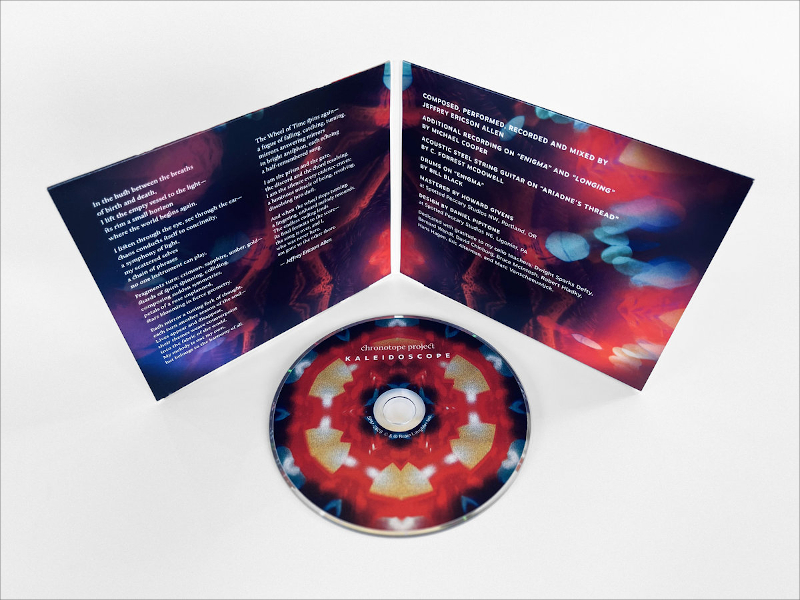
Creating remains, at heart, an act of wonder—and of play. This first story has to do with finding the way out through the dark halls where the Minotaur lives, “Ariadne’s Thread” (remix) 3:40, features harp, recorder, strings, and synths, with acoustic steel string guitar by C. Forrest McDowell. A passacaglia is a Baroque musical form initially associated with musicians playing between acts in theatre, continuous variations over a repeated, usually descending, bass line (ground bass) in triple meter. Time moves in circles, not lines. A trance-like spiral of rhythm and melody evoke the sacred dances of the Medicine Wheel—a healing mandala of sound. Ethereal choral voices emerge at the end to soothe and uplift, “Medicine Wheel” (remix) 9:13 evokes the abstract concept of a spinning wheel going around and around creating harmonics and rainbows, thunderclouds building at twilight, a constantly changing state, somehow rolling forward, strong and restful.
Opening as a jazz meditation, chimes and mallets going deep and long, “Enigma” 4:49 is a vision of the splendid darkness and power of brass, pounding noir shadows into wet concrete, transforming into visions of caravans, full brass beasts lumbering along in a long procession, the drums by Bill Black make it even more real. Additional recording by Michael Cooper.
Rhythmic energy, brilliant orchestration ::
A Zikr dance is an intense, circular, and meditative Sufi ritual, which often involves swaying or circling for long periods, often leading to a trance-like state, designed to achieve spiritual union with God through repetitive motion and chanting. What I hear here is a light and lively tempo, an unusual and enchanting time signature, rhythmic energy, brilliant orchestration, and deep woodwinds joined by brass and an organ. “Zikr Dance” 4:26, is a joyful, kinetic celebration of the rhythmic energy, brilliant orchestration, and deep, humanistic themes of John Adams.
According to one myth, Erda lives in the deepest part of the earth, a goddess of the underworld. “Erda (Raga of the Earth remix)” 8:36 is a somber, earthy raga rising from the drone of creation. Erda, the Norse goddess of wisdom and fate, sings from the roots of the World Tree. I sometimes hear the spirit of a whale calling from the distance, the feeling is long and slow, deep underwater everything is dark, quiet and mysterious, ultimately slowly coasting to a quiet fade out as the cello laments.
Flutes, recorders, and synths guide a dreamlike pilgrimage—a “new age” quest through luminous inner landscapes and enchanting time signatures, a “Spirit Walk” 4:35 that easily journeys between worlds. I see rattling dry walking skeletons, dancing bones and solemn whistles with a strong sense of beat, very solid. There is a magic moment when the doll talks, “Geosynchronous” (remix) 4:57 could easily be ambient minimalism at its most hypnotic. Orbiting patterns of sound evoke gravity, momentum, and the serenity of circular motion, floating in space and looking at the distant planets as they spin about. “Dance of the Raven Man” 5:45 begins with a slow, raga-like invocation and bursts into thunder growls, throat singing, dancing in the darkness around the fire, and that flute gets crazy again in an ecstatic shamanic celebration. Opening into soft fuzzy clouds, becoming more steady with wandering throbs, “Automatic Writing” (remix) 3:53 traces unseen patterns across the surface of awareness. I return to the water’s surface looking up at the light flickering with flashes of shadows; a short visit to a particular sound just to linger and listen.
Track 10 is dedicated to the composer’s cello teachers, and the Romantic spirit of Brahms and Schumann, “Longing” 7:32 the cello’s yearning voice rises from solitude to a radiant orchestral sunrise, bringing tension and drama, near hysterical sadness and yearning, perfectly evoked awakened emotions, all the best empathetic human feelings, closing in benediction. Additional recording by Michael Cooper.
Peace and renewal beneath the awakening sky ::
A night soundscape of crickets and chimes unfolds into a serene chorale performed on the flute-like Haken Continuum, then as a full vocal chorus—an offering of peace and renewal beneath the awakening sky, this is the closing, “Clear Bell Ringing in Empty Sky” (remix) 7:04, things quiet down even more as the cello butterfly emerges from the chrysalix. Here we are almost in the heavenly realms so far from Earth, visible way up above, rocking gently with the stars. The whales are out tonight.
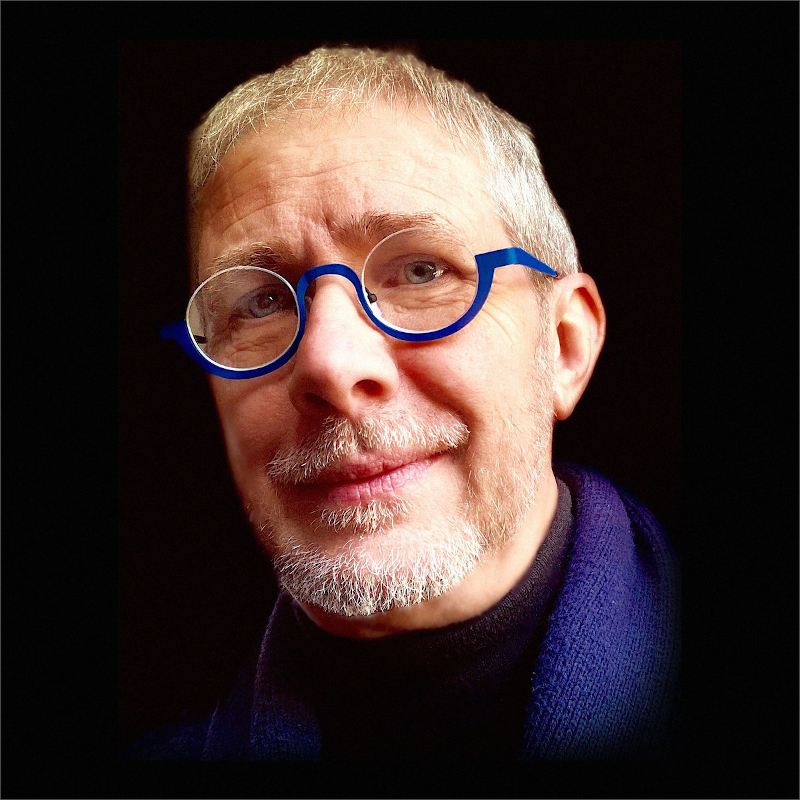
Jeffrey Ericson Allen (b. 1958) is an Oregon-based composer, cellist, and electronic music artist whose work bridges classical, acoustic, and experimental traditions. Since the release of his debut recording Primeval Mind (1985), he has produced more than a dozen solo albums and two collaborative projects with the acoustic folk-jazz ensemble Confluence. His music has also been featured in full-length dance works created with choreographers Bonnie Simoa and Nina Little, and in the mytho-poetic drama The Descent of Inanna (1997–98) at Lane Community College.
Allen’s compositions have been performed at the Oregon Bach Festival Composer’s Symposium (1999, 2000) and as part of the “Seventh Species” composer’s collective concert series. A graduate of Willamette University (B.A. in Philosophy, 1980), his work reflects a lifelong engagement with philosophy, literature, mythology, and Buddhism.
For twenty-five years, Allen also served as a children’s librarian and storyteller—an experience that continues to shape his music. His compositions often unfold as sonic narratives, evoking inner journeys and mythic transformations through sound.
Since 2012, Allen has presented his acoustic–electronic music under the moniker Chronotope Project, his most recent and ongoing expression as a creator of contemporary progressive ambient music. He joined the Spotted Peccary Music label in 2015, under which he has produced seven recordings. Through Chronotope Project, Allen explores this fusion of time and space, crafting immersive soundscapes of rich texture, gentle pulsing rhythms, and lyrical, soulful melodies. His music has been featured on major syndicated ambient and electronic music programs, including Hearts of Space, Echoes, Musical Starstreams, Ultima Thule, Journeyscapes, and Star’s End.
“Chronotope” refers to the essential unity of space and time, a concept with numerous expressions in literature, physics and the arts. A chronotope diagrams time and space, intricately connected and represented in narrative, chronotope acts as an organizing center for the narrative’s plot, where specific spatial settings and temporal frameworks determine how stories unfold and meaning is created. The music of Chronotope Project explores this time-space confluence and invites the listener on ambient journeys of deep texture infused with gentle pulsing rhythms and soulful melodies. Inspired by influential twentieth-century Russian literary theorist Mikhail Mikhailovich Bachden, what if all language and thought exist only in relation to others, through a continuous, interactive dialogue? Theories of dialogism, polyphony, and carnival, which emphasize language as a dynamic, interactive, and multi-voiced process, multiple, diverse, and often conflicting social voices and languages exist within a single text or society, rather than a static system.
Kaleidoscope reveals more hidden dimensions and interpretations of the marvelous world around us, an autobiographical journey through the creative life itself, cyclical rather than linear in form. The feeling is enriching and complex, more listening unlocks more new territories. The instrumentation is exquisite and the production values are outstanding. The subject matter is wide and broad, spanning centuries and lightyears. Classical themes prevail, nested with electronica and ambient vibrations.
Kaleidoscope is available on Spotted Peccary Music. [Bandcamp]
Related posts ::
 Chronotope Project :: Chronology (Spotted Peccary)
 Sverre Knut Johansen :: Still Time (Spotted Peccary Music)
 Craig Padilla & Zero Ohms :: To Sleep On Stellar Winds (Spotted Peccary Music)
 Rudy Adrian :: Reflections On A Moonlit Lake (Spotted Peccary Music)
 Rudy Adrian :: Along The Coppermine Ridge (Spotted Peccary Music)