






In a year already rich with strong releases, Serge Works stands out for its clarity of vision and depth of execution. It rewards patience, revealing new details with each listen, and invites the listener into a space where time, texture, and tone intertwine. Whether experienced as a technical showcase, a tribute to lineage, or simply as a series of immersive sound journeys, it resonates on multiple levels.
Allowing chaos to bloom and then gently recede
Ian Boddy’s Serge Works arrives as both a technical masterclass and a deeply human listening experience, a rare balance that only a handful of electronic musicians can truly achieve. As the founder of the DiN label and a long-standing figure in modular synthesis, Boddy has spent decades refining his voice, yet this release feels anything but retrospective. It is alive, searching, and profoundly immersive. Easily one of the standout releases of 2026, Serge Works deserves a place among the year’s most essential electronic music statements.
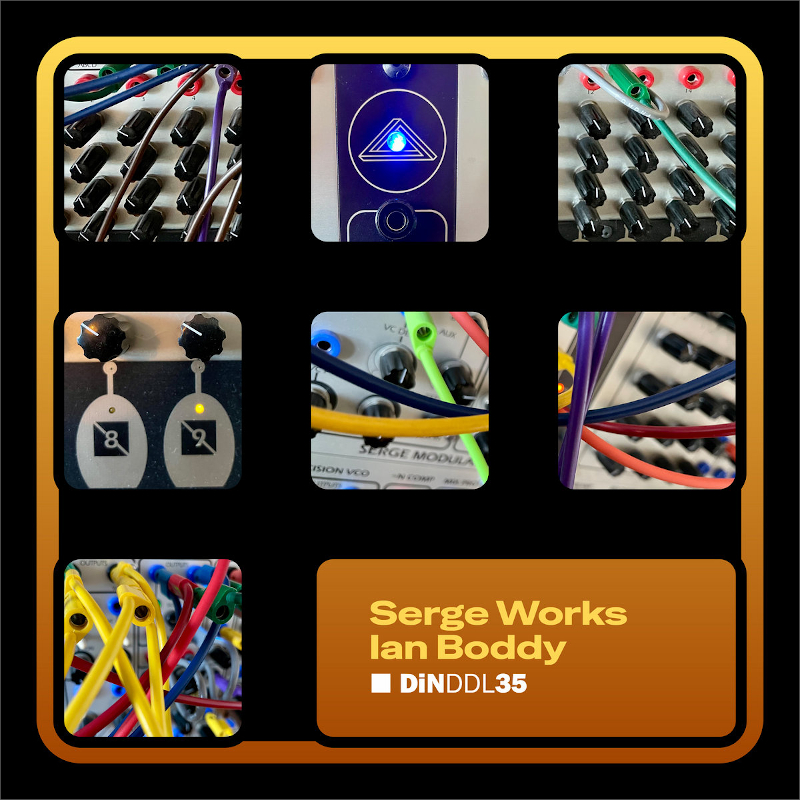
At its core, this album is a celebration of the Serge modular system, an instrument defined as much by its philosophy as by its circuitry. Boddy leans fully into its open-ended design, where audio and control voltages blur into a single expressive language. The result is not simply a collection of compositions but a set of evolving ecosystems. Each piece unfolds in real time, recorded live, with the patches themselves acting as co-composers. This approach recalls Boddy’s earlier Tone Science Module series work, yet here the scale and confidence feel elevated, more distilled.
The opening piece, “Hommage à Éliane Radigue,” sets the tone with breathtaking clarity and patience. It is a beautiful and deeply respectful tribute to Éliane Radigue’s legacy, capturing her sense of temporal expansion and microscopic sonic change. Boddy constructs a slowly shifting harmonic field using four oscillators, carefully retuned over extended durations. The transitions between chords are not abrupt but blurred through long delays and analogue processing, creating zones of dissonance that resolve with luminous inevitability. Around the twenty-two minute mark, when the final C major chord emerges, it does not feel like a destination so much as a revelation. The piece breathes with a quiet intensity, honoring Radigue not by imitation but by channeling her spirit of devotion to sound itself.
“Hypothesis” shifts the focus toward complexity and generative behavior. Built as a self-playing patch, it demonstrates the Serge system’s ability to produce endlessly evolving structures. Two oscillators anchor the piece with a steady drone while others move through quantized sequences shaped by layers of modulation and randomness. What is striking is how musical the result remains despite its inherent unpredictability. Boddy’s subtle interventions guide the system without overpowering it, allowing chaos to bloom and then gently recede. The gradual acceleration into more turbulent territory, followed by a soft and spacious denouement, reveals a composer who understands pacing at a fundamental level.
With “Liturgy,” Boddy brings a different kind of discipline into play. Drawing on harmonic material inspired by Bach, the piece bridges centuries of musical thought. The painstaking programming of the Serge sequencer, with its 64 tuned controls, results in a harmonic progression that feels both structured and fluid. The chords emerge slowly, almost tentatively, before gaining clarity and presence. When the sequencer accelerates into audio rates, the effect is mesmerizing, collapsing the progression into a shimmering harmonic mass. As the piece returns to a slower pace and introduces randomization, it opens into unexpected pathways, suggesting that even the most carefully constructed systems can yield surprise and beauty.

The raw power of analogue synthesis ::
“Diatribe” stands as the album’s most visceral and confrontational work. Originally commissioned by Modulisme, it embraces the raw power of analogue synthesis. The use of diminished scales and cross-modulated oscillator pairs creates a tense and unstable foundation. From there, Boddy pushes the system toward extremes, exploring a vast frequency range that moves from subterranean rumble to piercing highs. The interplay of phasers, filters, and wave-shaping modules generates textures that feel almost tactile. There is a sense of risk here, of pushing the instrument to its limits, yet the piece never loses its coherence. It is a reminder that abstraction can still carry emotional weight, even when it resists easy interpretation.
Closing the album, “The Perfect Fifth” offers a moment of reflection and calm. Inspired by La Monte Young’s minimalist instruction to sustain two notes over time, Boddy strips his approach down to its essentials. The interaction between oscillators tuned to B and F sharp becomes a study in resonance and harmonic interplay. Subtle shifts in filtering and amplitude bring out hidden overtones, revealing the richness within apparent simplicity. Compared to the density of the preceding pieces, this track feels almost weightless, a meditative space where time seems to dissolve. It is a fitting conclusion, emphasizing that restraint can be as powerful as complexity.
Throughout Serge Works, Boddy’s use of analogue effects plays a crucial role in shaping the sound. Tape echo, spring reverb, and delay are integral components of the compositions. They extend and blur the sonic material, adding depth and dimension while reinforcing the album’s organic character. There is a tactile quality to the sound that digital processing rarely achieves, a sense that each tone occupies physical space.
Serge Works stands out for its clarity of vision ::
What makes this album particularly compelling is its balance between technical rigor and emotional resonance. Modular synthesis can often become an exercise in abstraction, appealing primarily to those interested in the mechanics of sound design. Boddy avoids this trap by grounding his work in musical ideas, whether through harmonic progression, dynamic shaping, or sheer attentiveness to texture. Even at its most complex, the music remains inviting, encouraging deep listening rather than intellectual distance.
Boddy’s importance in the electronic music landscape cannot be overstated. As a composer, performer, and founder of the DiN label, he has consistently championed exploratory approaches to sound. Serge Works reinforces that legacy while also demonstrating a continued willingness to evolve. It is not the work of an artist resting on past achievements but of one still fully engaged with the possibilities of his medium.
In a year already rich with strong releases, Serge Works stands out for its clarity of vision and depth of execution. It rewards patience, revealing new details with each listen, and invites the listener into a space where time, texture, and tone intertwine. Whether experienced as a technical showcase, a tribute to lineage, or simply as a series of immersive sound journeys, it resonates on multiple levels.
For those willing to engage with its extended forms and subtle transformations, Serge Works offers a profoundly satisfying experience. It is an album that earns the listeners attention, unfolding gradually and leaving a lasting impression. In every sense, it is a testament to the enduring power of analogue synthesis and to Ian Boddy’s place among its most thoughtful practitioners.
All tracks composed, produced and mixed by Ian Boddy on a Serge modular system with the addition of Echo Fix EF-X2 tape echo, Wellspring stereo spring reverb, Doepfer A-199 with Accutronics spring reverb tank, Moog Moogerfooger MF-104M Analog Delay & 12 Stage Phaser and Boss DD-20 Giga Delay pedal.
Artwork by Bernhard Wöstheinrich (studioflokati.de).
Serge Works is available on DiN. [Bandcamp]