






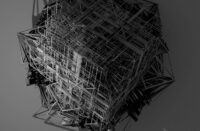
Some records ask to be heard; Philippe Petit’s Lightning Field 01. Constraint asks to be observed, documenting the unpredictable conversation between composer, electricity, and machine at the heart of modular synthesis.

Fragments of a larger ongoing investigation
Modular synthesis releases occupy a deeply specific and persistently misunderstood territory within experimental electronic music—a territory that operates by entirely different rules than those governing conventional recorded sound. These aren’t listening experiences in the expected sense. They’re dispatches. Evidence gathered from the interior of a process most listeners will never witness directly. A conversation conducted between a composer and a system that has its own grammar, its own tolerance for deviation, its own appetite for accident. The best of them carry no trace of manufacture. They feel discovered rather than designed, unearthed from the space between human decision and machine response. At its most essential, the modular release functions less like composition and more like field recording, the distinction being that the field here is electrical, the landscape assembled from patch cables, voltage gradients, and the irreducible uncertainty that lives in the gap between what a composer instructs and what a system chooses to return.
Modulisme—the platform born in July 2019 out of Marseille, described as a media documenting left-field modular synthesis, has been building this archive since its inception, reaching session 144 here. The platform operates like a library rather than a label, curating exclusive one-hour sessions from composers working with modular systems across the full range of the form, from academic electroacoustic tradition through to experimental improvisation and everything in between. By session 144, the catalog represents over a thousand exclusive works and a genuine document of where modular synthesis composition stands in the mid-2020s.
The artist behind Modulisme is Philippe Petit himself—a Marseille-born composer, DJ, label operator, and self-described “musical travel agent” who has been releasing work since 2000 across labels including Sub Rosa, Monotype, Home Normal, Staubgold, and his own BiP_HOp imprint, which from 2000 to 2010 advocated left-field electronica before eventually becoming Modulisme. He studied electroacoustic music at the CNRR Conservatory, specializing in multi-channeled diffusion and modular synthesis, working with Buchla System 200, Serge 73/75, and a modified EMS Synthi A. His catalog includes collaborations with Lydia Lunch, Edward Ka-Spel, Eugene S. Robinson, and a genuinely vast network of experimental musicians accumulated over decades of restless cross-genre activity. He describes himself not as a composer but as someone who transmigrates source material, an apt description for an artist whose work has always been about the movement between forms rather than the forms themselves.
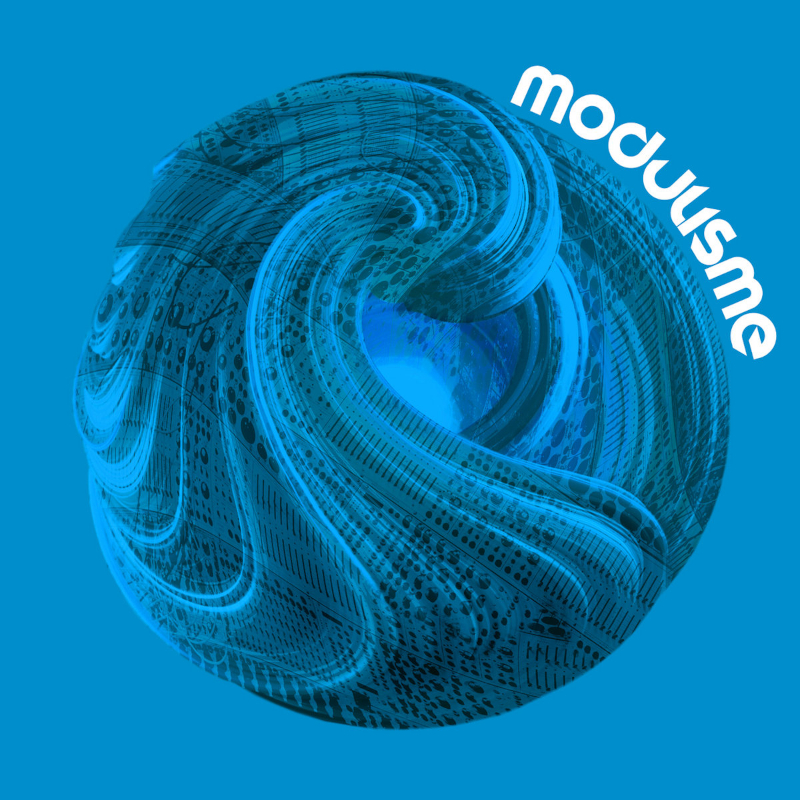
Electricity itself as the subject rather than a medium ::
Lightning Field 01. Constraint is the first volume of a new series in which Petit imposes a specific limitation on himself: no acoustic instruments, no vocals, no field recordings. The usual escape routes he describes reaching for in composition—a piano frame, a prepared guitar, voices, found sounds, are deliberately removed. What remains is his Buchla and Serge systems working in isolation, and the results of letting those systems define the boundaries of what’s possible. The title is precise, this is a volume about the founding decision, the acceptance of voluntary limitation, and what that limitation reveals. It’s the same constraint logic that has driven the most interesting experimental music for decades, from Alvin Lucier‘s single-premise compositions to the Oulipo literary movement’s rule-based writing. What happens when you remove the familiar? What surfaces in the space left behind?
What surfaces here is a series of works that treat electricity itself as the subject rather than a medium. Petit describes the modular as a miniature weather system whose internal architecture has been laid bare, not an instrument but a machine for intimate storms. That’s not marketing language. It’s an accurate description of how Buchla and Serge systems behave in the hands of someone who understands their particular logic. Unlike Eurorack, which tends toward precision and control, the Buchla and Serge traditions lean toward instability, drift, and the productive unpredictability of analog voltage. A patch on a Buchla system creates relationships between modules that interact and evolve in ways that can’t be fully predicted in advance. The composer sets conditions rather than issuing instructions. What emerges from those conditions is the work.
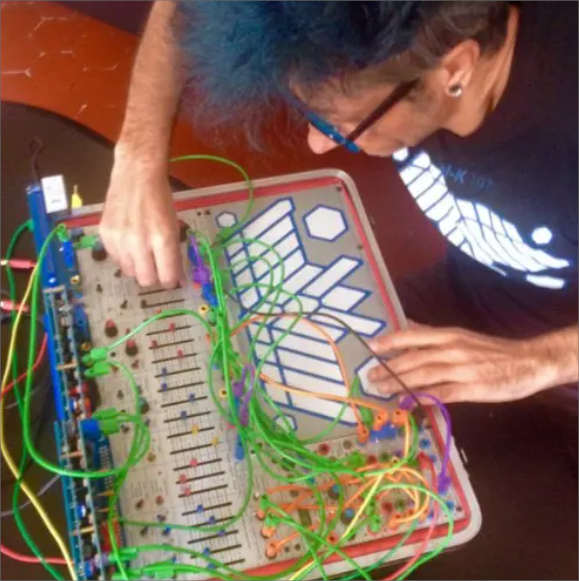
The tracks themselves are labeled in iterations: “Field 04,” “Field 05,” “Field 06,” and so on, through to “Field 15.” Each one is a short burst of electronic bubbles and modular clicks, some containing feedback, others carrying rhythm. They function less as tracks in the conventional sense and more as specimens, individual electrical events captured and named sequentially rather than titled descriptively. That naming convention is itself a statement about what these pieces are. They’re not songs. They’re not compositions in the way that word is usually understood. They’re fragments of a larger ongoing investigation, numbered because they occurred in an order, not because they need to be experienced in one.
This recalls the classic modular sessions of the 1970s and 80s, the early Moog explorations of Wendy Carlos, whose Switched-On Bach (1968) introduced the synthesizer to mainstream audiences but whose later works like Sonic Seasonings (1972) pushed into more abstract, atmospheric territory. Klaus Schulze‘s extended Berlin School synthesizer pieces, Tangerine Dream‘s Phaedra and Rubycon, Morton Subotnick‘s Silver Apples of the Moon (1967)—the first electronic work commissioned by a record label, and the musique concrète lineage running through Pierre Henry and Bernard Parmegiani at INA/GRM in Paris all share the same fundamental question Petit is asking here: what does electricity sound like when you stop trying to make it sound like something else?
The longest track in the batch is “Field 06,” running at 11:08, and it’s the most melodic of the bunch. It opens with a sequence arp cycling through different tones, rhythms going off-tone and on again, speeds shifting, different oscillators being introduced and withdrawn. More than any other piece here it plays on the melodic and rhythmic side of modular synthesis—the arp becoming a kind of unstable melody, never quite resolving, always pointing somewhere it doesn’t arrive. Much of what’s played throughout the series sits in distortions and rhythms rather than conventional melodic structure, which is consistent with Petit‘s stated intention to let the systems generate the conditions rather than imposing a compositional outcome on top of them.

This is not for the casual listener. That needs to be stated plainly. You won’t find structural familiarity here, no verse-chorus logic, no emotional arc that announces itself. These are pieces, not tracks, electrical specimens, experiments in what a Buchla and Serge system will produce when given a set of conditions and allowed to follow its own logic.
This is Session 144, and the fact that it’s Petit‘s own session rather than a guest is significant. He built this platform to document the modular synthesis community and has spent years giving that platform to others. Turning the session on himself, and specifically doing so under a constraint he describes as deliberate, as a way of denying himself the usual escape routes, suggests this isn’t a casual exercise. Lightning Field is announced as a series, meaning this first volume of constraint is the beginning of something longer and more sustained. Not obsessively themed, but genuinely exploratory, each volume investigating the same territory from a different angle, the synthesizer as an active field through which forces circulate rather than a machine that produces predetermined outcomes.
For an artist who has spent over two decades documenting what other people do with electricity and cables and voltage, this is Petit finally turning the recording equipment on himself and letting his own storm be captured. The sound is no longer manufactured. It is, as he writes, captured. Guided. Transmuted. Whether that transmutation continues to reveal new territory across future Lightning Field volumes is the question worth watching. Session 144 makes a compelling case that it will.
Modulisme Session 144. Lightning Field 01. Constraint is available on Modulisme. [Bandcamp]

Related posts ::
 2View — Fernand Vandenbogaerde :: Modulisme Session 133 / Early ElectroMIX #49 (Modulisme)
 France Jobin :: Modulisme Session 123 (Modulisme)
 Dark Circuits Orchestra plays Phill Niblock :: Modulisme Session 137 (Modulisme)
 Philippe Petit :: Closing Our Eyes (Crónica)
 Philippe Petit :: A Reassuring Elsewhere, Chapter 1 (Oscillations)