



Melting Days is constantly in motion—loops building, layers arriving and dissolving, rhythms surfacing and retreating, and that restlessness is what keeps it from becoming background music. It demands a kind of attention that most ambient records politely decline to ask for. Ten albums in, that quality hasn’t dulled. If anything it’s sharper.
A record built from grief and transition
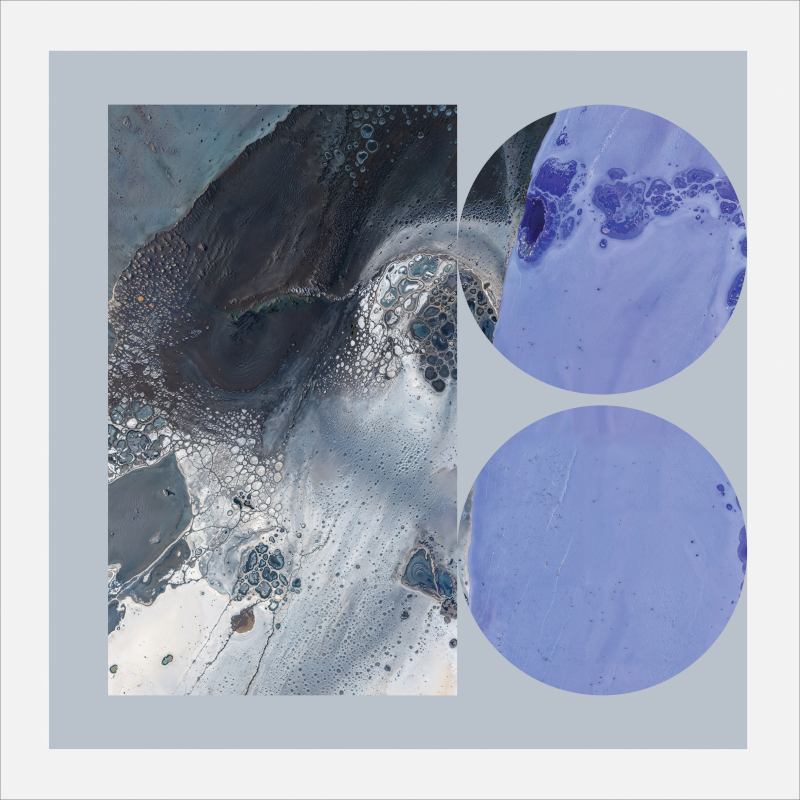
Jeff McIlwain has been one of electronic music’s most quietly consistent producers for over two decades. Working as Lusine out of Seattle, he’s built a catalog across Ghostly International that spans techno-adjacent productions, avant-pop collaborations, and ambient works, never fully committing to any single lane but always recognizable within all of them. His 2007 ambient landmark Language Barrier remains a touchstone, cited by Loraine James as her favorite ambient album of all time. Melting Days is his tenth full-length, and it returns to that same territory, minimalist, textural, patient, following the more song-forward and collaborative Long Light (2023). The closest reference point McIlwain himself offers is Susumu Yokota‘s Sakura and the mid-2000s output of Mountains, which tells you something about the emotional register he was aiming for. Mastered by Rafael Anton Irisarri at Black Knoll, with saxophone contributions from Bryan Manzo framing the album’s opening and closing tracks, and percussion from longtime collaborator Trent Moorman woven through several pieces, Melting Days is a record built from grief and transition, assembled intuitively, more like a film than an album.
This isn’t a drone record. It’s a good selection of ambient works filled with looping ambience and patterns that grow on you as they build. That distinction matters—McIlwain shares the old-school UK approach to the ambient tag, something closer to early Aphex Twin and Seefeel than beatless canvas music. The album remains active and fluid throughout, far more in the foreground than sonic impressions might initially suggest.
“Pendulum” stands out as a different tone for the album—a 4/4 kick drum sitting beneath soft static arps and melodic builds that open up gradually as the track develops. It’s very dreamlike and classic Lusine. As it builds, the arp and looping ambience reveal themselves layer by layer, things surfacing that weren’t audible on the first pass. McIlwain has always had this quality in his productions, the sense that a track is withholding something until you’ve earned it, and “Pendulum” is the clearest example of that on Melting Days. He describes it himself as the album’s centerpiece, swinging from muffled shimmers to pulsing string-flute-static territory. For a producer who comes from a beat-heavy background, the rhythmic restraint here is deliberate and considered.

Transformation through erasure ::
“All Clear” is another interesting track—the melody stabs sound like they’re being played in fast-forward increments, a looping pad with static movement underneath and a distorted pad sitting in the back. Beautiful and hypnotizing. There’s a technique here that McIlwain has refined across his catalog: taking a simple melodic gesture and running it through enough processing that it becomes something between a melody and a texture, occupying both spaces simultaneously. The distorted pad underneath gives it weight without pulling focus. “Intruder” carries a unique eerie quality—strange samples sit beneath the surface and that unease is classic Lusine, the kind of track where beauty and discomfort occupy the same space without resolving into either.
“Apparition” is worth noting specifically, McIlwain describes it as a happy accident, the result of running a cello loop through dozens of filters until it became some other instrument entirely. That process of transformation through erasure runs through Melting Days as a whole. The saxophone that opens “Sightline” and closes “Uncharted” gives the album its symmetrical frame, Reich-like layers creating a sense of arrival and departure that mirrors what McIlwain was processing in his personal life while making it.
Melting Days is a good ambient record, one Lusine fans will be proud of. The amount of detail put into each track and through the production process is evident on every listen. What McIlwain does better than almost anyone working in this space is make ambient music that doesn’t feel like it’s standing still. Melting Days is constantly in motion—loops building, layers arriving and dissolving, rhythms surfacing and retreating, and that restlessness is what keeps it from becoming background music. It demands a kind of attention that most ambient records politely decline to ask for. Ten albums in, that quality hasn’t dulled. If anything it’s sharper.
Melting Days is available on Ghostly International. [Bandcamp]





![[2View] Maps and Diagrams’ beneath still stars (handstitched*) & returning light (Home Normal)](https://igloomag.com/wp/wp-content/uploads/2026/10/maps-and-diagrams-returning-light-beneath-still-stars_feat-75x75.jpg)