




IDM has a long history of artists who hide behind machines, faceless names and cryptic titles, letting the equipment do the talking. Trickjumps turns that tradition inside out. Calella tells you plainly who she is and how she moves through the world, then lets the machines say everything her face won’t.
Transformation more than high score
Vorpalgaze holds eye contact a little too long. Her own album notes say so. Rossella Calella describes herself as a neurodivergent young woman who rarely shows emotion through her face, but who carries a vast, complicated inner world that mostly finds its way out through music. That gap between a still surface and everything moving underneath it is a good way into Trickjumps, her first album. Composed and mixed between October 2021 and the end of 2025, it took four years to build six tracks, and you can hear every one of those years in the sound design.
Audiobulb Records, David Newman’s Sheffield label running since 2003, has always leaned toward ambient, microsound and the quieter edges of experimental electronics. Trickjumps is a sharper turn for them. It’s dense, rhythmic, sometimes aggressive IDM, and it widens the label’s range without feeling out of place. The title sounds like arcade gaming, and there’s play in the music, but Calella frames each track as a level, a passage the listener moves through on the way somewhere higher. Transformation more than high score.

“Trapsuutjie” opens on drums that move and pass each other while a dark IDM mood settles in around them. Underneath runs an algorithmically generated background that lasts the whole piece, with the rhythms and harmonies of each section adapted and woven into it. You don’t need to know that to feel it. The track has a sense of something constant beneath the surface, and the drums keep shifting on top of it like weather over terrain.
“Trickjump” is where the playfulness she talks about shows most clearly. A steel drum melody sets the rhythm, 8-bit tones flicker in, and a sweeping pad loops strategically underneath to keep pulling you forward. It’s inviting in the way a good game level is inviting. The friendliness hides where the track is heading, and the shifts in intensity and harmony arrive before you can see them coming.
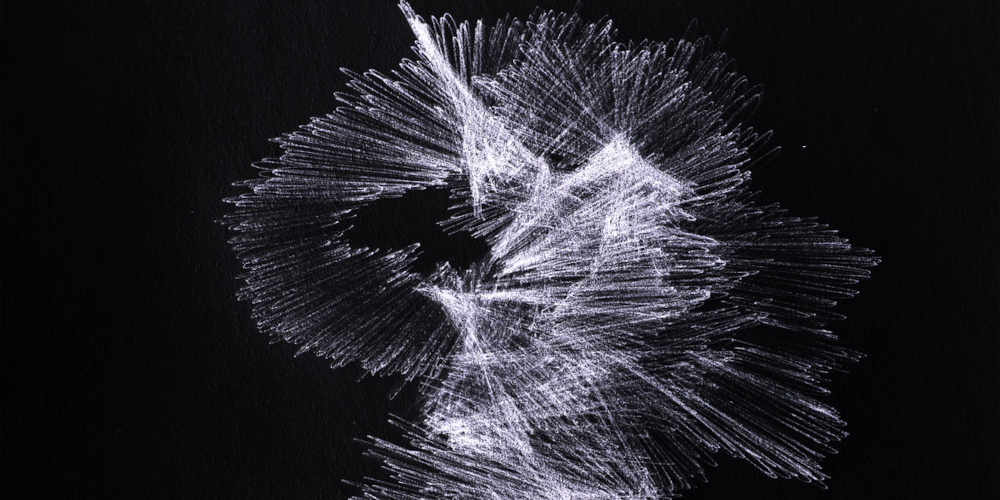
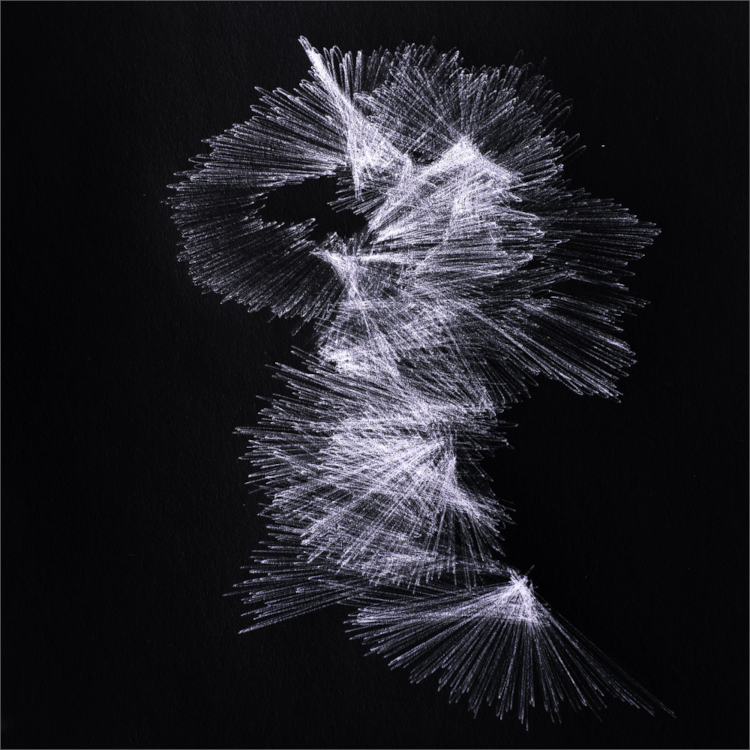
“Edge,” co-written with Shigaraki, the Italian bassist and composer Franz Cardone who also drew the album artwork, is the drum-play highlight. Rhythms bounce back and forth across the stereo field, ping-ponging off each other in a way that recalls Funckarma’s early collaborative drum work, that same sense of two patterns arguing and somehow agreeing at the same time. Calella calls this the threshold track, the one where everything in her vision converges. It earns the description. The piece ends somewhere very different from where it starts, and the transition never feels forced.
“Monkeywolf” leans into drum rolls that dominate the sound while sub-bass fills the room, building through darker atmospheres. Like “Trapsuutjie,” it rests on an algorithmic bed, and the rolls feel almost generated themselves, pouring forward in shapes a human hand wouldn’t quite choose.
Reverse playback runs throughout. Calella notes that the harmonic material came from a single improvisation, recorded and then edited, with sections alternating between forward and reverse, and you can hear that movement as a kind of back-and-forth tide. ~J. Batista
“Laniakea” closes the album and it’s the standout. Calella does something different with the bass here, running it through a degraded, lo-fi, fizzy treatment that keeps morphing as the track unfolds. Reverse playback runs throughout. She has said the harmonic material came from a single improvisation, recorded and then edited, with sections alternating between forward and reverse, and you can hear that movement as a kind of back-and-forth tide. Rhythm barely matters here. The focus is the bass and how far it can be bent while the dark atmosphere carries everything else. Around 4:45 a strange, off-timbre melody surfaces, wonderful and unpleasant at once, and it’s clearly deliberate. That’s the kind of risk most debut IDM albums don’t take this late in the runtime.
IDM has a long history of artists who hide behind machines, faceless names and cryptic titles, letting the equipment do the talking. Trickjumps turns that tradition inside out. Calella tells you plainly who she is and how she moves through the world, then lets the machines say everything her face won’t. The result feels intimate in a way this genre rarely does. Not because it’s soft or confessional, but because every strange timbre and abrupt turn sounds like a real decision made by a real person. Most debut albums introduce a sound. This one introduces a mind, and it leaves you wanting to hear what it thinks next.
Trickjumps is available on Audiobulb.
Related posts ::
 OdNu + Ümlaut :: Metamorphoses (Audiobulb) — Exclusive preview!
 Autistici :: Familiarity Unfolded (Audiobulb)
 Build :: A Development with a Grid of Streets and a Shopping Center Heart (Audiobulb)
 Seth Thorn :: a curious doubling of terms (Audiobulb)
 Jacek Doroszenko ft. Ewa Doroszenko :: Bodyfulness (Audiobulb)