


Field of Coincidence is the debut album documenting the collaboration between LA-based artists Jesse Perlstein (Sontag Shogun, AxOxH) and Michael Robert Chadwick (Fake Sword, Plum Professional), aka Trellis. Perhaps the perception of coincidence can serve as a link to folk psychology and philosophy as well as supernatural, occult, or paranormal claims, psychological reasoning, and the statistical probability of chance events.
A surreal flow of sound as art music for careful listening
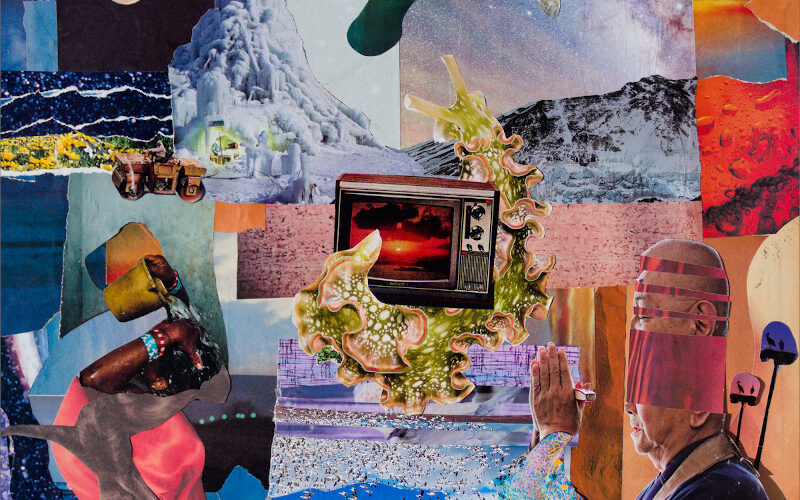
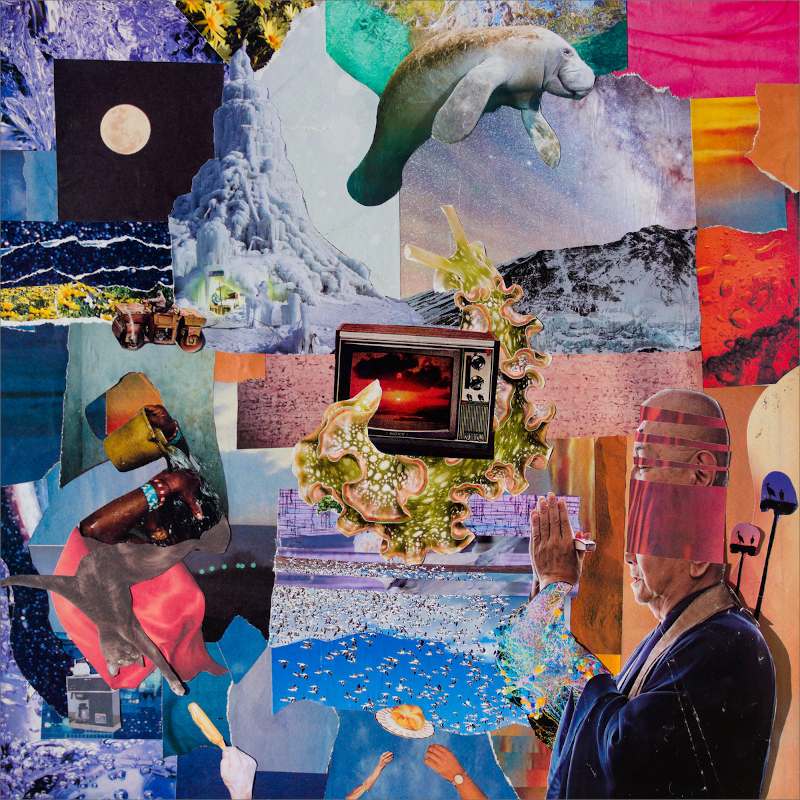
Field of Coincidence is the debut album documenting the collaboration between LA-based artists Jesse Perlstein (Sontag Shogun, AxOxH) and Michael Robert Chadwick (Fake Sword, Plum Professional), aka Trellis. Perhaps the perception of coincidence can serve as a link to folk psychology and philosophy as well as supernatural, occult, or paranormal claims, psychological reasoning, and the statistical probability of chance events. Perlstein: vox, roland ju06a, OM-1 cassette synth, various pedals & field recordings. Chadwick: kobol expander, korg minilogue xd, yamaha sy35, lexicon mx200, roland DEP-5, polyend tracker. Complex art collage cover and layout by Trellis. I think of this surreal flow of sound as art music for careful listening, the sound can trigger a search for meaning or hidden patterns, with no design of providing the relief of therapeutic sleeping.
First build a machine by adding parts, let it run, and then after a good duration, shut it down. Of course, you can dream while the motor runs. This experience connects events that are causally unrelated, and yet their occurrence together has meaning for the person who observes them. Field of Coincidence flows slowly, builds in secret, and glitters with life around every measure’s bend. At times dark and brooding, at other times consonant and crystalline, this multi-hued suite of songs showcases the depth and range of a project burgeoning out of its fruitful first pursuit.
“A circular or spiral motion unfolds, as if the collage forms the oceanic currents driven by the wind and planetary gravitational rotation.” ~Robin B. James
Opening with what could be waves or surf in the distance, “At The Tiller” (4:45). Soon there emerges a strange carnival merry-go-round soundtrack, with a melting fun house feeling, and a haunting kaliope. A tiller could be on a boat, or for digging the fields, or a shoot sprouting. A firefighting tiller is the second driver on a big hook and ladder truck. The sound feels upbeat and positive, and certainly as artificial as electronic music might be, synthesizers just can’t help it. The second track opens into strange brightness, building a weave of electronica and interesting sky hooks, “Sacrificial Anode” (2:51). Perhaps the anode does not want to be an offering and goes along very slowly. “Stars Our Destination” (4:23) opens in mystery, during a long journey. The tempo is somewhat subdued. This might be a lullaby, the feeling is very calming and quiet. We are out in space, smaller vessels approach the big ship, machines are running, things are slower here. Next, heading into a cinematic opening that is rippling with hope and uplifting the spirits. As the sun rises, flute-like drones emerge, “Ashen Rain” (4:57) paints a picture of planets in motion.
The title track suggests to me a long helix formation spiraling slowly, in constant motion, adding new bits as we go behind a hall of mirrors loop. Perhaps there is a simulated choral element. “Field of Coincidence” (5:09) leads into a wilderness populated by unseen creatures that call and cry, with room for a little drama at the end. A circular or spiral motion unfolds, as if the collage forms the oceanic currents driven by the wind and planetary gravitational rotation, “Gyres” (5:14) is panoramic, suggesting thick gases or fluids flowing on a grand scale, leading a steady exploration of this beautifully strange and peaceful place where nothing seems to happen.
“Along the way new electronic things show up as the end approaches, the feeling is heavenly and dark, always both.” ~Robin B. James
The birds were here first, “Ominous Dawn” (4:34). Soon electronics slip in slowly under the birds, the other instruments also emerge slowly, and below all that, the sound of something bumping about in the chamber swells the tableaux. Something complex is coming up from below, the realm down there is huge, it gets into our world through echoes, iron chimes, an electronic choir with solo drone vocalists, the birds, and a sleepy Martian, who is present only for an instant. “Tunneled” (4:33) is a long slow atmospheric excursion where nothing happens and we accumulate overlapping atmospheres, maybe that bell is from a distant foggy harbor. I think something is waiting in the dark tunnel, signalling to bring us to enter the mystery, so I give in. My God! It is sunny and bright in hereI I was expecting more gloom. It is still a subterranean tunnel in the end, and we are deep below the surface of the Earth. From one of the most dangerous tunnels, “Luciferin Haze” (4:52) makes a slow entrance, like a sunrise, a slow drone of long sustained layered tones. The feeling is rather uplifting and positive upon reflection, often in soft focus and fanciful. Nothing is real here, perhaps we are in a sweet cosmic funeral.
I think I hear unconnected events at the same time or place, purely by chance, I hear water, the snowflakes are dancing, suggesting a sparkling atmosphere. “Eddies” (3:56) evokes distant ocean surf, or water in the cave in the short distance. Somehow we are with the choir out here, and the keyboard is over there in the big cave. Pareidolia is the tendency for perception to impose a meaningful interpretation on a nebulous stimulus, usually visual, so that one detects an object, pattern, or meaning where there is none. The unknown forces cause what is perceived as just the peaks, or groupings of coincidences. A coincidence is a remarkable concurrence of events or circumstances that have no apparent causal connection with one another, contrasting with fatalism, a doctrine which holds that that events will happen in the exact manner of a predetermined plan. Along the way new electronic things show up as the end approaches, the feeling is heavenly and dark, always both.
Recorded & Mixed by Trellis in Highland Park, LA
Mastered by Michael Robert Chadwick
Cover art and layout by Trellis
Although ambient in scope, these pieces employ pop structures, natural environmental recordings, and FX-laden sound design, released on May 12, 2026 to tell emotive stories in abstract auditory theatre. Between swarms of vocal layering and harmonic analog synthesizers, there’s a timbral warmth to these tracks that feels refreshing in this AI-driven age of algorithm.
This is not a synth album designed in a laboratory, nor on a perfectly grid-mapped sequencer, the subtle blemishes and analog acoustic artifacts that populate this record throughout serve to remind us that this is human music, made by people (friends, together), for people. Like Hiroshi Yoshimura‘s 1982 Music for Nine Postcards. Yoshimura‘s music lies mostly in the minimalist genre of kankyō ongaku, or environment music—soft electronic melodies infused with the sounds of nature: babbling brooks, steady rain, and morning birds. Famously, Yoshimura said that he was inspired by “the movements of clouds, the shade of a tree in summertime, the sound of rain, the snow in a town.” He wanted to create music that was “as close to air itself.” His beloved 1984 tape Watering a Flower, finds a delicate grandiosity in the private intimacy of a lamplit domestic space; evolution is driven by adapting to new environments.
Field of Coincidence is available on Aural Canyon. [Bandcamp]
Related posts ::
 Shahzad Ismaily, Stanford Cheung, Andrea Scala :: ENDROLL EP (Aural Shapes)
 Field Lines Cartographer :: Resplendent In The Light Of The Universe (DiN)
 Monolake :: Gravity (Reissue) (Field) — First vinyl pressing
 Ard Bit :: Field Recordings – 07 Iceland (Self Released)
 Field Lines Cartographer :: This Vibrating Earth (Castles in Space)