


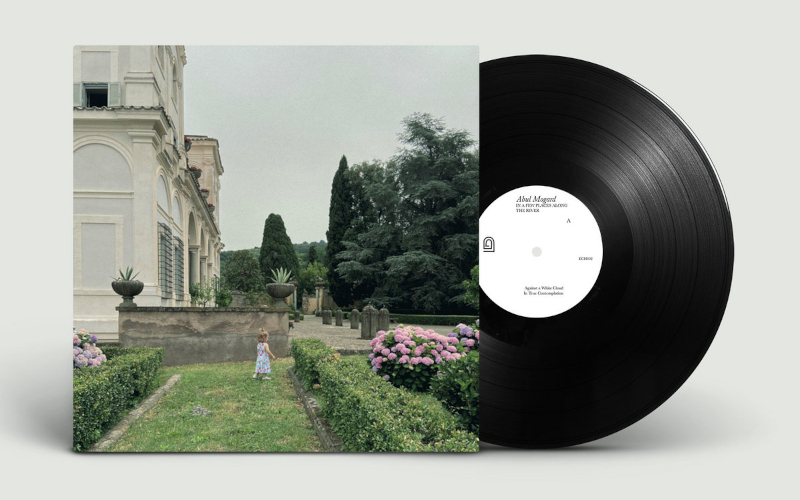



With its long-awaited vinyl release via Soft Echoes, In a Few Places Along the River by Abul Mogard emerges as a work of immersive duration and sculpted resonance, where sound unfolds as a patient architecture of depth, silence, and inner attention.
Sound held in slow matter
The first physical appearance of In a Few Places Along the River finally allows this work to be measured for what it truly is: a record conceived as duration, as the slow pressure of sonic matter, as an architecture of listening.
Released digitally in 2022 and now entrusted to vinyl by Soft Echoes in a limited edition, the album acquires, in the form of the LP, a necessity that the file had only hinted at. This is not merely a different editorial frame; it is the very substance of this music that calls for a surface capable of holding, separating, and articulating it. In the groove, Abul Mogard rediscovers his true scale, that of an author who for years has worked with density, shadow, and an idea of immersion that offers no comfort and does not seek to furnish silence, but transforms it into a space of concentration.
Ever since the figure of Abul Mogard ceased to be a side legend of experimental music and returned to the name of Guido Zen, the core of the discourse has become even clearer. The biographical fiction, which did play a fruitful role in protecting the project’s autonomy, matters less than the moral quality of this sonic writing. Mogard composes like one who has stripped away everything superfluous, like one who distrusts emphasis and prefers to work through minute mutations of timbre, slow harmonic torsions, reverberations that seem to prolong sound beyond its own body. In this album, that discipline reaches an exemplary balance. Every choice appears necessary, every frequency seems placed with an almost ascetic patience, every passage produces a sense of depth that is neither illustrative nor decorative.
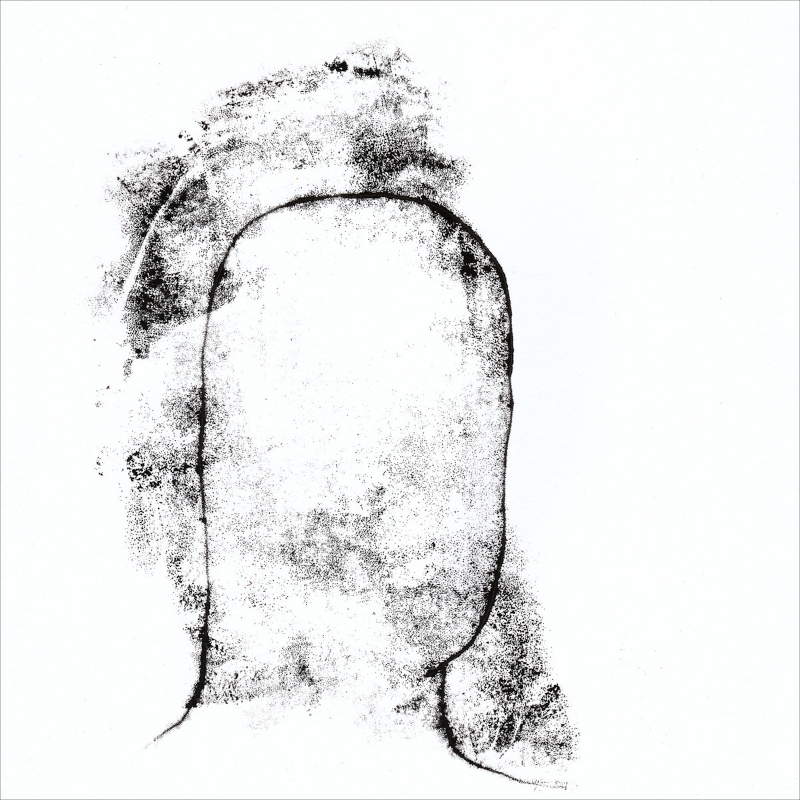
The three compositions, created between 2019 and 2022, between London and Rome, move along a subtle border where electronics, drone, and a certain memory of modern classical cease to be genres and become modes of breathing. “Against a White Cloud” opens the record like a remote brightness, a harmonic field that seems still and yet slowly bends, thickens, gathers weight. Mogard’s beauty has always lain in this ability to make movement felt without declaring it, to transform the almost motionless into an inward event. In In True Contemplation the process becomes even more distinct. The tones grow denser, the timbral grain darkens, the piece arranges itself as a vast resonance chamber in which harmonics pursue and veil one another. The listener is called to enter a different time, slower, graver, almost alien to the ordinary measure of attention.
The use of the reverberation of the Inchindown oil tanks, those celebrated Scottish reservoirs capable of an almost unreal sonic decay, is here far more than a technical refinement. It is a constructive principle, a choice that acts upon the perception of space and time. The reverb does not simply widen the sound; it removes it from itself, deprives it of immediacy, turns it into the memory of an apparition, the echo of a presence withdrawing even as it still resounds. From this point of view, In a Few Places Along the River is one of Mogard’s most fully realized works, precisely because the technology remains in the service of an austere, inward, almost severe vision. There is no desire to astonish, no search for artificial grandeur; rather, there is the intention of allowing the music to become a mental environment, a suspended space, a meditative threshold.
The summit of the record is naturally “Along the River,” twenty-one minutes that occupy the second side on their own and give the whole its secret axis. It is an elegiac composition in the highest sense of the word, because it knows how to describe melancholy by producing it as an effect of time itself. The piece proceeds by thickenings and rarefactions, by slight emergences of light and descents into harmonic half-shadow, with a calm that has nothing narcotic about it. In Mogard, sound keeps thought awake precisely as it removes it from the noise of the world. Along the River possesses this rare faculty of making duration felt as a moral experience, as a silent inquiry into permanence, loss, and the possibility of remaining within a form without consuming it too quickly in meaning.

Where silence learns weight ::
The vinyl heightens all this with remarkable clarity. The division into sides restores to the album a structure of great balance. On side A, the first two tracks prepare the ground, define the field, regulate the sensibility of listening. On side B, “Along the River” asserts itself as a long terminal meditation, as a current carrying with it the weight of the preceding tracks and distilling it into a barer, more exposed, more definitive form.
Even on the strictly sonic level, this edition seems to do justice to the quality of the material. The mastering by Rafael Anton Irisarri and the cut entrusted to Lupo enhance the depth of the low frequencies, the transparency of the stratifications, the sustain of the harmonic tails, avoiding both an indistinct blur and excessive polish. The matter remains alive, porous, crossed by slight ripples that are part of its charm.
Today there exists a vast ambient and drone production that mistakes slowness for intensity and contemplation for a form of elegant inertia. Abul Mogard remains elsewhere, because he possesses a sense of form and a seriousness of tone that derive from a long fidelity to his own language. In In a Few Places Along the River, that fidelity is translated into a work of rare coherence, capable of uniting compositional rigor and evocative power without seeking sentimental shortcuts.
It is an album that works in depth, that grows with repeated listening, that leaves behind it an almost physical persistence. Its greatest merit may well be precisely this: to make sound into a place of thought, and thought into a restrained, grave, necessary vibration.
On vinyl, all this finally appears in its most fitting form, as though this music had awaited the long time of matter in order to reveal, to the very end, its own truth.
In a Few Places Along the River is available on Soft Echoes. [Bandcamp]