






Within the latest Speaker Music transmission, Brown returns to the bastion of seriously adult musical content that is Planet Mu Records for the frankly exquisite Synoptic Audio. With its theme-first offering to the experience, De Forrest proposes sound itself as a system of critical inquiry.

Sound itself as a system of critical inquiry
My own finely honed musical aesthetic undulates between musical snobbery and finding myself in possession of some game undoubtedly changing music—and missing out on some too. One such recent discovery was my three year long encounter with DeForrest Brown’s impulse to tell the truth as he creates through music and word. His truth-sayer ethos and rigorous academic approach to the study of the why and what-for of creativity tells no lies. In the shape of his Speaker Music guise, he has consistently taken what has been taken and offered it back with dignity, integrity, and historical clarity.
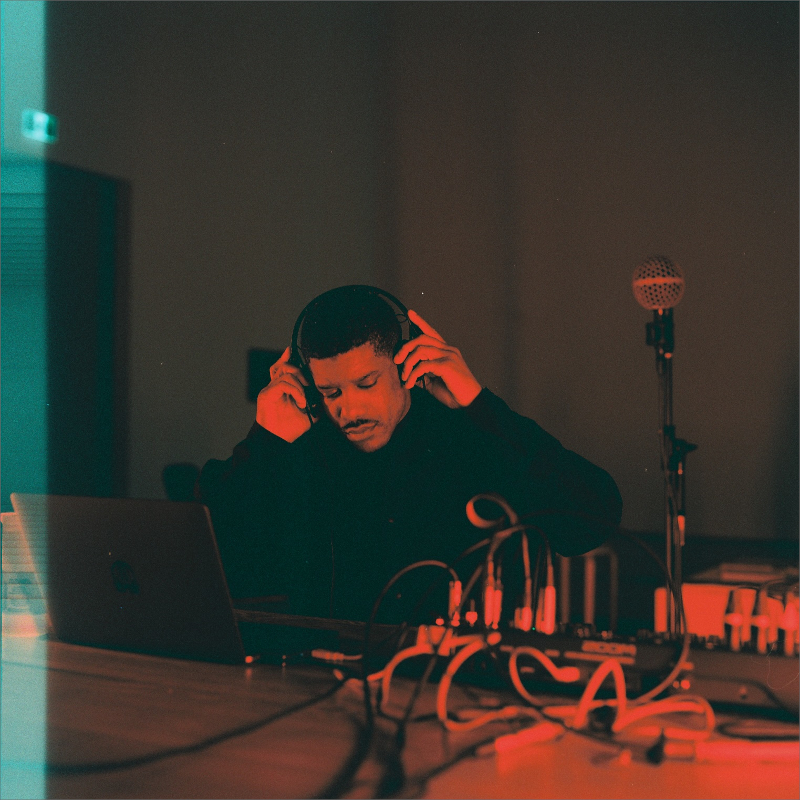
Within the latest Speaker Music transmission, Brown returns to the bastion of seriously adult musical content that is Planet Mu Records for the frankly exquisite Synoptic Audio. With its theme-first offering to the experience, De Forrest proposes sound itself as a system of critical inquiry. Here, numerous drums, drones, keyboards, and hardware intentions emerge as interdependent architectures for communication, articulated through a spectral hi-tech jazz intuitive movement via basic Apple devices in a heightened state of performance consciousness.
Initially performed as a real-time expression—in order to preserve the immediacy and necessity of instinct—the material channels Mark Hollis’ enduring maxim: “Before you play two notes, learn how to play one note. And don’t play one note unless you’ve got a reason to play it.” What follows is not improvisation as navel-gazed indulgence, but necessary improvisation as disciplined attentiveness: each gesture arriving with knowing and purpose, each absence functioning as core structural information.
The same recordings were later honed through an elevated speaker environment designed to incorporate the environmental instruments of space itself—bounce, wall, ceiling, resonance, pressure, decay, and texture. Space here is not passive acoustics but collaborative material; architecture acting upon and as composition in real-time. Brown’s process ultimately models a radical aural inclusiveness in which the music and its intent supersede the compatibility of shifting units for income.
A kind of alternate-dimensional expressionism ::
Across its ten tracks resonates the elemental wisdom that has become the DNA of the Speaker Music discography. Detroitian textures, techno-soul warmth, Motor City abrasions—a rhythmic capacity rendered through birthright and impossible to reproduce even under a direct attempt to xerox. The tempos continually elicit that merging of dancefloor and performer upon which Detroit’s electronic lineage was built: you could dance to it, absolutely. Yet the work simultaneously proposes a deeper question concerning the reason one moves at all.
The dance here appears dedicated to the machine-soul pioneers preceding the work itself. If all pioneers that channel transcendence from the outmoded and the fake. This album is political on the ears. Essential by force of its creative nature. Unapologetically elemental.
Opener “Techno Vernacular Expressionism” unfolds as a vast soundscape designed to articulate the scale and dimensionality of the recording methodology itself. By the time “Beyond the Broken Beat” arrives, Brown’s delicious haptic drum strafes emerge in scattergun celebration and fierce rhythmic propulsion, the bit-crush intensifying as though the tracks were actively rupturing under its their own abrasions and ecstatic pressure breaks.
Both the title piece “Synoptic Audio” and the following “GLO//A (Global Latency Optimization // Acceleration)” fuse experimental banshee-like aesthetics with the wall-of-sound traditions of Noise Music, mutating those roots into a kind of alternate-dimensional expressionism: white noise, pink heat, black soul, pure love. No nonsense. No lies.
Near the conclusion, “Dhalgren (Nihilism is Not Enough)” peaks outward into beatless industriana, returning the listener to the project’s central proposition: sound understood as source-intent and theoretical structure before commodity, before distraction, before the wasteful question of what the thing might merely do.

The very perfect closing of a circle ::
Having survived the closure of so many musical projects and artistic voices—including the aforementioned Mark Hollis, and alongside the newly re-emergent Boards of Canada—one cannot help but wonder the rationale for whether this could stand as Brown’s final statement as Speaker Music. Having heard the album in promotional form, the possibility strangely makes sense. Not from exhaustion, but completion. With sincere hope that other means of expression lend themselves as facilities for him. But I can still await, this nonetheless feels like the very perfect closing of a circle.
Naturally, at times artists continue speaking merely to fill the emptiness that follows having already said what needed to be said. Yet when an artist channels a wisdom—and wisdom enough to embody the humility and integrity required to recognize the fullness of a season—there is something profoundly rare in the ability to stand before a completed structure and simply say the immortal phrase: it is finished.
Perhaps that itself signals a deeper, acutely healthy relationship De Forrest‘s has to both beginnings and endings; an understanding that expression is not a pathway of infinite accumulation, but the innate capacity to travel consciously through all arrival, disappearance, and return. And that is a wisdom for the ages that feeds Truth to the art and the form. It’s sounds good to be reminded.
Synoptic Audio is available on Planet Mu July 10, 2026. [Bandcamp]
&bsp;