


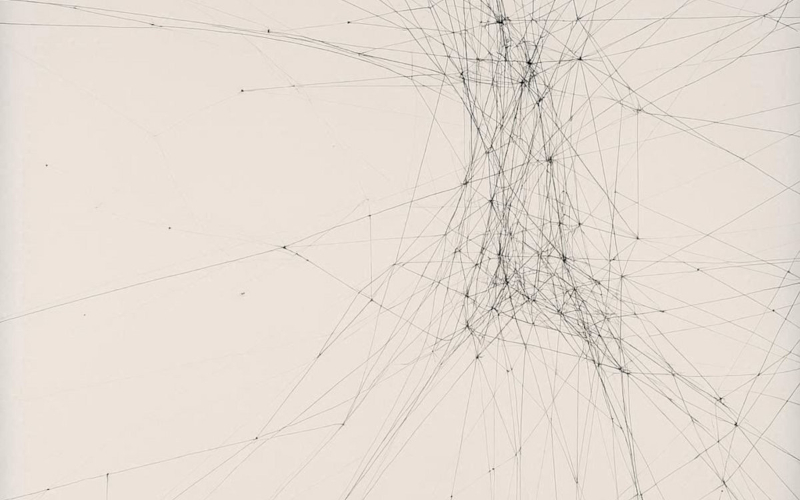



_729.root functions less as compositions in the conventional sense and more as active scaffolding for expression—temporary sonic architectures that think through signal, texture, and constraint, that lead the artists rather than being led by them.
An intoxicating miasma of restrained, harmonious code and data
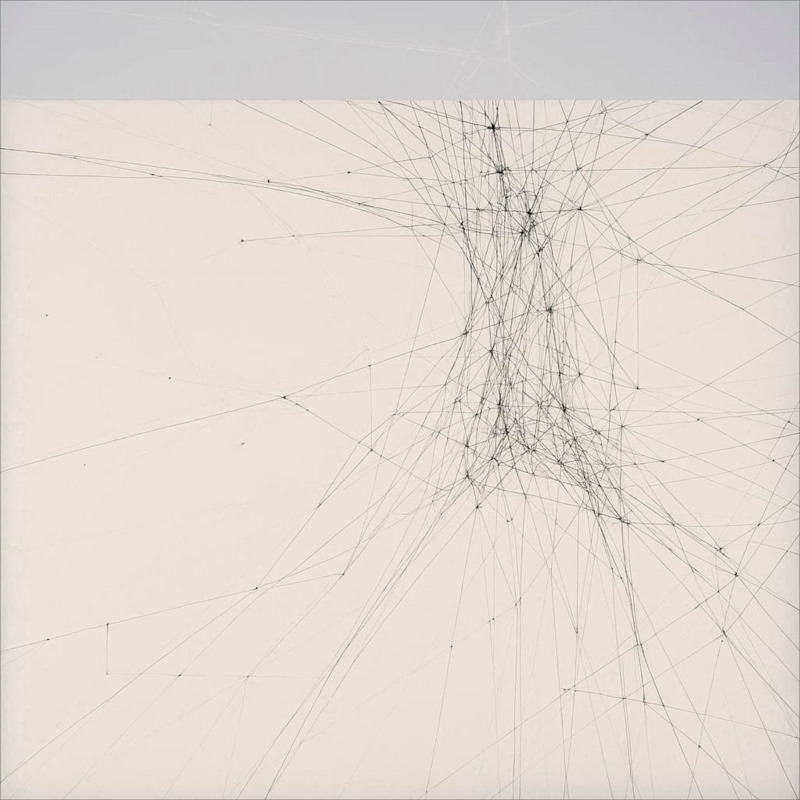
Bilbao’s electronic home of mature aesthetics, Polygon Network, returns with rheom‘s _729.root—a quietly commanding set of finely honed signals, pulses, and undulations, structured across eight segments of a single, cohesive work of latent synthesized experimental beauty.
Built through the art of subtraction rather than accumulation or indulgence in effect, the album sustains an intoxicating miasma of restrained, harmonious code and data. Abstract tonal pulses coalesce with skewed temporal signals, while micro-shifts in timbre and tension subtly destabilize any routine fixed sense of ground. Nothing is overstated; everything feels precisely placed and cohesive, as if each sound has been reduced to its most necessary state. Indivisibly raw and aurally inviting.
If there is such a thing as a “pure” strain of experimental electronics [there isn’t]—music that resists pretense while remaining entirely self-contained—then rheom‘s creativity stands as a compelling entry point. It doesn’t announce itself as a known and quantifiable familiarity, so much as resolve into being as it unfurls, occupying its own essential logic without reference to any desire for our external validation. Such intent if the genesis of an authenticity that resonates beyond accessibility and any need to pander. What remains is alluring precisely because of that. Marvelous.
Music that seems to think while it unfolds ::
As contemporary music moves further beyond the notion of linear artistry and the older, arguably redundant forms of creative expression, it increasingly inhabits what we might call a post-IDM condition: one that extends the lineage running from Stockhausen, through Reich and Sakamoto, Kraftwerk, into the early computational imaginations of next-gen early Warp Records’ Artificial Intelligence series, where electronic listening music began to definitively articulate itself as a space for non-human logic, synthetic interiority, and machine-led composition. This trajectory is further complicated by the fractal rhythmic and textural intelligence of Aphex Twin, Plaid, et al, whose work reframed complexity not as virtuosity but as emergent system behavior—music that seems to think while it unfolds, rather than express a need to declare.
Within this evolving context emerges what might be described as an a-musical practice: sound not organized around traditional hierarchies of melody, harmony, or narrative progression, but instead operating as self-regulating structure, process, and perception. A field condition rather than a composed object.
In this sense, works like rheom and the broader, 80 releases deep Polygon Network articulate this form resolutely outside any expectation. It functions less as compositions in the conventional sense and more as active scaffolding for expression—temporary sonic architectures that think through signal, texture, and constraint, that lead the artists rather than being led by them.
_ 729.root is available on Polygon Network. [Bandcamp]