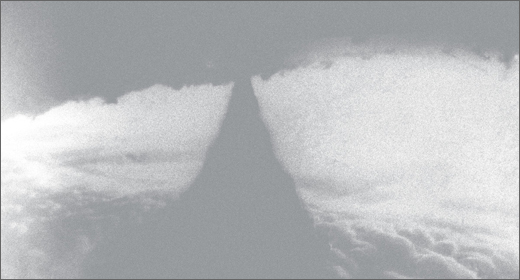



That Porous Line follows as a deliberate shift—letting in just enough light to see differently without abandoning the dark corners they prefer to inhabit.
Push For Night arrives here as a natural fit
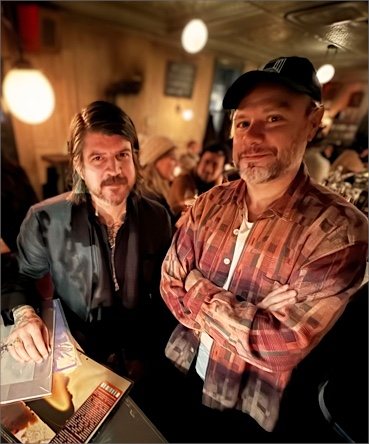
Room40 has been one of experimental music’s most important and quietly consistent labels since Lawrence English founded it in Brisbane in 2000. Over 25 years and more than 300 releases, it has built a catalog that spans electroacoustic composition, musique concrète, ambient, and avant-garde sound art—releasing work from Ben Frost, Tujiko Noriko, William Basinski, Grouper, and dozens of others. English works from a home studio built beneath a storage room containing literally a ton of records, an apt metaphor for a label that operates under the weight of its own history while continuing to push forward. Push For Night arrives here as a natural fit.

The duo of Oliver Chapoy—Brooklyn-based musician, producer, and engineer known for his work with Saxon Shore, Warm Ghost, and collaborations with Helado Negro and Mikael Jorgensen of Wilco and James Elliott, Louisville, KY-based and equally steeped in experimental and post-rock sensibility, began their collaboration in 2017 and have been slowly building a body of work that lives at the intersection of electroacoustic processing, collage, and abstract sound construction. Their previous Room40 release Lapsed Gasps was a dense, intense record built around Jon Mueller‘s archived percussion recordings, processed through heavy electronics. That Porous Line follows as a deliberate shift—letting in just enough light to see differently without abandoning the dark corners they prefer to inhabit.
“It’s Sure To Be Dark If You Shut Your Eyes” is a standout. The drums and glitched phaser of what sounds like a rolling percussion or hit every 8 to 16 bars is beautiful to the ear. There is a lot of stereo panning at play with their sound elements throughout, and while there really isn’t any persistent melody taking place, this leans more toward sound play and effects stacking—how many effects can they layer onto the same overlying loop until it gets absolutely destroyed and becomes something else. That question is the compositional engine driving a lot of this album, and here it’s applied with precision rather than aggression.
“Idler’s Reward” is another strong one as far as melodic content goes—its emotional build and three-part structure make it a compelling standpoint for emotional construction. The song has three distinct sections if you hear it that way. What sounds like a marking drum echoing in the background is ringed with delay and echo on particular instruments and synths, making it interesting to listen to as it unfolds. Right at the six-minute mark, a highpass filter is applied to a looping note being echoed as a beautiful clarinet, played by Zachary Koeber—emerges as the second section of the track, playing out until 7:39 where the third section arrives with no warning: distorted, filtered guitar chords coming in and echoing to their own death. It is a fascinating build piece that earns every minute of its eight-plus-minute runtime.
“Bait Is Lowered” continues the album’s definition of itself as a collection of building emotional pieces. Another fascinating piece of sounds. The incredible thing about experimental ambience like this is how long you can keep the listener engaged with the sounds being created and fatiguing them with noise or drone. Halfway through this track there’s a disruption—what can only be described as if you took a drum beat and submerged it in a bucket of water and started washing it aggressively as it builds up with suds. The music is very much imaginative. “Turned Slowly And Slowly Turned” is another dark piece with very subtle coos and creaky electronic rolls simulating what sounds like electronic animals or chirps, separated into two distinctive zones, far away and reverbed out on one side, the subtle coos chirping consistently back and forth softly on the other, no effects on them but slowed. Distortion play at its finest.
“Push For Night describes their process as decorating the cave and inviting specters to reveal a message, trying to catch something in the semi-dark.” ~J. Batista
“That Porous Line” is actually a beautiful closer, not the one expected after listening to this piece, but one that sounds genuinely immersive. The concept and theme of the album is still present, the bizarre distortions remain, but the melodies are toned down. Towards the end of the track there may be recycled field recordings surfacing, not to the naked ear but the trained one would catch it. The overall listen is actually pleasing, which for Push For Night is itself a notable statement.
This is fundamentally an effects album and it shows, in the best possible way. The structure of experimentation with guitars and ambience has come a long way from the post-rock tradition that both Chapoy and Elliott carry in their backgrounds, and what That Porous Line represents is those backgrounds fully dissolved into something that no longer resembles where it came from. Push For Night describes their process as decorating the cave and inviting specters to reveal a message, trying to catch something in the semi-dark. On That Porous Line, they caught more than they usually let go of, and the result is their most emotionally varied and accessible work yet, which for this duo still means strange, flickering, and lit by crepuscular light. That’s the appeal.
That Porous Line is available on Room40. [Bandcamp]