



MEGAFAUNA creates a dark atmosphere using nature sounds and electro-acoustic manipulation to take the mind somewhere it didn’t expect to go. Listening to this at early morning hours, at normal volume, lying down, not fully awake, is a specific and disorienting experience. It’s quite amazing for what it is: a live improvisation built from birds that manages to sound like a horror score composed by the landscape itself.
A strength in honest field recording work and a meticulous approach to effects
MEGAFAUNA is a project based out of Hazelton, British Columbia, a small town in Northern BC’s Skeena Country, deep in a landscape of mountains, rivers, and boreal wilderness. Operating under the self-described tag “despairtronica,” the project has built a catalog of IDM-influenced and breakcore-adjacent electronic music characterized by hard drums, fast tempos, and dense sonic construction. A September release is on the horizon that will return to that territory. Birdsong is something else entirely, and that contrast is part of what makes it worth paying attention to.
The field recording and bioacoustics tradition has a long and serious history. Bernie Krause—one of the foremost soundscape ecologists alive, has spent over fifty years recording natural soundscapes and coined the term “soundscape ecology,” documenting how the sonic layers of an environment (biophony, geophony, anthrophony) create a complete acoustic picture of a habitat’s health. The Cornell Lab of Ornithology‘s Macaulay Library holds over 175,000 audio recordings of wildlife going back to 1929, including the world’s oldest known wildlife sound recordings. Ornithological vocalization analysis—the study of bird calls for species identification, territorial behavior, and mating patterns, is a genuine scientific discipline. What MEGAFAUNA does here isn’t science. But it borrows from the same raw material and pushes it somewhere considerably darker.
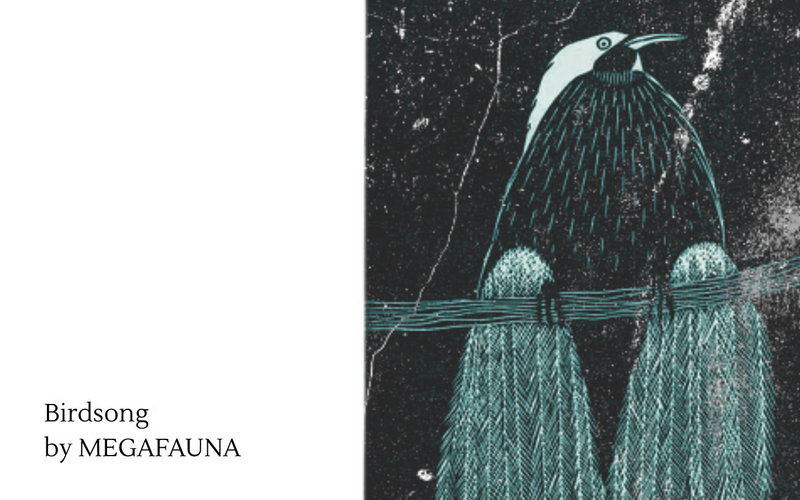
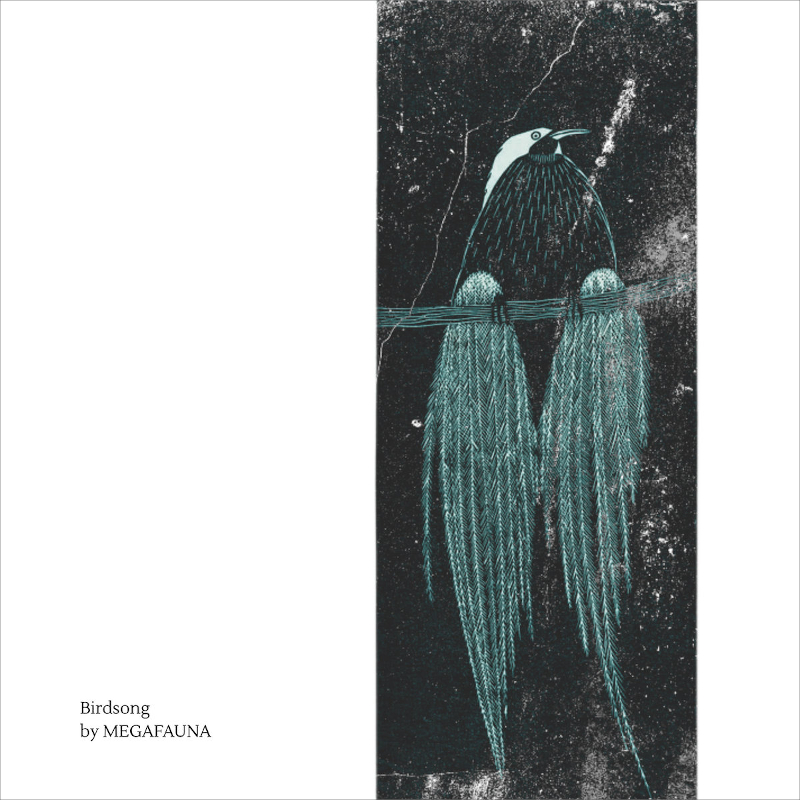
Birdsong was commissioned by circumstance, an invitation to perform at the Midsummer Music Festival in Smithers, British Columbia, with a specific request for something more ethereal than the prior year’s set. The response was a 42:42 improvised piece built entirely from bird call samples, performed live on July 4th, 2026, with rain and thunder added afterward to reflect what was literally happening before, during, and after the performance in real life. The track listing credits specific birds by role—percussion (Shoebill, Crested Caracara, Lyrebird), vox (Quail, Three Wattled Bellbird, Bearded Bellbird, Capuchin, Horned Screamer, Screaming Piha), ambience (Common Loon, Helmeted Hornbill, Pheasant Coucal, Tawny Frogmouth), melody (Raven, Australian Bustard, American Bittern, Common Starling, Magpie), and keyboard (Crow). Whether this is satire, creative taxonomy, or a genuine documentation of sources used, it’s a uniquely compelling framing device that makes the listener hear the piece differently, starting to identify what each bird might be contributing to the overall texture.

What MEGAFAUNA shows with “Birdsong” is a strength in honest field recording work and a meticulous approach to effects, how carefully FX are applied to these recordings and how that compositional process produces something genuinely interesting. None of it is repetitive. These are natural sounds being manipulated very carefully with dark ambience throughout. None of the atmosphere on this release is pleasant, it presents itself as a dark record, which is also what makes it strangely unique. When you think of birds, darkness isn’t the first association, unless you’re thinking of vultures or birds of prey. But MEGAFAUNA pulls darkness out of unexpected sources. The Horned Screamer and Screaming Piha are doing exactly what their names suggest, and pitched down and ring modulated, they become something else entirely.
The first two minutes present something resembling a rainforest, birds layering and overlapping in what sounds like natural habitat. Then around the 3:30 mark, things shift. The atmosphere darkens and stays dark, little bursts of FX being applied to various bird calls, distortions and pitching manipulations building until the 23-minute mark where something changes audibly. A pitch-bending melody arrives like an echoing alarm, a new segment of birds being introduced, the composition pivoting into its second movement. At the 27:40 mark, another sound surfaces that reads initially as an alarm but is clearly a bird call being manipulated—low pitched, ring modulated, buried under heavy reverb, looping in a way that creates something deeply unsettling and hard to source. It’s the kind of sound that makes you question what you’re hearing.
The FX work is what really stands out, the ability to keep ears engaged with bird calls and sounds for 42 minutes without the piece becoming monotonous is a genuine compositional achievement. MEGAFAUNA creates a dark atmosphere using nature sounds and electro-acoustic manipulation to take the mind somewhere it didn’t expect to go. Listening to this at early morning hours, at normal volume, lying down, not fully awake, is a specific and disorienting experience. It’s quite amazing for what it is: a live improvisation built from birds that manages to sound like a horror score composed by the landscape itself.
Birdsong is available on Bandcamp.