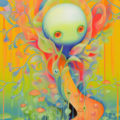


The music of John Cage & Earle Brown captures the essence of Cage’s and Brown’s avant-garde philosophies, making it essential for enthusiasts of experimental classical music, and for those that want to tip their toe into exploring the beginnings of electronic music.
An ephemeral constellation of sounds
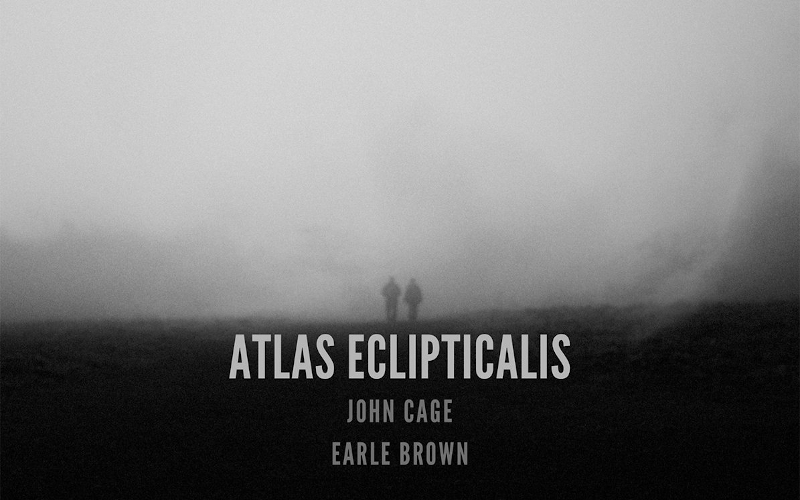
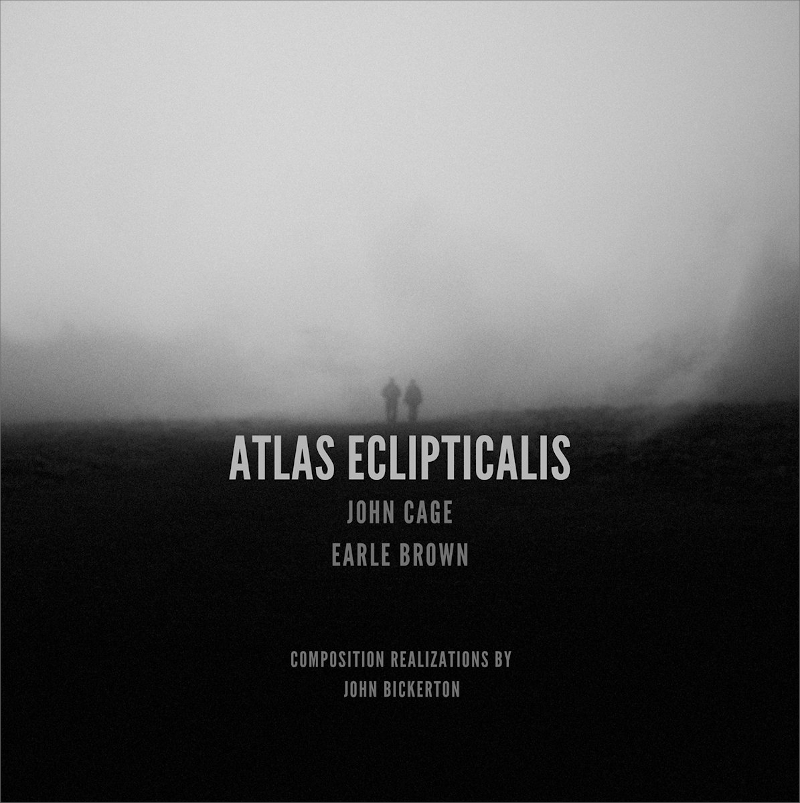
Atlas Eclipticalis – The music of John Cage and Earle Brown, released on Simple Harmonic Motion, is a captivating exploration of chance, structure, and sonic unpredictability. The album presents realizations of Cage’s Atlas Eclipticalis (1961), Variations IV (1963), and 0’00” (1962), alongside Earle Brown’s graphic scores November 1952 and December 1952, concluding with Cage’s Radio Music.
The performances, arranged by John Bickerton, honor Cage’s and Brown’s radical approaches to composition. Atlas Eclipticalis, originally inspired by astronomical charts, emerges here as an ephemeral constellation of sounds—fragmented, shimmering, and unpredictable. Variations IV transforms an architectural space into a dynamic sonic landscape, while 0’00” blurs the line between music and everyday action, embracing amplification as a means of highlighting mundane yet musical gestures.

Brown’s November 1952 and December 1952 offer structured freedom, with musicians interpreting spatial and visual cues rather than traditional notation. These renditions maintain the tension between intent and randomness, a hallmark of Brown’s work. Finally, Radio Music recontextualizes AM radio broadcasts into an intricate, evolving soundscape.
This release captures the essence of Cage’s and Brown’s avant-garde philosophies, making it essential for enthusiasts of experimental classical music, and for those that want to tip their toe into exploring the beginnings of electronic music.
“This album presents realizations of famous indeterminate and graphic music scores from what became known as “The New York School.” The term refers to a circle of composers in the 1950s, which included John Cage, Morton Feldman, Earle Brown, and Christian Wolff. Their music influenced the music and events of the Fluxus group. It drew its name from Abstract Expressionist painters working in New York.” ~johnbickerton.hearnow.com
Musicians ::
Veronika Blachuta – flute
Nick Akdag – bassoon
Giovanni Todaro – trumpet
Zachary MacLurg – trombone
Cecilia Cuccolini – harp
John Bickerton – piano/electronics
Jessica Townsend – violin
Thomas McCluskey – violoncello
Atlas Eclipticalis – The music of John Cage & Earle Brown is available on Simple Harmonic Motion. [Bandcamp | Site]