

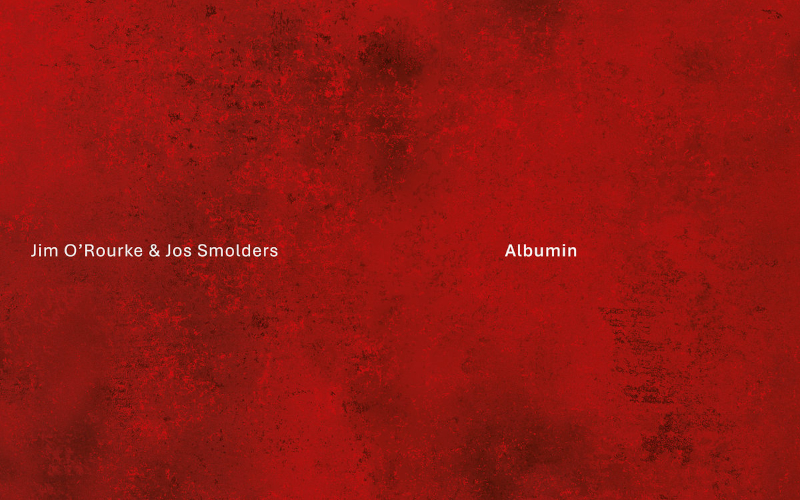

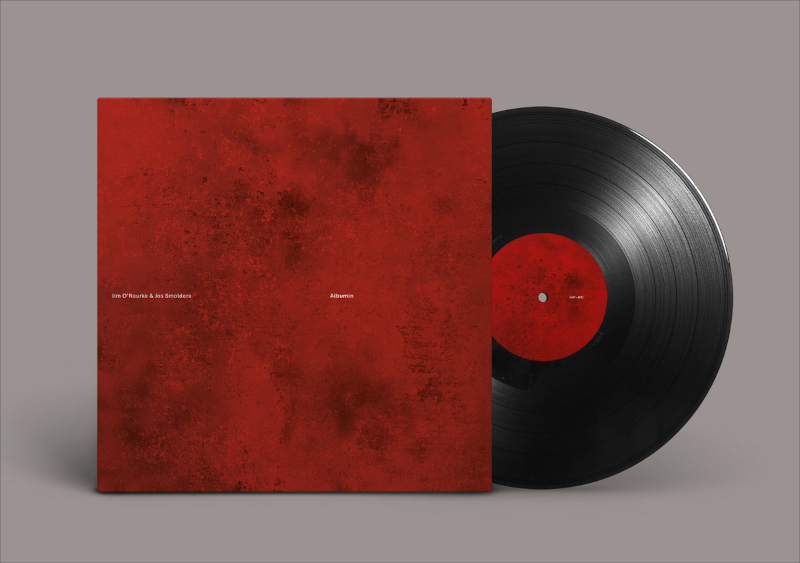
Albumin is limited to 500 copies on vinyl through Moving Furniture Records, and it’s exactly the kind of release that rewards deep, focused listening. Put it on, turn it up, and let the textures do the work.
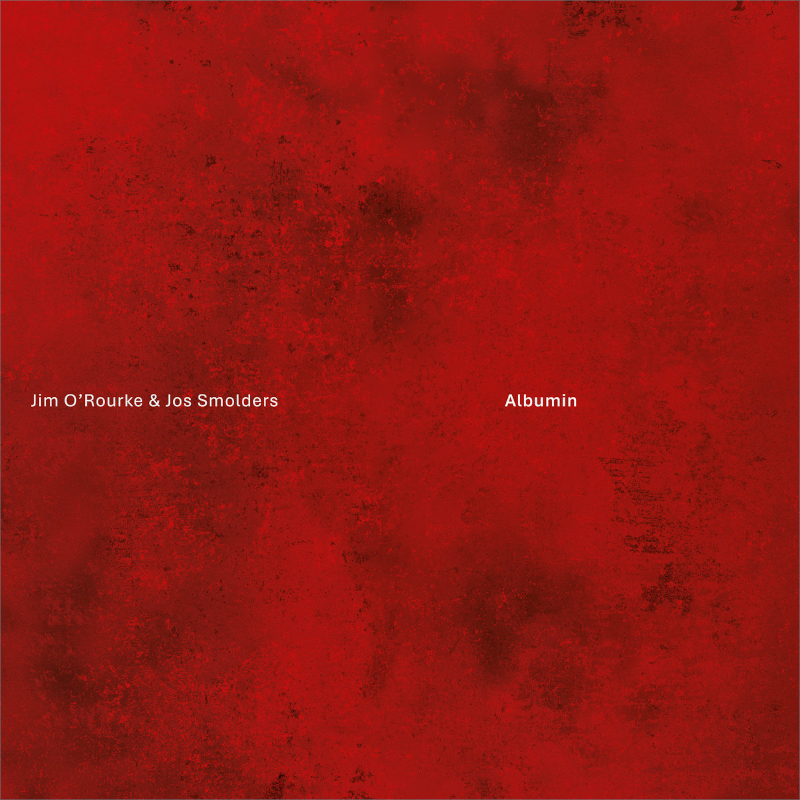
From hard surfaces to deep sonic wells
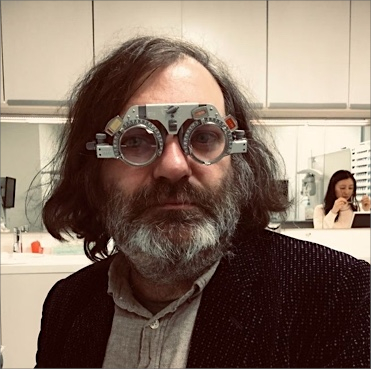
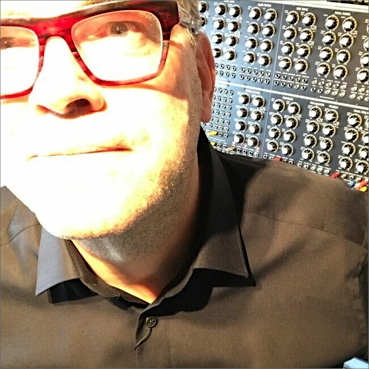
Jim O’Rourke and Jos Smolders don’t need much of an introduction—at least not in the traditional sense. O’Rourke, the Chicago-born experimental musician, composer, and producer, has spent decades moving between post-rock (Gastr del Sol), indie rock (Sonic Youth), avant-garde improvisation (collaborations with Derek Bailey, Loren Connors, Oren Ambarchi), film scoring (Wilco’s Yankee Hotel Foxtrot, Ryusuke Hamaguchi’s Drive My Car), and solo electroacoustic work released through his Steamroom series. Jos Smolders, the Dutch sound artist and founding member of the electroacoustic ensemble THU20, has been researching electronics since 1980. He started with tape experiments as a teenager, quit architecture studies at Delft Technical University to pursue sound full-time, and has since built a career around meticulous sound design, mastering, and restoration work at his EARLabs Studios. Their first collaboration, Additive Inverse (2021), was a careful exchange of sounds built over time. Albumin follows the same workflow, but this time O’Rourke took the lead, kicking off with a salvo of sounds extracted from his Kyma System.
This release consists of two tracks that are treated as longer excerpts. Since this is experimental ambient work, it’s not out of the ordinary for productions to be treated this way. This is looked at as an abstract piece of art: track 1 titled “(HP-HP)” and track 2 titled “r(OP-OP)”. The track titles are cryptic—my guess is they’re references to signal processing terminology or spectral analysis. “HP” could stand for high-pass filter, “OP” for operational or operational amplifier, or they could be algorithmic markers from the Kyma System or granular synthesis parameters. Either way, the titles suggest a technical approach to sound rather than a narrative one. Both O’Rourke and Smolders were quite interested in the spectral character of sounds. O’Rourke applied Kyma algorithms while Smolders granulated his basic recordings. That way, textures are built, quite slowly moving from warm to gritty, from hard surfaces to deep sonic wells.
This is explorative and open for interpretation ::
This release is ambient but not drone in nature or even melodic. There is a mixture of sound experimentation here. “r(OP-OP)” in its essence has a very high-pitched sound that bleeds in throughout and seems to be the backbone for everything else that evolves around it. A mature listen for sure, as this is not set up for melodies or drums at all, just sound design at its core. Although its intro was very beautiful in its start, instead of describing the production piece, it’s easier for me to explain what I’m hearing visually, as these things are very imaginative when I hear them. That sharp ringing sounds like electronic crickets inside a sea of dying and corrupted files. With a runtime of 18 minutes, still referring to “r(OP-OP),” the excerpt has four phases: intro—dark mystery build—high-pitch sound starts to evolve—to a forgotten sound, or corrupted sample that drones.
The first track, “(HP-HP),” is different in its sound design. As it opens up with faded stereo atmospheric pads, its experimentation deals more with subtle tones. You hear a sneak of “r(OP-OP)”‘s high frequency bleeding in, and I think it’s because both producers are really trying to explore that piece of sound design throughout. This has three phases: intro—electric wind chimes that are corrupted—just dark ringing from a phased and collapsed sound from the intro.
Sculpting timbres, resonances, and harmonic relationships ::
This is explorative and open for interpretation more than it is just a concept. O’Rourke and Smolders are working in the tradition of musique concrète and electroacoustic composition, a lineage that traces back to Pierre Schaeffer, Karlheinz Stockhausen, and Luc Ferrari. The Kyma System O’Rourke uses is a high-end sound design platform that’s been a staple in experimental electronic music and film sound design since the 1980s. It allows for real-time spectral manipulation, granular synthesis, and algorithmic processing that would be difficult or impossible to achieve with traditional hardware. Smolders‘ approach—granulating basic recordings, is a complementary technique. Granular synthesis breaks sound down into tiny grains (usually 1-100 milliseconds) and reassembles them, allowing for extreme time-stretching, pitch-shifting, and textural manipulation without the artifacts you’d get from traditional methods. When both artists focus on spectral character, they’re working with the frequency content of sound rather than its temporal structure. This means they’re sculpting timbres, resonances, and harmonic relationships in ways that feel more sculptural than compositional.
The music is in constant flux. What makes Albumin work is that it never settles. Both artists are committed to process over product, and the result is a document of two seasoned experimentalists exploring the grain of sound itself. For listeners familiar with O’Rourke‘s more song-oriented work on Drag City or his tenure with Sonic Youth, this will feel like a return to his roots in the Chicago improvisation scene. For those who know Smolders through THU20 or his mastering work, this is familiar territory, meticulous, patient, and uncompromising. Albumin is limited to 500 copies on vinyl through Moving Furniture Records, and it’s exactly the kind of release that rewards deep, focused listening. Put it on, turn it up, and let the textures do the work.
Albumin is available on Moving Furniture. [Bandcamp]

Related posts ::
 Jos Smolders :: Textuur 1 [number 1-9] (Moving Furniture)
 Orphax :: Continuation (Moving Furniture)
 Fani Konstantinidou :: Undertones (Moving Furniture)
 Aidan Baker & Dead Neanderthals :: Cast Down And Hunted (Moving Furniture)
 Zeno van den Broek, HIIIT, Gagi Petrovic & Machines :: Relatum (Moving Furniture)