






Coniglio has made an album that honors the craft of earlier soundscape practice while carrying it into a private, contemporary meditation on cause, chance and presence. It is beautiful, grave, lucid, quietly overwhelming.
Programmed with the patience of reception, performed with exact mercy
13/19/32 A Catalogue Of Delays opens like a machine that has learned to breathe, a gentle engine of memory where every tone casts a future shadow and every future shadow returns carrying a new tint. Enrico Coniglio, Venetian guitarist, composer, sound artist and environmental recordist, has long treated sound as a way of reading place, weather, ruin, industry, water and human trace. Here he turns that long devotion toward time itself. The city that shaped him seems present in the work, purified of postcard temptation. Venice appears as method, as humidity inside the signal, as patience, as refraction, as a pulse moving across stone, canal light and electrical air.
The title gives the key to the whole undertaking. Thirteen, nineteen and thirty two seconds, with the longer delay doubled, form the temporal grammar from which the album grows. The source is a classic lineage of guitar synthesis and delay craft: Roland tones, the revered TC Electronic 2290, Eventide treatments, the living afterglow of Robert Fripp’s Soundscapes. Coniglio approaches this inheritance with care and gratitude, turning a tradition of looping guitar into a personal philosophy of consequence. A played note becomes a promise. Its return carries the exactness of a diagram and the tenderness of a recollection. The delay line becomes a moral instrument: it teaches the listener that every gesture continues to act after its first appearance, that sound is action prolonged.
Across nearly forty five minutes the album unfolds as one broad organism. It has short luminous portals at each end and a central body that expands in slow waves, gathering density, brightness, fatigue, splendor and ash colored calm. The field recordings placed near the opening of a couple of pieces do exactly what they should do in Coniglio’s world: they give the electronic material a climate. They bring air into the circuit. Then the guitar synthesizer rises, sometimes choral, sometimes reed like, sometimes close to the soft pressure of an organ heard through water. The tonal mass favors low and middle bands, where the music gains weight, while upper harmonics enter as silver powder. The result feels tactile, a music one almost reads through the fingertips.

What fascinates is the way the album makes order sound unstable while preserving its secret arithmetic. Delay is usually sold as atmosphere, a halo around the note. Coniglio treats it as architecture in motion. The repeated events meet and fold into asynchronous constellations, precise in origin, sensuous in effect. The ear receives them as drift, and the system knows where each return belongs. This creates the record’s deeper emotional charge: a calm fatalism crossed by choice. The device predicts; the musician intervenes. A line is placed into the circuit, then life begins inside the pattern. Each new note changes the moral temperature of what came before. Each silence becomes an act of composition.
The album carries drama through pressure, through the way a tone gathers companions until it resembles a weather front, through the way a harmonic shimmer slowly acquires a body and then yields to a darker current. Coniglio’s sound palette cultivates duration as an ethical practice. One senses a musician trained by field work, by the discipline of listening before naming, by the humility required to follow a place through its smaller signals. That background gives 13/19/32 a special gravity. In its purely synthetic passages, it feels observed, programmed with the patience of reception, performed with exact mercy.
The Fripp reference could have become a comfortable shrine. Coniglio uses it as a living tool. The sustained guitar synth lines carry an unmistakable ancestry, and his Venetian sensibility bends the language toward silt, fog, industrial resonance, lagoon dusk and civic melancholy. Cosmic reach gains tidal pull; celestial shine gains mineral grain. It favors gradual pressure over flight. Its beauty comes from held attention, from discipline around ornament, from a faith in the long curve. In this sense, the album belongs to a lineage where technology gains dignity through restraint. Machines are allowed to sing because the hand guiding them has learned how to wait.
The old dream of ambient music, sound as environment, gains a sharper contour here: this is ambient as causality, ambient as memory under voltage, ambient as the patient study of what follows an act. ~Mirco Salvadori
The longer central movements hold the listener in a suspended physics. Coniglio’s delays behave like planets with fixed orbits, while his improvisational gestures act like sudden lights crossing those orbits. The album’s conceptual frame, hovering between classical causality and quantum possibility, could sound academic on paper. In practice it becomes deeply sensual. You hear destiny as overlap. You hear freedom as timing. You hear the smallest intervention opening a field of possible futures. The old dream of ambient music, sound as environment, gains a sharper contour here: this is ambient as causality, ambient as memory under voltage, ambient as the patient study of what follows an act.
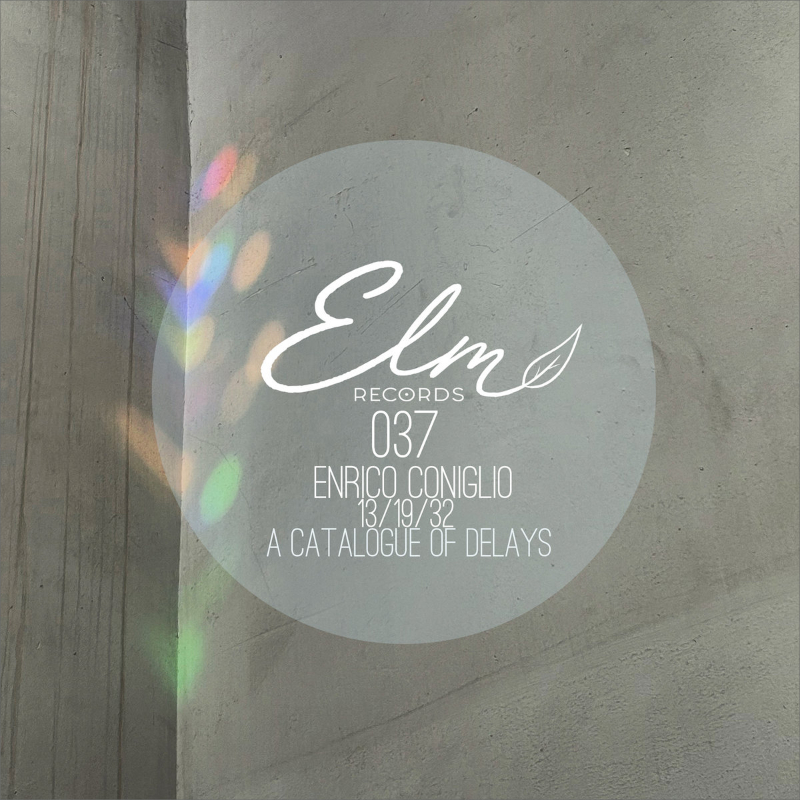
The mastering by James E Armstrong leaves the work broad and breathing, preserving the soft grain of the delays and the syruped density of the reverbs. James Osland’s artwork, pale, concrete toned, touched by spectral color, mirrors the music with striking precision: a muted surface crossed by hidden radiance. This visual restraint matters, because the album itself operates through muted force. It glows by accumulation. It does its most powerful work through recurrence, through patient returning, through an elegant distance from easy climax.
By the time the final tones dissolve, 13/19/32 A Catalogue Of Delays has described an entire poetics of return. It speaks of how time copies us, how each act sends replicas into the hours ahead, how memory may be exact and still feel mysterious. Coniglio has made an album that honors the craft of earlier soundscape practice while carrying it into a private, contemporary meditation on cause, chance and presence. It is beautiful, grave, lucid, quietly overwhelming. A catalogue, yes, and a weather system of the mind: measured, human, radiant, and filled with the solemn grace of sounds that know where they came from and where they are going.
13/19/32 A Catalogue of Delays is available on Elm. [Bandcamp]