



Sonnailles moves from restraint into release, but never fully lets go. It maintains the precision associated with Raster while leaning more into physicality and motion. The influence of rhythm and movement is more present, but still abstracted, never fully resolving into something predictable.
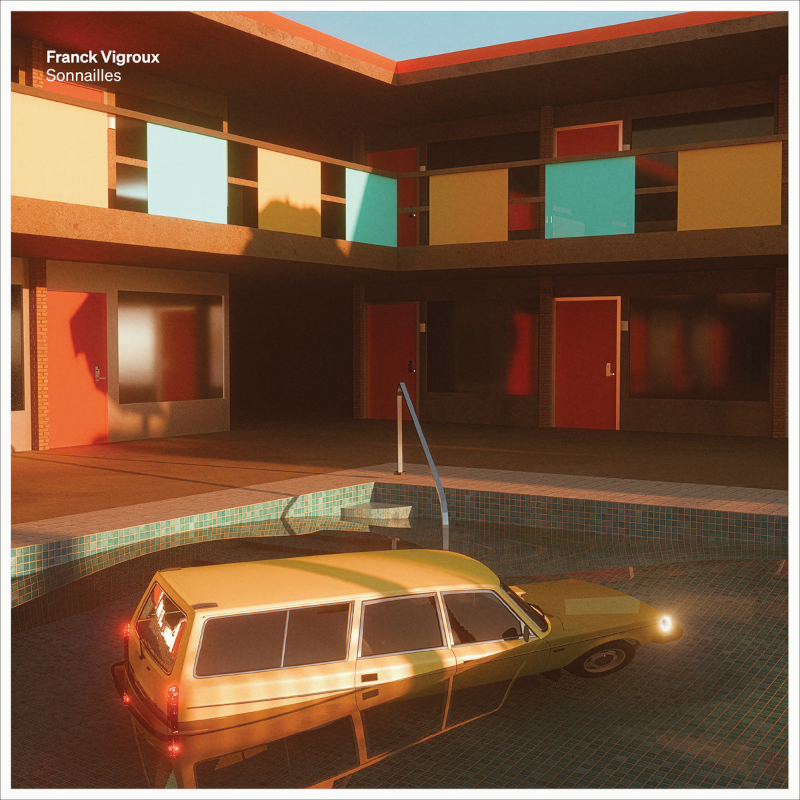
Movement and tension
There’s a certain expectation that comes with a Raster release. The label’s history, from its earlier Raster-Noton era through to its current output, has always leaned into precision, structure, and a kind of architectural approach to sound. Artists like Alva Noto and Ryoji Ikeda helped define that language early on, focusing on reduction and detail, while more recent releases have shifted toward something more physical and textural. Franck Vigroux fits into that evolution naturally, but Sonnailles pushes further into movement and tension without losing that controlled edge.
This album feels very thought out from the start, and what stands out first is the intention behind the drums. Vigroux locks into a particular drum palette early on, using subtle, controlled hits across the first four tracks. It’s not about impact in a traditional sense, but more about placement and restraint, where each sound feels measured and deliberate.
The percussion carries much of the emotional weight. Rather than driving the tracks forward in an obvious way, the drums act as textural anchors, shaping the atmosphere through tone, decay, and spacing. These opening tracks almost function as a study in drum sound design as much as composition, where small variations in texture become the focus.”La porte du paradis” stands out as the midpoint, but not as a transition. It feels more like a rest stop within the album’s structure, allowing space to open before the second half shifts direction. One of the defining elements here is a long, sustained horn-like synth that stretches across the track, sitting alongside a brighter, almost 64-bit sounding tone that drops in intermittently. There’s something oddly familiar about it, like the introduction screen to a late 1980s adventure game, but recontextualized in a more minimal and abstract setting. It adds a subtle sense of nostalgia without breaking the overall tone, giving the track a slightly different emotional register compared to the more restrained material surrounding it. It holds its own position rather than bridging sections, which makes it feel even more distinct.
More restrained and embedded into the structure ::
From there, the tone becomes noticeably harsher. “Plein soleil” marks a clear shift, introducing distorted kicks, detuned guitar-like samples, and vocal elements that feel raw and confrontational. The vocal presence in particular has a kind of intensity that briefly recalls someone like the artist Igorrr when he leans into shouted or strained vocal bursts, but it doesn’t sit in that same chaotic or theatrical space. Here, it feels more restrained and embedded into the structure, less about spectacle and more about pressure. The voices come through as fragmented outbursts rather than full expressions, adding to the track’s sense of instability without fully taking it over.
There is also a stronger presence of sampling here. Fragments of guitar riffs and vocal chops begin to cut through the more controlled framework established earlier, adding instability and a sense of rupture. It feels less contained, as if the system built in the first half is starting to push beyond its limits. This track stands out as one of the strongest moments on the release, leaning into a distinctly Raster-like sound. The drums and rhythmic structures feel more defined here, and they continue to open up with each pass, revealing more detail and depth over time.
“Videopolis” feels like an extension of ideas introduced in “La porte du paradis,” but it develops them into something more defined. There are moments where elements briefly lock into place, creating a sense of direction that stands out against the earlier restraint, even if it never fully settles.
Overall, Sonnailles moves from restraint into release, but never fully lets go. It maintains the precision associated with Raster while leaning more into physicality and motion. The influence of rhythm and movement is more present, but still abstracted, never fully resolving into something predictable. In that sense, the album sits in an interesting space between structured sound design and something more immediate. It does not fully commit to the dancefloor, but the intention to move bodies is clearly embedded within its framework, making this a distinct entry in both Vigroux’s catalog and Raster’s evolving output.
Sonnailles is available on Raster. [Bandcamp]