



A return forged in fire, Where Light Pauses in the Silence of the Sun transforms memory into a weighty, luminous architecture of sound that feels both inevitable and enduring.
Transformed continuity
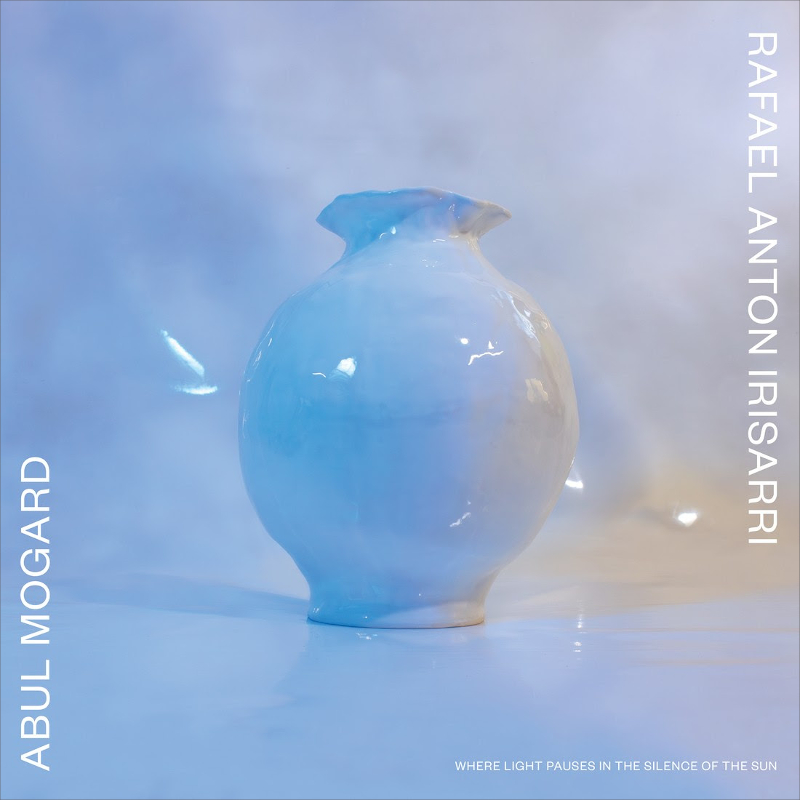
On the cover, a vessel returns. It returns from 2024, the year of Impossibly Distant, Impossibly Close, with a different temperature, a different degree of completion, a different light resting on its shoulders. There it was clay still exposed to its primary nature. Here it is a form that has passed through fire, smoothed, glazed, ready to reflect the shimmer around it. It is an image that says a great deal even before the music begins, because Where Light Pauses in the Silence of the Sun lives within this idea of transformed continuity, of matter that preserves the memory of its origin while moving toward a condition that feels firmer, broader, more final.
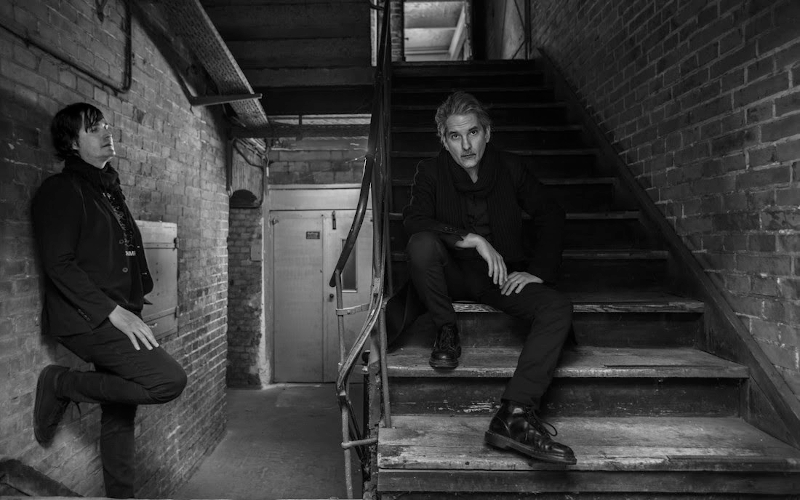
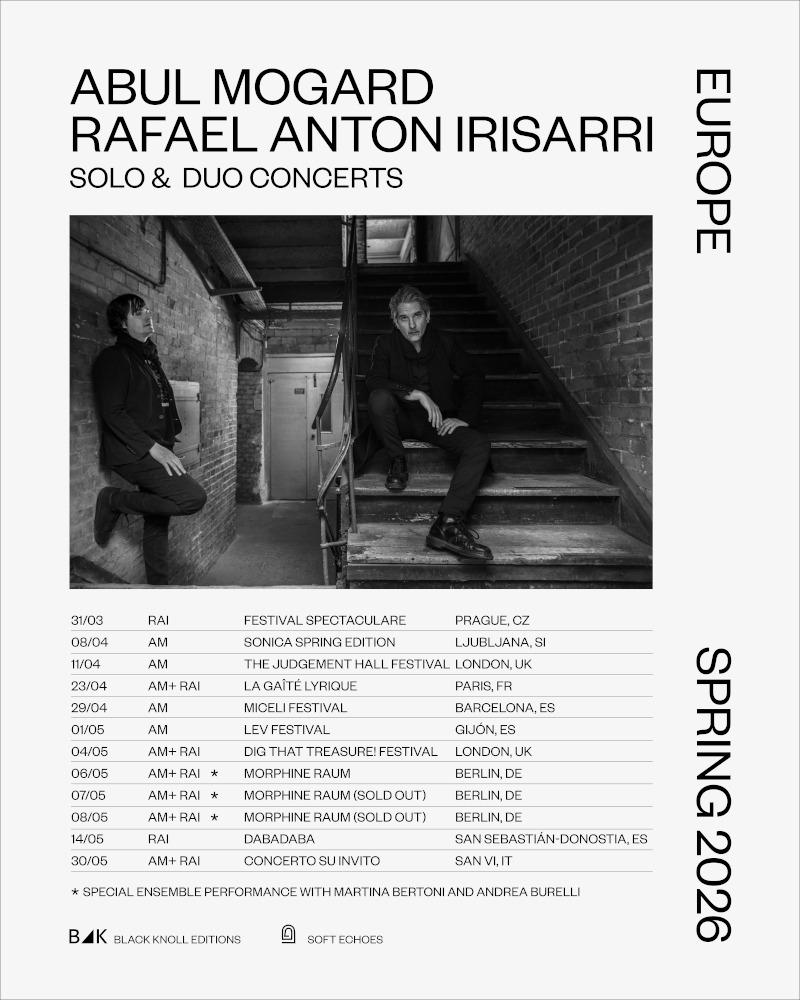
The second shared work by Abul Mogard and Rafael Anton Irisarri, due out on June 26 through Black Knoll Editions, presents itself as the natural continuation of an understanding that had already found a rare balance on the previous record. That balance now widens, breathes more fully, gains a deeper sense of perspective and a sculptural quality of sound. The album was born out of a three day residency at Morphine Raum in Berlin in March 2025, a space with no stage, where those who perform and those who listen share the same ground and the same exposure. It is a crucial detail, because this album carries within it that kind of proximity, that direct current between gesture and reception, between vibration and body, that only certain live situations can impress into sonic matter.
From those evenings the duo drew its initial material, then set it back in motion in the studio, above all in Rome, through a patient process of transformation. Extended passages, isolated fragments, loosened tempos, recomposed forms. A practice that belongs to the great tradition of electroacoustic music, yet here bent toward an extraordinarily strong narrative sense. The sound is guided toward a slow becoming. Every thickening has a function, every suspension prepares a threshold, every return carries with it a different quality of time.
Perhaps the album’s most striking quality lies in its ability to become monumental without growing rigid. Much contemporary ambient music works through suspension, persistence, the beautiful surface of timbre. Mogard and Irisarri choose another path, the path of construction. There is gravity here, there is weight, there is an architectural notion of sound, and yet within this grandeur an extremely subtle inner mobility remains intact. The low frequencies press forward, rotate, pull. The textures open into depth like fields of force. Electronic instruments and bowed ones merge so completely that the origin of any single sonic event becomes secondary. What truly compels is the point at which the signal stops declaring where it comes from and begins to exist as full presence.
Every addition is absorbed into the overall organism ::
Within this process, the contribution of Martina Bertoni and Andrea Burelli carries far more weight than the credits alone might suggest. Their presence reshapes the album’s breathing, broadens its palette, and introduces an organic element that pushes the whole structure toward a zone of greater emotional resonance. Bertoni’s cello brings with it a rough, material grain, capable of giving the music a precious friction. Burelli’s violin and voice add an ascending quality, a tension with a liturgical inflection, which illuminates the centre of the work and heightens its sense of verticality. Every addition is absorbed into the overall organism.
This is where the album reveals its true stature. Where Light Pauses in the Silence of the Sun has the assurance of a fully formed shared language. The two authors seem to have reached a level of interpenetration in which individual decision loses its central place in favor of a broader, almost impersonal dynamic, as though the sound had found its own trajectory and they were simply following its inner demands. It is a rare quality, one that belongs to genuine artistic partnerships, those in which each identity remains recognizable and yet flows into a third presence, larger than the sum of its parts.
The listening experience returns exactly this sensation, that of a work moving through shifts in density, through slow currents, through changes in focus. It asks the listener to remain within its gravitational field long enough to understand how the light of the title acts as a structural principle. Here light does not console, it does not embellish, it does not spread warmth. It pauses, lingers, filters across dark sonic surfaces and makes them glow from within with measured intensity. It is a light that thinks, that weighs, that makes the sediment of time visible. That, too, is why the title is so beautiful. It suggests a pause, a point of stillness, and within that pause it allows the full tension between apparent immobility and continuous transformation to emerge.
There is also another element that makes this release important for the current year. While a substantial part of ambient and electronic production dissolves into a decorative function, into polished soundscapes ready for immediate consumption, Mogard and Irisarri continue to defend the idea of the album as a demanding experience, as a form endowed with historical weight and inner necessity. In their music one can still hear the lesson of a certain European minimalism, of more abstract industrial music, of sacred music reimagined through electricity, of drone tradition understood as a discipline of listening and duration. Yet nothing here feels museological, nothing feels like repertory. Everything lives in the present with a severe lucidity and a beauty born of control, subtraction and patience.

Even the choice of BioVinyl, in an edition that already announces itself as an object to be kept, seems entirely coherent with this poetics of permanence. It is as though every detail, from the sound to the image, from the iconographic genealogy of the vessel to the final shaping of the whole, contributed to defining a work that intends to endure. And to endure, truly, today, means stepping outside the traffic of the instantaneous, the rapid obsolescence of commentary, the quick consumption of the new.
For this reason, Where Light Pauses in the Silence of the Sun should already be welcomed as one of the decisive statements of the season. It is an album that confirms the strength of the artistic bond between Abul Mogard and Rafael Anton Irisarri and at the same time raises it to a higher level, more cohesive, deeper, more ambitious. Above all, it is a work that restores to listening a lofty, almost moral function: to stop, to enter, to allow oneself to be altered. The vessel, in the cover artwork by Marja de Sanctis, returned to us from 2024 and now transfigured by fire, says this better than any promotional formula ever could. Within that form lies an idea of continuity that safeguards the past and sends it forward. Within this album, sonic matter finds a rare balance between memory and vision, between discipline and surrender, between shadow and radiance.
When it arrives, it will be clear that we are in the presence of one of those works that give measure to the time in which they appear.
Fully, unmistakably, already today.
Where Light Pauses in the Silence of the Sun is available on Black Knoll Editions June 26, 2026. [Bandcamp | LinkTree]
Related posts ::
 Abul Mogard & Rafael Anton Irisarri :: Impossibly Distant, Impossibly Close (Black Knoll Editions)
 Five Questions with Rafael Anton Irisarri (Black Knoll Studio / Black Knoll Editions)
 Rafael Anton Irisarri :: A Fragile Geography: Reworks (Black Knoll Editions)
 Rafael Anton Irisarri :: Points of Inaccessibility (Black Knoll Editions)
 Rafael Anton Irisarri :: FAÇADISMS (Black Knoll Editions)