




There’s no dancefloor here, no need to lock into a groove or deliver a drop. Instead, Paap is chasing sound for sound’s sake, pushing stereo dynamics, distorting drum loops until they fray, stretching reverbs until they fill entire rooms.

Chasing sound for sound’s sake
Speedy J — the alias of Rotterdam-based Jochem Paap, is a techno pioneer in every sense of the word. Since his first record landed on Plus 8 in 1990, Paap has been at the forefront of electronic music’s evolution, releasing seminal electronica LPs on Warp Records‘ Artificial Intelligence series and Planet Mu, ambient epics on FAX +49-69/450464, and a relentless wave of razor-sharp club 12″s across iconic techno labels. His 1991 breakthrough track “Pullover” became a worldwide rave anthem, cementing his place among the first generation of European techno producers alongside Laurent Garnier, Aphex Twin, and Richie Hawtin. Over the decades, Paap has explored every corner of electronic music — from industrial techno to experimental ambient, collaborating with artists like Surgeon (as Multiples), Chris Liebing (as Metalism), and µ-Ziq (as Slag Boom Van Loon). Around 2016, he opened his STOOR studio facility underground in the heart of Rotterdam, developing a circular culture of sonic experimentation that has yielded pioneering remote live jams, in-house lathe cuts, and the STOOR Live series. Walkman is his first solo album in over 20 years, a 90-minute, 20-track journey released on STOOR in 2026.

The album is experimentation with sounds and playing with those sounds in different dynamics. It’s interesting for the audiophile to hear these when they’re really known to your ear. A standout track like “Trippy135/Phase 0” is a beautiful example of this. There’s a lot of pitch play and different stereo dynamics that get played with in between minutes, and it sounds fun to listen to because it’s so unexpected. Paap has always been known for his meticulous sound design — his work exploring 1950s BBC Radiophonic Workshop and Philips Lab techniques with Phil Kieran, his use of test and measure equipment from the 1950s on General Audio with Albert van Abbe, and his deep collection of outboard gear at STOOR all point to a producer who’s obsessed with the grain of sound itself. “Trippy135/Phase 0” showcases that obsession, pushing spatial dynamics and pitch manipulation into disorienting but captivating territory.
“Chronoroute Fank” is another favorite of mine, just because Paap really has fun playing with the sound of a loop or drum roll fx to see how far he can push the loop until it becomes unbearable to listen to. It’s a test of endurance and restraint, the track hovers at the edge of collapse, constantly threatening to tip over into noise but never quite getting there. “DLN – Soft Ruin” is another one that takes the listener for a ride in stereo dynamics and playful distortion applied to a drum loop. Paap demonstrates here it’s not all about melodies, and there’s an aspect that he loves to just push these drums and their distortion and delays to the top. Reverbs fill the room space in this track, and it’s beautiful to listen to. The production is precise but not clinical – there’s warmth in the way the reverb tails decay, space in the way the drums breathe.
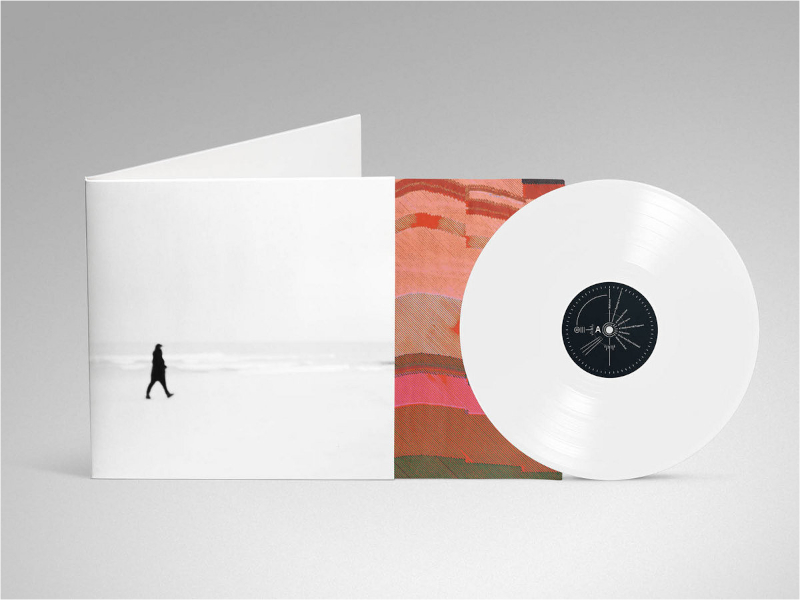
Paap knows exactly how far he can bend a sound before it breaks ::
Still, the track “JT33Unstable Core” is the longest track on the album, and it’s the craziest one set up. This leans toward more minimal dark experimental with the sound, and Paap knows that here. The track sprawls across its runtime, shifting through different tonal spaces and textural layers without ever settling into a groove. It’s ambient in the sense that it creates atmosphere, but it’s too restless to be meditative. Every track on Walkman was either experimenting with sound or the range of sound they can get. Paap‘s sound design has always been about pushing tools to their limits — whether it’s vintage test equipment, modular synths, or drum machines. His decades-deep studio experience means he knows exactly how far he can bend a sound before it breaks, and Walkman is full of those moments where he gets right up to the edge.
Walkman works because it refuses to sit still. Paap‘s message is clear: put your headphones on, get outside, and lose yourself in the sound of an artist constantly committed to moving forward. For someone who’s been releasing music for over 30 years, that restlessness is rare. What’s striking about Walkman is how far it stands from his earlier work — not in skill, but in intent. The Speedy J who released “Pullover” in 1991 was chasing the energy of the rave, building tracks designed to detonate on club sound systems. The Speedy J who contributed to Warp‘s Artificial Intelligence series in the mid-90s was exploring the meeting point between techno and electronica, crafting headphone music that still had a pulse. Walkman, by comparison, feels liberated from both contexts. There’s no dancefloor here, no need to lock into a groove or deliver a drop. Instead, Paap is chasing sound for sound’s sake, pushing stereo dynamics, distorting drum loops until they fray, stretching reverbs until they fill entire rooms. This isn’t a rejection of his past so much as a continuation of a trajectory that’s been unfolding for decades. It’s Paap at his most free, unbound by genre, format, or expectation. And in a career defined by boundary-pushing, that freedom feels like the logical next step.
Walkman is available on STOOR. [Bandcamp]