






Ikue Mori’s Of Ghosts and Goblins transforms the ghostly folklore of Lafcadio Hearn into a mesmerizing electronic séance—an album where myth, memory, and machine intertwine. Using her OP-1 as a spirit catcher, Mori conjures a world of shimmering sprites, fractured rhythms, and spectral beauty that feels both ancient and futuristic.
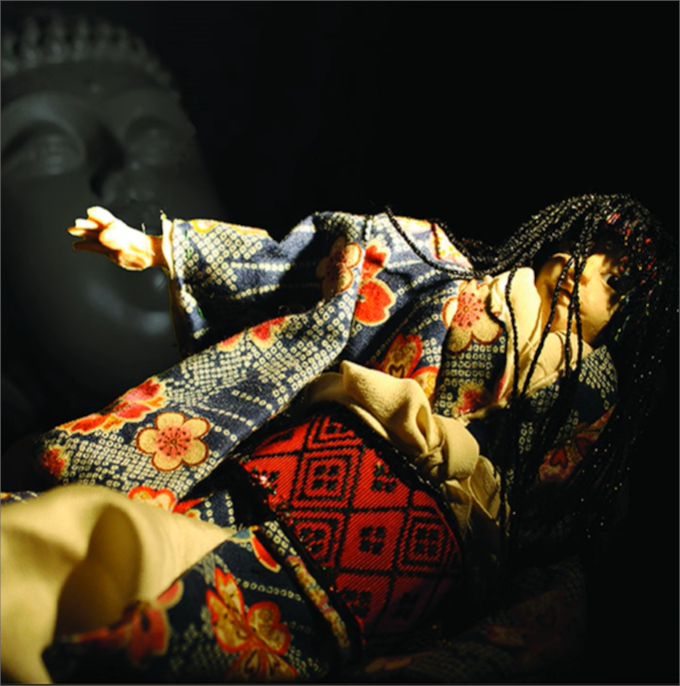
Folklore reimagined through sonic alchemy
When this CD dropped into my lap I was blown away. As soon as I became aware of it, I knew it was going to be something I wanted to write about, before I even heard it, and my excitement about listening to it was not diminished at all by the listening, but only compounded and multiplied my feeling of exultation in the power of music to enchant and make the world a place of wonder. Now this record sits at the top of my favorite releases in 2025. Let me tell you why.
Of Ghosts and Goblins is Ikue Mori’s tribute to the 19th century writer Lafcadio Hearn, and is a musical evocation of the many magical ghosts and goblins he wrote about across his prolific career as a progenitor of the weird. Hearn was an emissary of folklore, an ambassador of ghost stories, a diplomat of the diabolical. Ikue Mori has become his perfect interpreter, an interlocutor of his esoteric investigations. Let me tell you a bit about them in case you don’t know their work already.
Lafcadio Hearn was born on the Greek Ionian island of Lefekada to Greek and Irish parents in 1850, before moving to Dublin, Ireland where his parents abandoned him. It was during this time, during an accident, that he damaged his left eye. I always thought, it was because, like Odin when he hung on the world tree above the well of Mimir, he sacrificed an eye to gain knowledge of the inner worlds. Sometimes mythologies seem to play out in the lives of people. Hearn later wrote an essay on the Havamal, which can be translated as Words of the High One, referring to one of the names for Odin. His essay was on how the sayings gave an ethics for life. Stories were the blood of his life, he sought them out from all across the world. The stranger they were, the more he seemed to be entranced by them. As he learned the craft of the writer, he would take these traditional stories and write them out according to the illumination of his own inner genius.
Hearn was also a world traveler. When he left Ireland he came to America and settled in Cincinnati, where he got a job at a local printers shop, where he could sleep in the back amidst all the printed papers. He spent long hours hanging out at the Cincinnati library where he slaked his thirst for stories, yet always sought out more. After some time working for the printer, he got started in professional writing by working as a newspaper reporter in the city.
Hearn was influential in the development of what became true crime writing. He was a kind of godfather of the form as he made his grisly reporter rounds. Articles on the “Violent Cremation” that happened as part Cincinnati’s “Tanyard Murders” were unlike any other kind of criminal reportage that had been done up until then, in terms of the dark literary spin he put into his prose. He also reported on other subject matter people wouldn’t touch, such as an underground abortion clinic, back before it was called a clinic at all. People still had abortions, even when illegal, and at great risk to all involved. He reported on what was going on in the African-American communities in town, and how life was lived among the down and out in the shacks on Rat Row next to the Ohio River.
Eventually Hearn traveled down that river, and down the Mississippi, after a scandal in Cincinnati. The scandal came from him being engaged to a Black woman. Though he was in love, the social forces of the time forced him to move on.
Ikue Mori summons digital ghosts ::
He settled in New Orleans where he trafficked in tales of voodoo and other mysterious stories, and was entranced by the mixing of cultures: Creole, African-American, and beyond. All the while he was translating Guy de Maupassant and Gustave Flaubert from the French. His powers as a writer grew, and he always had his nose sniffing out any kind of ghost story or strange folklore, the weirder the better. From there he went on to the West Indies before going to Japan on an assignment as correspondent.
The assignment got terminated, yet he found a way to make it in the culture, and through one of his contacts got a job as a teacher at the sea town of Matsue. It was here he met his wife, a daughter of a samurai family, Koizumi Setsuko. It didn’t take him too long to start collecting local Japanese stories of an otherworldly nature to write for English readers. Ghost stories, Shinto tales, little vignettes about local spirits. All of these became grist for his mill. These stories, many of them macabre, ended up collected in his most famous book Kwaidan: Stories and Studies of Strange Things, published in 1904. By then his legal name had been changed to Koizumi Yakumo and he had become a legal citizen of Japan, not something easy to do. The people of his adopted nation had adopted him as much as he did them.
A love for Koizumi Yakumo, a love for Lafcadio, seems to have permeated Japan since his death the same year his most famous book came out. The same is true of Cincinnati (and I imagine New Orleans) where those of us with a gothic bent are pulled in by the allure of his shadowy romanticism. So when I discovered this new album out from Ikue Mori that is inspired by Kwaidan and other books Hearn wrote while in the last part of his life such as In Ghostly Japan and Glimpses of Unfamiliar Japan, I was hooked before I even heard the music. It helped that it was out on Tzadik which is a label I can trust.
Enter Ikue Mori who was born in Japan in 1953. She wasn’t interested in music much until she heard the raw sounds of punk rock. In 1977 she came to New York for a visit, but ended up staying, and right off the bat she became a drummer who had never drummed before, for the No Wave band DNA with Arto Lindsay. Sometime in the eighties she met John Zorn, and he directed her to the Downtown improv scene. Mori took to the freedom and creativity exemplified by her fellow habitues in the worlds of experimental slash avant-weirdo whatever.
The current album is unclassifiable, except as electronic. By the end of the nineties she’d gone from drumming to beginning to developing an electronic music palette and was soon working with a laptop. In no time she’d become a wizard of the form. This album follows numerous other Tzadik releases, solo, and in collaboration. This record sees her working with the OP-1, an instrument from Teenage Engineering inspired by budget Japanese synths and samplers from the 1980s. I know the instrument mostly from music videos by Hainbach on YouTube. The Op-1 combines a synthesizer, sequencer and sampler. On this album Mori uses it as if it were a spirit catcher.
One of the creators of the instrument noted how “limitations are OP-1’s biggest feature.” As a fan of embracing limits for creative growth this was nice to learn about. Digital audio workstations can induce a kind of writers block by being open to so many possibilities. By limiting what the OP-1 could do, it forces the user to choose and make creative decisions.
The pieces are miniatures, also limited, but you can voyage into them like a landscape painting. Once inside all manner of spirits are encountered. The sounds throughout are very Japanese in some respects. I don’t know if Mori sampled traditional instruments like the koto or used synthesized koto sounds, or where all the other sounds come from, and which emerge from the instrument. Plucked strings, whether originating from organic sources in the acoustic field, or digital, dance around with tinkling bells as synth incense drifts into the air.
Of ghosts, goblins, and circuits ::
There is a lo-bit quality to some of the textures, and they have a noisy grain, while others are bright and sharp. The goblin voices try to speak out of the radio crackle like a medium working with the tools of EVP. But just when you think you have a lock on a particular entity coming through, it shifts around, mischievous as a fox spirit, playing tricks, going off to dance in some garden of abstraction.
There is a dream-like quality to the pieces here. You think you know what is going to happen, and then it abruptly shifts onto a different trajectory. After listening it is hard to recall exactly what was heard or how it all happened. Quivering rhythms and tiny byte sized blurps of melody fizzle in and out of focus. Tender sprites and distorted pixies travel through a world of ring modulation and sparse drums that clip and clop in their own somnolent tempo.
If you are at all interested in the kind of music that can shift your mind into a different headspace, a place where creativity has structure and form, but is built around unusual geometric logics, then the mystifying equations summoned by Mori into this bestiary of electronic song and whimsy are sure to confound and delight.
This is hands down one of the best electronic music releases of 2025. Mori may not have had any training as a drummer back in the No Wave days when she joined DNA. But that fearlessness to make a go of being a drummer anyway has resulted in a body of work that arrests efforts at easy categorization. Her experience in improvisation, and for bending computers to her wizardly ways make her the consummate creator for a dalliance with the Japan that Lafcadio Hearn came to call his home.
Of Ghosts and Goblins is available on Tzadik.

Related posts ::
 Vortice Mortale :: Momento Mori (Waste Editions)
 Depeche Mode :: Memento Mori (Columbia/Mute)
 In The Absence of Words :: Memento Mori (Self-Released)
 Less Bells :: “Feral Ghosts Of The Golden West” video premiere from The Drowned Ground (Meadows Heavy)
 Moss Garden :: Understanding Holy Ghosts (Kaico)




![[2View] Maps and Diagrams’ beneath still stars (handstitched*) & returning light (Home Normal)](https://igloomag.com/wp/wp-content/uploads/2026/10/maps-and-diagrams-returning-light-beneath-still-stars_feat-75x75.jpg)