

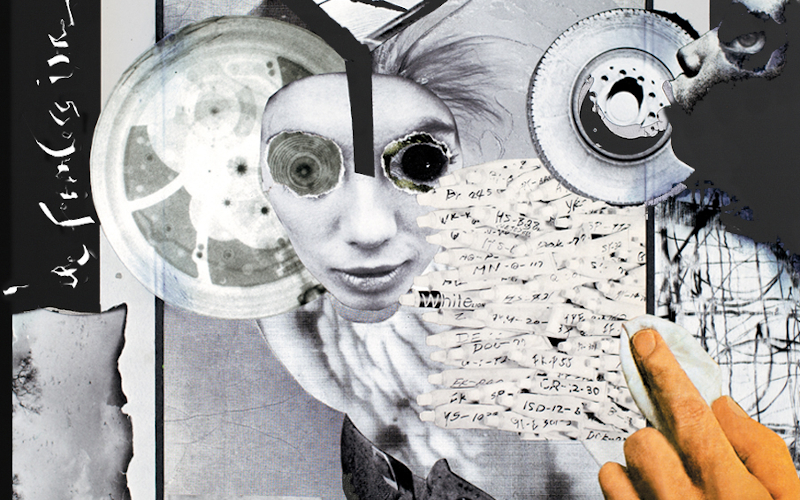


A definitive, full-color celebration of the elusive visionary Babs Santini—whose surreal, erotically charged collages shaped the visual world of Nurse With Wound and its avant-garde circle—The Formless Irregular spans five decades of radical image-making that transforms waste, dreams, and noise into haunting, darkly humorous art.
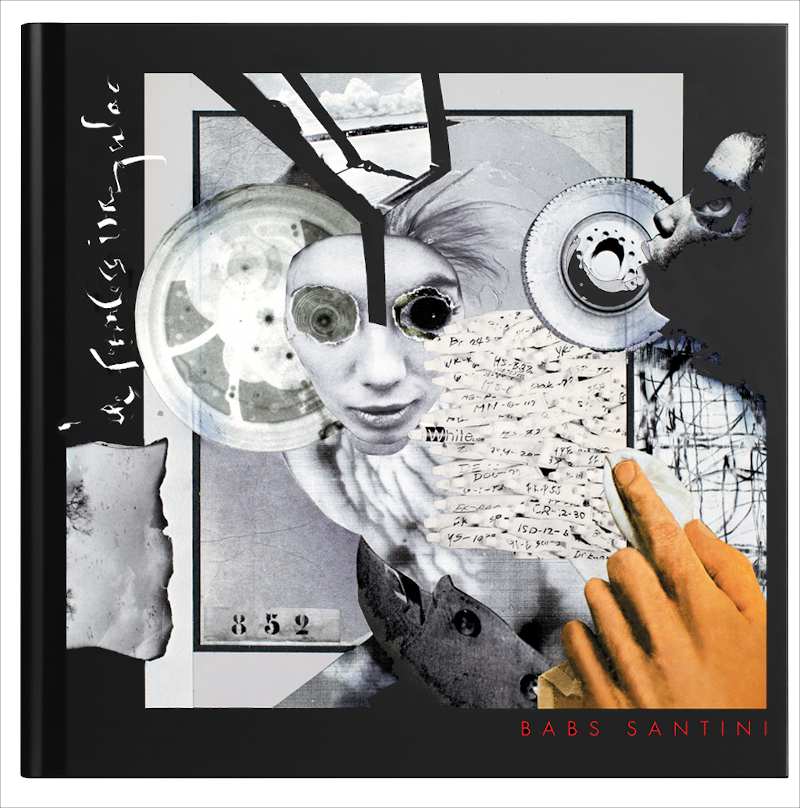
Noise made flesh in collage
What little is known about the great artist Babs Santini comes to us from the world of experimental music and the mysterious albums of queasy listening made by Steve Stapleton and his long running project Nurse With Wound.
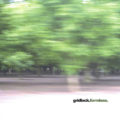
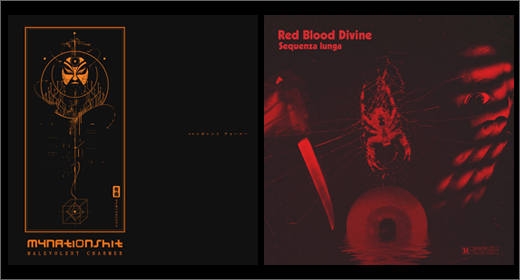
Santini made a bold move by focusing her considerable artistic powers on designing covers and inlays for the Nurse With Wound albums as well as the albums of her many friends in bands such as Current 93, Legendary Pink Dots, Coil, and Stereolab just for starters. This allowed her work to get directly into the hands of fans of this music, and allowed her to bypass, until later, the rigmarole and jaded taste associated with the late twentieth century art world. As the magnetism exerted by her prolific pieces continued to permeate and exude into the astral and material atmospheres of the world, it was only a matter of time before she would be lauded in their galleries and hallowed halls.
Her formidable collages and other graphic multimedia work reference myriad art-historical and popular culture sources—pin up posters, early Dada cut-ups, the work of Surrealist icons. They are also a keyhole into her private interior world of sexually charged fantasy madefrom the detritus of dirty magazines and imagery from who knows where else. All combine into a private imagistic world of startling immediacy and timelessness.
Santini‘s work cannot be defined as entirely mainstream or self-taught, because she did have art training, but it is visionary and is steeped in the surrealist tradition. It is also damn funny. Within the humor and whimsy, however there is a touch of the sinister. There is a sharp edge throughout, an edge that just might wound. From the wound there seeps a mysterious energy which goes beyond the strange and the weird, to the uncanny. With the humorous material set right next to the sensual, and the sensual set right next to the scary, the senses are jarred and the viewer is left disoriented. But out of the disorientation come new perceptions.
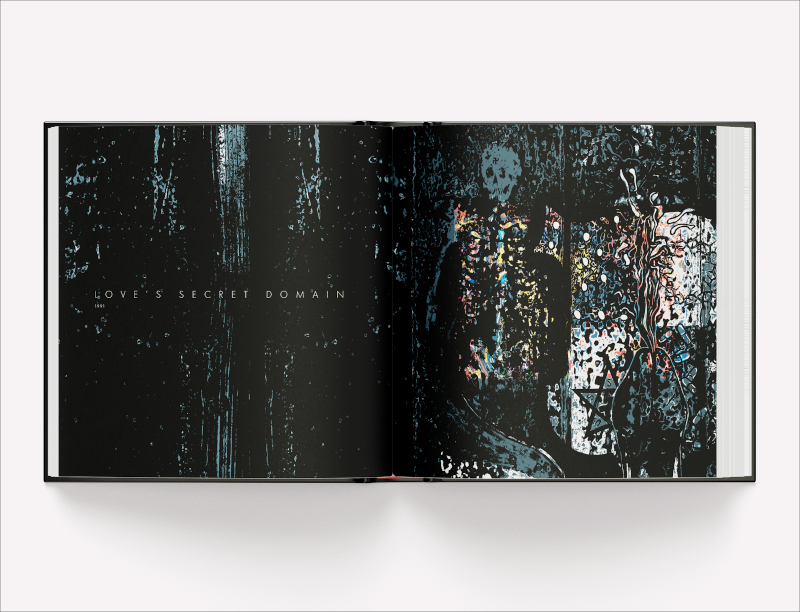
The Formless Irregular was strictly limited to 800 copies of 560 pages in full color, that spans over five decades of Santini’s vast, varied, and exceptional body of work. A brief note by Andrew Thomas and short essays by Conor McGrady, Geoff Cox, and Andrew Liles all give nuanced layers of meaning to the body of work at hand, but they aren’t over analyzed. The work is allowed to speak for itself.
Even a casual perusing of the book will show that Santini is a master of retinal art. She has used her skill and imagination to execute her own explicitly aberrations, mutations and variations on themes of Dada and surrealism. It is for this reason an unexhaustive ABC of the methods used will be provided here as a key to exploring this book. Explaining the book has it limits. Exploring it can go on for a very long time.
Retinal overload, sacred afterglow ::
A is for Automating. In keeping with Freudian theories, Santini’s unconscious is a site of frenzied erotomania, a place where figures pregnant with desire overwhelm rational understanding. It is also a place filled with animals and monstrous beings, all possibly stemming from childhood experiences. As a viewer it is easy to resonate with these images. They are at once alluring, creepy, whimsical, and terrifying because the familiar melds with the strange in a Kama Sutra of juxtaposed positions. Automating is as much about cars and other vehicles joining together in sexual congress as it is the “absence of any control exercised by reason, exempt from any aesthetic or moral concern” in the process of picture making.
B is for Bulletism. The concept of deriving artistic inspiration from random or accidental marks predate the work of Santini by centuries. The techniques however are timeless. The chaotic generation of paint splatter to circumvent conscious control and tap into subconscious imagery is showcased throughout the book. In the late 1950’s Salvador Dali pioneered a method of filling bullets with ink and firing them onto a surface and using the splatter as the basis for a work. The unpredictable nature of this kind of acute psychic discharge inspires artistic activity. It is not known whether Santini uses guns in the making of any of the randomized paint patterns seen throughout this catalog of her work, but it is not out of the question she might have packed some heat into the studio. Whatever the case may be, it is also possible food juices were used on prepared surfaces.
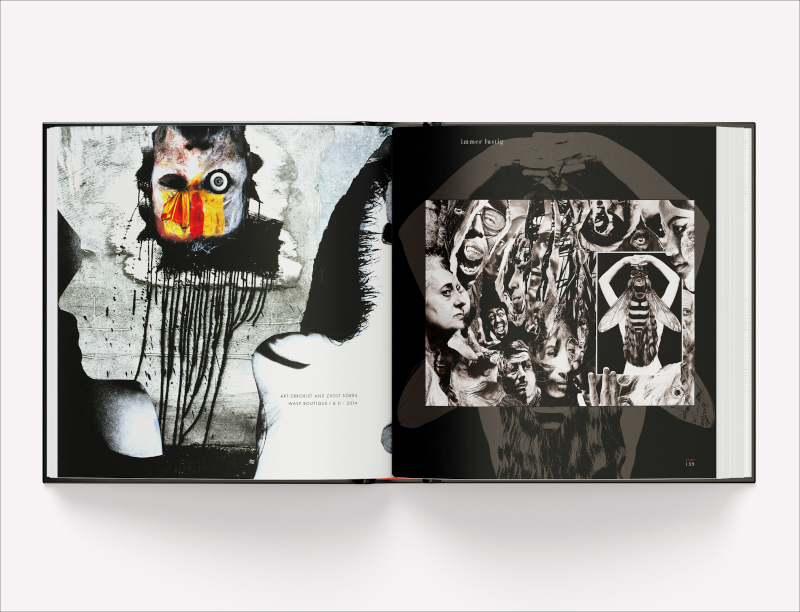
C is for Collage. Of the many techniques used throughout the book, collage is the one Santini comes back to again and again and again. Unlike other terms in this A to Z, collage has become a kind of folk-art practice through its ease of accessibility, the ready availability of glue and scissors, and the mass proliferation of cheap disposable images. The distinctions between folk art and high art are fuzzy and subjective at best. Any technique when put into the hands of a master, produces masterful results. The evidence for mastery is why this massive tomb was produced. These are visual counterparts to the recycled sounds so often heard on Nurse With Wound records. The way they are positioned to defamiliarize unquestioned perceptions is just part of their seductive charm.
D is for Dream. It is no secret that the inspiration for the Rock & Roll Session album came to Stapleton in a dream. “[The] album arrived somewhere after a dream meeting of several individuals, Graham Bond, Joe Meek, Jacques Berrocal and myself. After a few beers and a heated disscussion of puncture repair we all lay down in a circle and point our penises at Venus, telepathic messages are sent out to Colin saying he can use the two golden microphones.” Dreaming is a form of automatism, that is, something not under the control of the rational mind. It is only rational to deduce that Santini has used dream imagery throughout this illogical book, just as Stapleton did in receiving inspiration for his music.
D is for Dump. The city or town dump, in particular. This is a place where free paint can be found, along with the trove of discarded vinyl records that Santini later went to paint on (see V is for Vinyl). The theme of using discarded materials to get into a creative groove where the juices will flow is a recurring dream throughout the book. A little groove grease goes along way, after all. Santini is a master of using the found object, the discarded. Recycling, repurposing, reusing things otherwise to be thrown away is a way of life. Using found objects is another kind of chance operation. What is to be found when exploring the dump is often a matter of chance. Furthermore, in dream symbolism, the act of defecating or taking a dump is sometimes interpreted as “creative output.” If Western society was less biophobic, our own human waste wouldn’t be flushed down the toilet but composted to use in restoring fertility to the soil. The fact that Santini can go to a place of waste and find useful materials to create with is just another example of her fertile imagination.
E is for Echo Poem. Last year I wandered through a lonely baroque hotel. It was populated by wealthy socialites, so it must have been a dream, or I wouldn’t have been there. A person came up to me in the dream and asked if I had seen them at another resort hotel the previous year. I hadn’t recalled that I had. Then they gave me a copy of the book The Formless Irregular which is supposedly what you are reading a review about right now. It was in this book that I first noticed how Santini made precise use of echo and delay systems in their copious visual output. One page mirrors another in inverted symmetry. In another page, I disappear to find myself going down a long hallway and reminded I might have shared a past with the person who gave me the book, but I don’t remember. They are speaking in French and it forms a sequence of echoes.
Through ambiguous flashbacks and disorienting shifts in time and location, The Formless Irregular explores the relationships between music and strange cast of characters who seem to have been pulled out of the very aether of dreams itself. Conversations and events are repeated in different parts of the book, accompanied by numerous pictures with looping repetitive voice-overs -if you get into the right state paranoia first. The book offers no definitive conclusion regarding what is real and what is imagined, but the book itself is real. I know. I dreamed about it myself.
The uncanny, hand-assembled ::
E is for Exquisite Corpse. The visual works aren’t necessarily collaborations, but Santini closely collaborates with Steve Stapleton. It could be said that one couldn’t exist without the other. Not all collaborations are exquisite corpses, but all exquisite corpses are collaborations. Not all corpses end up looking as enigmatic and full of life as the ones that Santini stitches together from a bucket full of discarded parts. The energy infused in the different parts is what makes them come to life.
F is for Frottage. The person who spends too much time drinking at Bar Maldoror is likely to pick up flies for frisky fricative friction. It is also a form of rubbing used to make unexpected images.
G is for Grattage. This method is when a person uses a surface prepared with paint and oil and then lays various textured objects onto it to create textures. These textures can be read like tea leaves and used as the basis of a visual work, and is another means for tapping into the unknown.
H is for Homotopy. Santini’s good friend Marie was in need of a homotopy. This is a less-than-routine surgical operation where two shapes get deformed, stretched and compressed into eachother without the use of glue. Sometimes a coffee mug gets turned into a donut, for instance. Santini brought the entire field of homotopy theory into the art world. Now there is an entire realm of art criticism devoted to classifying certain works based on their “holes”. In the work of Santini, there are quite a lot of holes. Coffee cups and donuts can reach a kinship with Marie via this holy process.
H is for Huffin. The best way to get ahead in the art world is to use methods that your average landscape painter would find unappealing. Take, for example, the practice of going out behind a dumpster, getting some paint thinner, and instead of using it to clean your oil brushes, you put it on a rag, throw the rag into a paper bag, and start huffing. The visions gleaned from these dumpster sessions can then be sketched. Santini has done this admirably well and come back to tell us about those visions.
I is for Insect. Santini has taken inspiration from many previous artists who were deemed “weird” whether inside or outside the canon. There were many musicians and visual artists whose commitment to remaining noncommercial were savored and celebrated. But there were also writers. Boris Vian was one of these. To say his writings were bizarre would be an understatement. His works used frequent neologisms, or made up words, plots that weren’t plots, and reinterpretations of popular genres such as the detective novel, all put to surreal aims. The album Insect and Individual Silence was dedicated to Vian. The artwork for the album remains highly entomological.
J is for Jarring. Not the jarred specimens pickled in formaldehyde one might see on display when viewing a cabinet of curiosities at a freak show, but jarring just the same.
K is for Kraut. It is no secret that Stapleton is a krispy kraut. Included here are album covers for the various collaborations with Faust, Xhol Caravan and others from the außerdem side of German rock.
L is for Lilith. Who says the great artists of our day can’t have families? The great ambient masterpiece Soliliquoy for Lilith created by Stapleton, and dedicated to one of his children, finds a visual corollary in these pages. Lilith would go on to contribute vocals to several Current 93 and Nurse With Wound releases.
M is for Merz. Like Dada, Merz was characterized by spontaneity and frequently made use of found objects. Kurt Schwitters generated the name Merz by chance through a collage that incorporated the German word Kommerz (commerce). The word Merzbild, used in the Nurse With Wound piece “Merzbild Schwet” is another term from Schwitters that he used to describe his unique form of collage and assemblage, often made from found waste materials, street debris, and printed ephemera (see D is for Dump above). One of the most significant Merz artifacts constructed by Schwitters is the Merzbau, a tower-sized sculpture assembled from refuse and ephemera that occupied the inside of his apartment and existed from 1927 to 1943, when it was destroyed by a British air raid during World War II. It isn’t just Santini who found inspiration in this world, of Merz, but Masami Akita took the name Merzbow after Schwitters as well. Like Merzbow, Santini is a noise freak.
N is for Noise. Where would we be without Luigi Russolo and the Art of Noises? Visual noise also exists, as does noise in the information society. Santini is able to represent noise through her cluttered, distracting and overwhelmingly detailed maximalist images that hinder concentration, causes symptoms of ecstasy, and make communication difficult because of the ineffability of re-expressing what she already expressed. The range of stimuli available in a “typical” Santini piece is such that retinal overload sometimes occurs. Yet this overload, like the overload in noise music, leads to a feeling of power and exultation. The way out of a particular condition is sometimes the way in.
O is for Ostraneine. “What we are familiar with, we cease to see,” wrote Anaïs Nin. “The writer shakes up the familiar scene, and as if by magic, we see a new meaning in it.” So with the visual artist. This practice of defamiliarization can be considered one of the core keys to Santini’s entire oeuvre.
P is for Psychosexual. There is an orgastic potency to the work here that is paired best with paint. Some of the images will make you blush, or get excited. Erotic fixations are wholly part of the aesthetic. An efflorescence of fantastical and fetishistic tendencies leave a strong imprint.
Q is for Quiet. Sit and stare at the pictures in silence. New meanings will emerge.
R is for Rat-Trap. Swamp rats need not apply.
S if for Shipwrecked. From the plundered wreckage of field recordings many fish are dissected on an operating table. It appears that forensic use of these materials, the bones of fish and birds, may have been used in the creation of some of this work.
Where waste becomes vision ::
S is for Surveillance. In this lounge, only the paranoiac is allowed. Surveillance capitalism lends itself to people lounging and watching the antics of those they are spying on. Big brother becomes little brother. Some of those people may even just be farmers headed to a livestock auction. By spontaneously inducing irrational fears that someone is gang stalking you, or even that you are being spied on through the radio by MI5 and the CIA, a person can achieve a delirious state of mind where artistic gnosis is likely to occur.
T is for Triptography. When LSD is applied to the lens of a photo camera, it is impossible to tell what the results will be when the film is developed. Another way to use the triptographic technique is to reuse the same film for multiple shots. Whatever choice ends up being made, it’s a real a head trip.
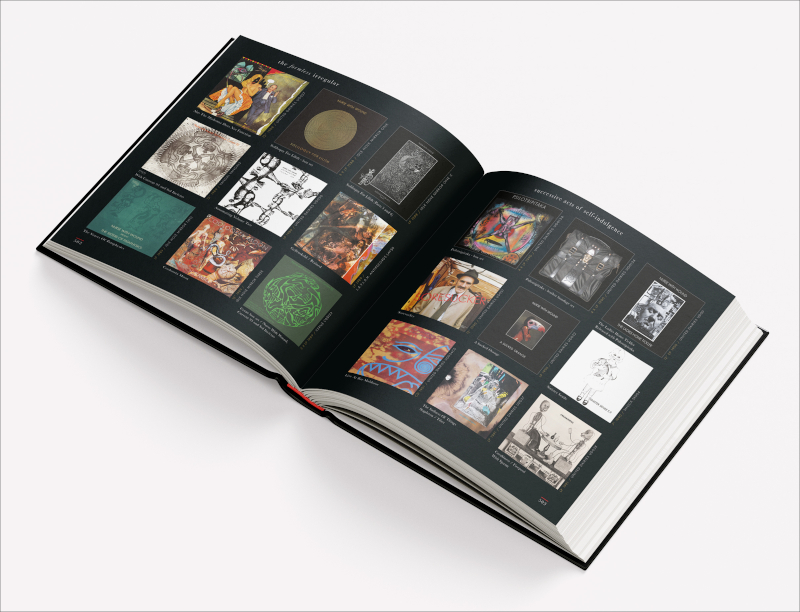
U is for United. In Ohio there is a chain of ice cream shops and convenience stores named United Dairy Farmers. In a parallel Ohio there might also be a United Diary Farmers. In either case it seems Nurse With Wound has been an inspiration for the chain. Santini created the artwork for many of the releases on the United Diaries label run by Steve Stapleton. Examples are included, as is a complete discography.
V is for Vinyl. In 2008, as part of the Angry Electric Finger releases, a small book was issued featuring the painted vinyl records Santini had found at the city dump. They are also included in this volume. Colorful, cerebral, and swimming in groove juices, they get the mind spinning.
W is for Wormwood. Absinthe makes the heart grow fonder. Babs Santini was commissioned to make label designs for boutique absinthe. These are included in the book. Consorting with the green fairy may or may not allow the viewer of this book to make better sense of what it all means.
X is for Xerogaphy. Evidence of of the use of photocopied material exists throughout this work. By moving an image on a photocopier while it is being copied distortions in the lines emerge in the reproduction. Reproducing a reproduction in turn creates more distortion as the original signal is lost in the noise. In many ways xerography can be thought of as the ultimate degenerative art practice, even an art practice for degenerates. Color adjustment, collage and other ways of manipulating the photocopied pictures adds to the pleasure of defamiliariazation.
Y is for Yoni. In Hinduism, it is the symbol of the goddess Shakti, the feminine generative power and represented in sculpture through the imagery of vulvas and vaginas. Santini may not be Hindu, but the imagery of this generative power is seen throughout the book. The lingam is also represented as well. The connection between artists, sexuality, and the life force is on full display throughout the Formless Irregular. See P is for Psychosexual, above.
Z is for Zone. The idea that certain geographical areas are altered by otherworldly forces is embedded inside the collective unconscious. These zones become mythical in their proportions A location that more or less seems to be alive, breathing, and possessing its own intentions. Such a zone can be found in Ireland, at Coolorta, where Santini has made their own studio zone and taps into the automating power of the unconcious. One can only hope that new material continues to emerge out of the creative zone where Babs Santini inhabits with Steve Stapleton.
The Formless Irregular is available on Timeless Editions.