


Deep into the piece I start to understand the importance of letting go—of just floating and rolling with the changes as they happen. In constant motion toward an uncertain future we come to realize that where there’s nothing, there’s everything.
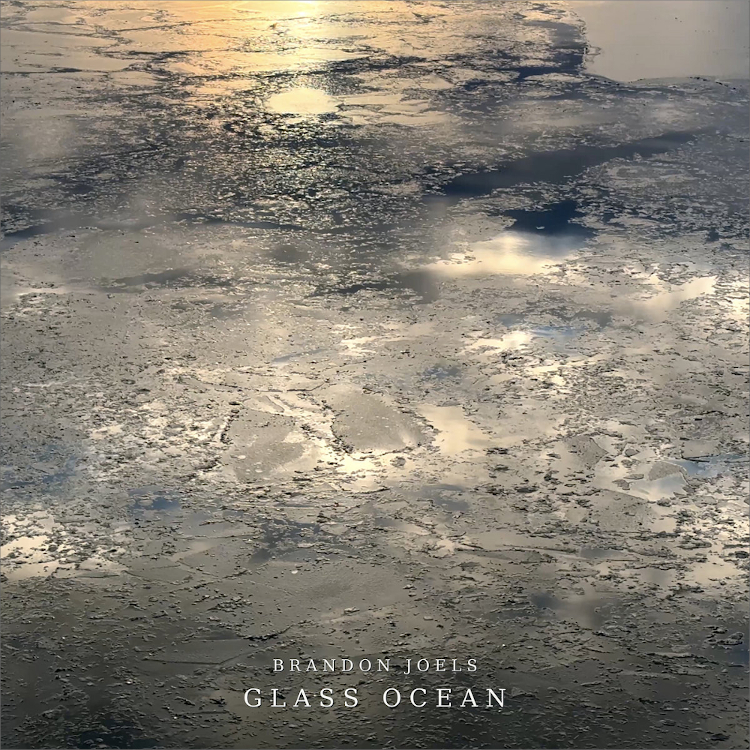
An ethereal and otherworldy sound
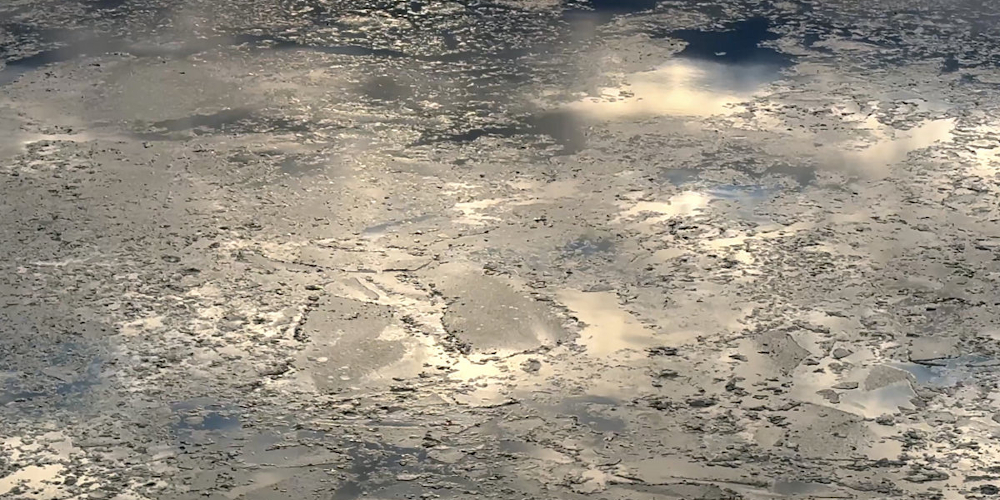
Evoking a stillness that masks constant changes almost too subtle to be noticed, Glass Ocean takes the listener on a journey of wonder to the high Arctic. Inspired by his residency there, classical musician and composer Brandon Joels crafted a single 46-minute ambient piece using bowed vibraphone, bowed glass, and rolled marimba. These instruments match the subject well, and are accompanied by a lovely looping video of ice, ocean, and mountains by the artist that is available on YouTube.
With an ethereal and otherworldy sound, Glass Ocean evolves slowly yet is ever-changing, like sea ice itself. Joels also focuses the listener on slow transformation—of water becoming ice, melting back to water again, then reforming as ice, which happens on an annual basis in the Arctic. The looping of the video reinforces this sense of transformation, coming back to the same images over and over again to help us see them in new ways, just as the music loops back on itself without ever repeating.
Yet beneath the ethereal beauty I also feel a sense of unease, even lurking menace, which reminds me of the severe threats this fragile environment faces from our actions. Here’s one data point as an example: the past 20 years, from 2007 to 2026, have produced the lowest 20 annual Arctic sea ice minimums since record keeping began in 1978.
Indigenous peoples describe ice as alive, speaking in a language of creaks and cracks. Canadian composer Carmen Braden recorded lake ice for her composition “Candle Ice” and I get the same sense of ice as a living being from Glass Ocean. The composition allows us to listen to the different tongues of sea ice speaking in ways we seldom get to hear.
Sea ice speaking in ways we seldom get to hear ::
Sea ice also speaks through color, and this emerges both in the video and in the music. The video shows an icy ocean suffused with blue-green and white, with floating sculptures carved by nature’s hand. The music sounds like a light, slightly greenish turquoise that seems like nothing from this world. I kept thinking of the colors of sea ice my TCU colleague Adam Fung evoked in his paintings from his “Mystic Sea” series from 2024, also based on residencies in the Arctic. I get the feeling that artists who experience the paired beauty and vulnerability of places like the Arctic cannot help but turn into advocates for their preservation.
Glass Ocean also demands close attention to follow its subtle shifts, which I think relates to that advocacy I just mentioned. Brandon Joels seems to be asking us to devote the same attention to the plight of the Arctic.
But there’s also a distinctively meditative quality to this music that I think I enjoy most of all. The sense of floating, but with some weight anchoring us, sometimes felt interstellar rather than oceanic. Deep into the piece I start to understand the importance of letting go—of just floating and rolling with the changes as they happen. In constant motion toward an uncertain future we come to realize that where there’s nothing, there’s everything.
If you’re looking for a similar nature-based drone composition, you can check out Joels’s 41-minute piece that uses rolled marimba to evoke clouds, Cloudbank Like Glass Ocean, Cloudbank also has an accompanying YouTube video.
Glass Ocean is available on Bandcamp.

Related posts ::
 Brandon Hurtado :: Bonfires for Nobody (Self-Released)
 Akira Rabelais :: The Little Glass (Self-Released)
 Nexcyia :: Heading Into The Ocean With Tearful Eyes (Self Released)
 [2View] Masaya Kato :: Glass Anthimeria, SAVVAS METAXAS :: Magnetic Loops IV (Line)
 Brandon Invergo :: Bringing On the Eschaton (Moon Atlas)