






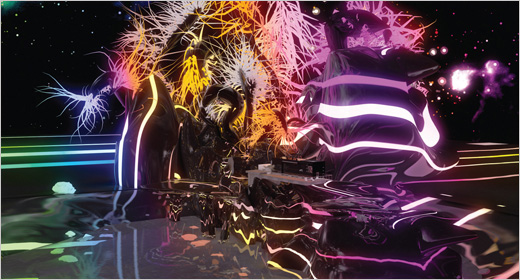
A full-circle encounter with Steb Sly’s The Galaxy Projector, a gloriously funky, retro-futurist transmission that bridges house, breaks and cosmic soul while reminding us that the deepest purpose of music is not simply to move bodies, but to bring us together.

Steb Sly reconnects with the cosmos
One of my most regretful missed outcomes was a submission I made for a Swayzak compilation on their 240 Volts label and series. I was simply too high to get it together. Such is life. Such, occasionally, is being me. The track never made it, but on that third compilation I encountered the artist then named Steb Sly for the first time.
Socials being what they are, I’m now having something of a full-cycle experience by connecting with Steve Sim (aka Steb Sly) and finding myself reviewing his newest set of transmissions, the album and game-adjacent The Galaxy Projector. There is something pleasingly circular about that. A missed connection, a few years of musical wandering, and here we are again, arriving at the same frequency from another direction.
The panache of Steb Sly’s production aesthetic is sweet like cherries. There is a delectable sass to the synthesis that permeates these grooves, each of the tracks carrying a tactile sense of musicianship beneath the electronic architecture. This is not retro for retro’s sake. The sounds may draw from a vocabulary whose roots are firmly embedded in the past, but the execution has the clarity and confidence of someone who understands precisely why those sounds still work.
Opener “A New Civilization” is house music with a forehead sense of absolute dignity. Head held high. Chin out. Shoulders back. Its sonics are retro, certainly, but painted onto a slate of the finest textural clarity. It has that particular quality that makes you bother going over to the DJ, through the haze, heat and increasingly questionable condition of your own faculties, and mouth the words: “What’s this?” while pointing emphatically at the middle of the, I guess, CDJ that you think the track is coming from.
Somewhere between a nightclub and a starship ::
At two we have the neuro-purplous phat-phunk of science-frictionalism that is “Interstellar.” Space dynamics and synthoid funk beats stutter through gutterfunkin’ breaks, heavenly and high. The whole thing seems to exist somewhere between a nightclub and a starship. It is music that presents the listener with a fairly straightforward binary: dance or die.
“Are You Ready” kicks off with 808 breakbeat, fat-filtering synths stabbing over euphoric funk. I can’t quite let go of the retro-funk feeling here: a bygone age that never actually was, or perhaps one that existed somewhere in the collective electronic imagination before the rest of us caught up with it. There is something innately Moog, inherently peak Stevie Wonder synthesis about the musicality and modelling of these soulful constructions.
“Incredible,” at track four, routes a repeating synth motif that simply refuses to let up. Fat synths stammer through big beats, more sublime space-funk accumulating around them, and the whole thing feels simultaneously familiar and strangely futuristic.
“Light to Dark” is full-on funk with a stunning groove and a meaty, bottom-tugging bassline, complete with the requisite funktopian a-go-gos. Offbeat rimshots and similarly spaced-out synths LFO, swirl and sparkle in what feels like a sunshine playroom of chill and vigour. This is music for intimate moments with like-minded people and a common cause. Music that understands that dancing together is, in itself, a form of temporary agreement.
Simply divine. Archetypal Sly ::
This is where the known of the game, the knower of the dance, and the knowing of how to merge the two as a unified field meet as music. There is an understanding here that groove isn’t merely a rhythmic device. It is a social technology. It is how bodies communicate before language gets involved. It is how a room becomes a room.
“Ten Fourteen” segues depth and weight, height and breadth, in ecstatic certainty. The colour template presents in sunshine yellows and turquoise skies. Synths reach high towards the ceiling while scattergun breaks loop beneath rolling, thunderous saw-bass. It pumps. It drives. It is relentless without becoming merely aggressive. There is a sense of ignition here: the lift-off phase of what has already been building, the point at which the machinery stops being machinery and becomes propulsion.

The groove that permeates the title track, “The Galaxy Projector,” immediately reminds me of the producers behind serious-ass disco legends such as Kashif or peak Shalamar—particularly the work of Leon Sylvers III. These were epic syntheopian groove merchants who preceded the formal arrival of house music, unwitting forefathers and foremothers of the hypnotic language that would subsequently define so much of electronic dance music.
Those are the elders to whom both Steb and I, in our different ways, pay homage: not through simple imitation, but through an understanding that the lineage remains alive whenever someone takes its vocabulary somewhere new. The track itself is a high-grade stepper: break-led, phat-killa’ bassline aesthetics, synth stabs and solo leads articulating the melodic and rhythmic aspects of that same lineage in real time. It is a stunning nod without becoming a museum piece. The past isn’t being recreated here. It is being switched back on.
“Future Responsibility” takes me to Chi-Town and the rooms inhabited by the two Larrys—Levan and Heard. Depotek-funk. A-typical house. Not house music, but, yeah, that. But just, you know, house.
It’s house, alright. House.
Its very own thing, mastered here with stunning assurance. Big, bold and brassy. For the ladies, the heads, the dancers, the selectors, the people who arrived intending to stand at the back and somehow find themselves three hours later sweating through their shirt. There is generosity in the groove. It wants to be inhabited.
“First Contact” traverses similar territory but establishes its coordinates immediately with a definitive 909 house workout. The offbeat rimshot. The scattering and rolling snares opening and closing around the beat. The musical scaffolding is an organ motif that refuses to budge from its route to the top. Wiry solo synths bleep and clunk around it, adding just enough instability to keep the whole structure breathing.
And there it is again: that feeling. The feeling of hearing Jupiter Jazz on Nation to Nation (UR) for the first time.
That moment when the music suddenly becomes an object of investigation. When you have to visit the decks and ask Mrs DJ, “WTF is this cut?” Not because you need to know, exactly, but because you need to acknowledge that something has just happened.
A rare and sublime occurrence. The other of another level. And so, eventually, we begin our descent.
“The Reveal” brings us back towards terra firma, and fittingly, what is revealed by the closer is perhaps the thing that remained unknown to the artist and curator of the piece while making it: what happens when intuition is trusted all the way through.
Because this is what The Galaxy Projector ultimately feels like. A set of tracks made not from a desire to demonstrate mastery, but from a willingness to follow an energetic thread wherever it led. Expectation after expectation is placed aside. The artist listens, responds, adjusts and moves. The music becomes less a declaration than a pointer.
We arrive. We move. We listen. We disappear ::
A pointer towards something that is difficult to name because naming it too confidently would rather miss the point.
Here, music is the medium and love remains the message.
And movement through art becomes a kind of unified field—a connection that is remarkably easy to forget in a world increasingly organised around business and busy-ness, division and competition, clamour and dominance. So much of the machinery of contemporary life seems to depend upon everyone trying to establish their position above everyone else, when beneath all that noise sits the much simpler truth that we are all participating in the same strange, temporary human dance.
The groove doesn’t care about our hierarchies. The bass doesn’t ask for our credentials. The kick drum does not require us to have figured ourselves out. We arrive. We move. We listen. We disappear.
And perhaps that is why The Galaxy Projector feels like more than an exercise in retro-futurist electronic craft. It understands the lineage without being trapped by it. It understands the dancefloor without reducing dance music to function. It understands that technology can be intricate without becoming cold, and soulful without becoming sentimental.
During the season of the Galaxy Projector, Steb Sly has been paying attention. And he has nailed the assignment, from take-off to re-entry.
We travel outwards through funk, house, breaks, synths and the imagined architectures of electronic music’s past and future, only to arrive back where we started: with the strange, stubborn, inexplicable human impulse to make something and share it with somebody else.
The message, ultimately, hasn’t changed. Love is immovable. Love is indescribable. All we can really do is point towards it and say: It’s like this. And for you, reader, listener, dancer, head, human—listen to this album. Because love is not just like this. It is this.
The Galaxy Projector is available on Bandcamp.




![[2View] Maps and Diagrams’ beneath still stars (handstitched*) & returning light (Home Normal)](https://igloomag.com/wp/wp-content/uploads/2026/10/maps-and-diagrams-returning-light-beneath-still-stars_feat-75x75.jpg)