


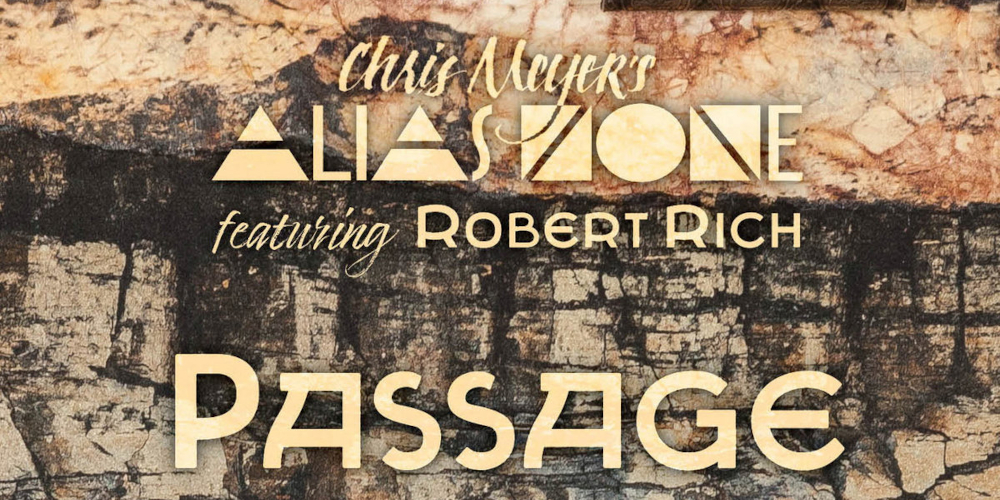
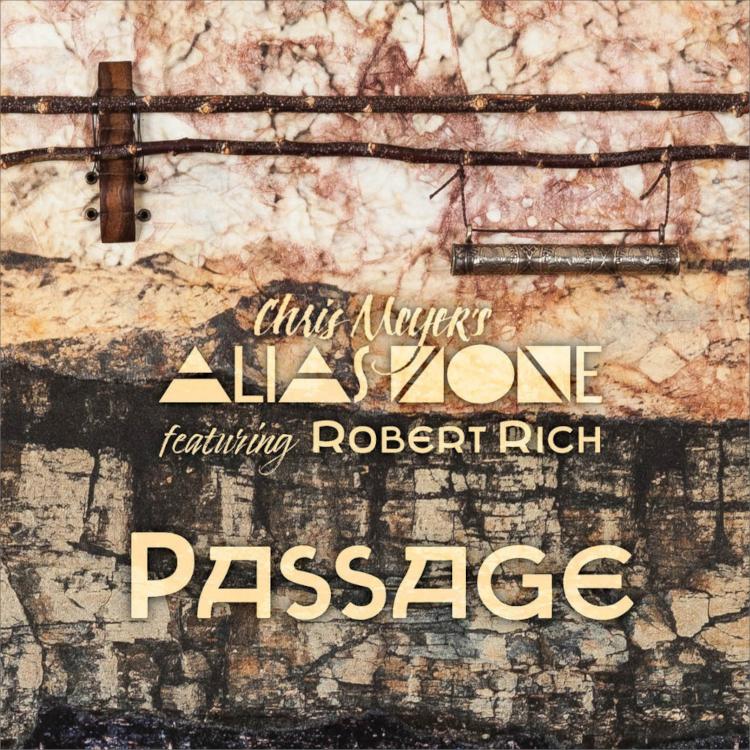
In Passage, some of the most elemental transitions are embraced and explored using sound to portray some complex and undefined spiritual concepts. The concept behind Passage is that of passing from one phase of your life to another. This may include new residences, changing relationships, traveling to an entirely different solar system, or passing on from this life to whatever may be next.
This strange dark new place possibly extends forever
Alias Zone is the cinematic tribal electronic music project of Chris Meyer of Learning Modular. Chris combines unique sounds crafted on his modular synthesizers with field recordings, hand percussion, and other elements in a unique, melodic fashion. I would tell you that the cavern here has no bottom, instead the earth is hollow, there are the sounds of very few strange forces moving about, these are their stories.
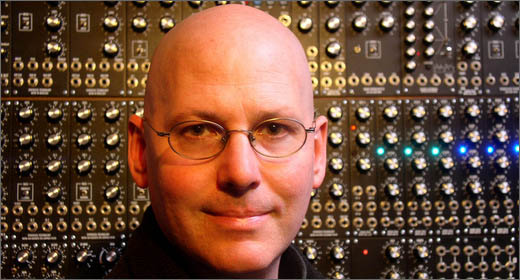
In Passage, some of the most elemental transitions are embraced and explored using sound to portray some complex and undefined spiritual concepts. The concept behind Passage is that of passing from one phase of your life to another. This may include new residences, changing relationships, traveling to an entirely different solar system, or passing on from this life to whatever may be next. Each slowly-unfolding piece is its own cinematic journey, inviting you to explore Alias Zone’s dreamscapes and imaginary worlds. This time, for Passage, Alias Zone features ambient music legend Robert Rich, who began building his own analog modular synthesizers in 1976, when he was 13, and later studied computer music at Stanford‘s CCRMA while researching lucid dreaming. Working in a wide array of the arts and with over 40 albums spanning four decades, his all-night Sleep Concerts opened up the performance of audio arts into a fundamentally whole new dimension.
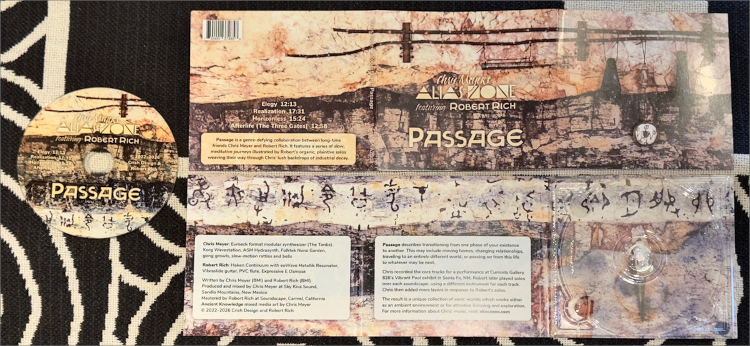
Robert Rich‘s solos on Passage illustrate a series of slow, meditative journeys featuring lush, organic landscapes and waterways, which weave their way through Alias Zone‘s backdrops of quiet industrial decay. Emerging shadows convey powerful stories from the biggest caverns. For Passage, Chris has chosen his custom modular synthesizer, Korg Wavestation, ASM Hydrasynth, Folktek Nano Garden, gong growls, slow-motion rattles & bells. Robert brings his Haken Continuum with eoWave Metallik Resonator, Vibraslide guitar, PVC flute, Expressive E Osmose.
This strange dark new place possibly extends forever. Let us commit to continue into the perfect darkness. We are just entering the cavern, the way is dark and we are the first after all these centuries. The old cave has a huge deep pool, the spirits take the forms of water sprites, naiads and undines. I cannot see anything, but I can hear so much, here we are at peace and in balance. Somehow things move slowly when they are this big. The first ceremony has already begun and it continues. “Elegy” (12:13) sets the opening trajectory, we are in the great hall leading to the abyss. After the ceremony usually the previously hidden inner being affirms the change. What I know for sure is that strange things can happen deep in these caves, we can listen and then let them rest. I hear the calls of eyeless creatures of the darkness, I think that all the water spirits are still here, but with a new message. Things get more complex, we are in a sleepy string forest haunted by a theremin-like night rider, “Realization” (17:31) comes into focus. I am dropping a rock into the dark hole and it never hits bottom. After all, we are getting deeper into the cave, travelling for miles and miles. The flute embraces us, and calms us, now it gets quiet. Beyond this place the territory is infinite, and the circumstances change. In the end, the drones melt back into the void.
We continue to slowly drift off into oblivion ::
The third track, “Horizonless” (15:45) starts, we are hanging out in the bigger cave, there is a construction site in here, too not very close, I hear bubbles swirl, maybe there is deep water, the flute glows, metal tings and rings and the constant listener just floats there. These must be the ancient bells that were once found on the bottom of the old cave. In the darkness, on a zephyr, the irregular sounds of banging metal clangs in the distance and get loud sometimes. We are kept afloat upon the water sounds and the flute. Who can imagine what they are building out there? We continue to slowly drift off into oblivion. Next we come to “Afterlife (The Three Gates)” (12:58), it sounds like we are passing further down. There is no hurry, I might hear spooky chanting monks beyond the veil. The cenobites are always heading further down into the caverns below, now they are taking us along. Slowly descending. As bowed strings shimmer and echo, I begin to look for signs of the three gates. This must be where the dead people are. Now I know, here is where they keep the real darkness.
Chris Meyers has been making electronic music since he was a teenager in the late 1970s. He has designed electronic music synthesizers and digital recording devices for companies including Sequential Circuits and Roland, such as creating the Vector Synthesis sound generation technique. His first album under the name Alias Zone was chosen by AFIM as the best independent electronic/new age album in 2002.
The core tracks for Passage came out of an invitation to play a two-hour ambient concert as part of Currents Gallery 826’s Vibrant Pool exhibit, where five different artists – Chris Meyer’s Alias Zone, Jim Coker of Meridian Alpha, Trovarsi, Jason Fink, and Anthony Ballo – performed simultaneously in different rooms of the gallery.
Chris recorded his many hours of exploratory improvisations as well as his performance the night of the exhibit, and edited them down to four extended soundscapes. He then passed these pieces on to long-time friend Robert Rich, who notes:
“When Chris sent me the raw tracks for his next album, he gave me open permission to try anything. I told him he could delete or modify anything I sent. I responded intuitively, after listening closely to the modes inherent in the pieces, and then charting out harmonic ideas within those pitch spaces. Each piece seemed to ask for a different approach, yet I also wanted to stay somewhat experimental to respond appropriately to the music. I intended my resulting improvised performances to thread between simple and slightly chaotic, to respond to the abstraction in the original tracks.”
Robert ended up choosing a Haken Continuum, Vibraslide guitar, PVC flute, and Expressive E Osmose to play over the four tracks. Chris then recorded additional percussion instruments – growl gongs and “slow motion” rattles and bells – on three of the tracks in response to Robert’s solos. The result is a unique collection of sonic worlds which works as an ambient aural environment for meditation or contemplation, as well as for attentive listening and mental exploration.
Passage is available on Bandcamp.