






The Bug’s Ladybug 2 pairs his heavy, hypnotic bass pressure with Friday Night Plans’ hushed vocals, turning six versions of “Miss U” into a dark, immersive journey where dub, shoegaze, and electronic melancholy slowly dissolve into one hypnotic flow.
Bass pressure meets quiet melancholy
The second chapter in the Ladybug series arrives just over a month after The Bug’s encounter with Dis Fig. The premise remains intact: Kevin Richard Martin entrusts his universe of bass pressure and deceleration to a different female voice, allowing each contact to alter its direction. This time the chosen presence is Friday Night Plans, the project led by Japanese vocalist Masumi. In 2023, Martin named Visitors his album of the year; three years later, that act of listening becomes a collaboration, taking shape in the six variations of Miss U released by Pressure.
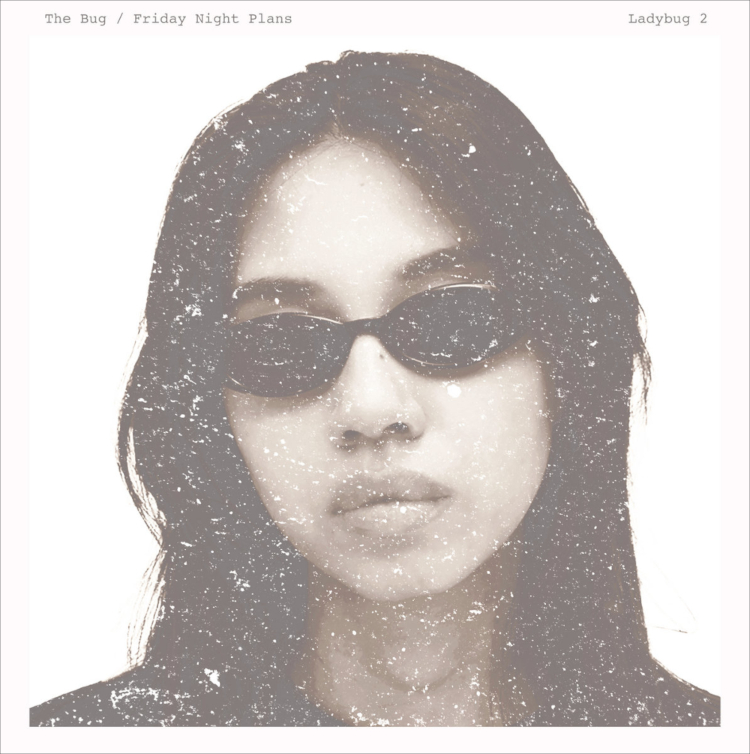
The artwork anticipates the character of the record. Masumi’s face, hidden behind dark glasses, emerges from a field of weathered white, almost erased by a layer of photographic dust. The music also withholds any sharp definition. Her voice feels close and already remote, the rhythm distorts the perception of time, while the bass presses forward relentlessly and casts a dim light around itself. This is sound that narcotizes, shifts the center of listening and carries the listener elsewhere through a calm troubled by unease.
Miss U is approached six times, through reductions and deformations that alter the weight of its individual elements. Martin works with recurrence, with the memory of what has just been heard, with the expectation of an impact that may arrive late or dissolve entirely. The Broken versions sharpen this logic: the song loses its outline and enters a haze where dub meets the languor of shoegaze and certain strains of electronic melancholy from the nineties. Keyboards float, the central matter grows rough, the foundation preserves an enormous power. Everything moves slowly and with absolute discipline, even when it seems close to collapse.
Masumi avoids any display of force. Her singing is hushed, melancholy, almost oblique; it brings a controlled fragility into a sound system capable of swallowing her whole. That disparity feeds the attraction of Ladybug 2. Her voice skims the surfaces, disappears for long stretches, then returns like a thought that sleep had only hidden. Martin gives her a simple and memorable melodic line, surrounding it with echoes and deep expanses of absence. The result retains a secret pop element, perceptible even in its most disintegrated forms.
“Masumi allows herself to be absorbed, becoming color and breath, encouraging an unbroken hypnotic continuity. The first volume moved through successive intensifications; this one favours dissolution.” ~Mirco Salvadori
The comparison with Ladybug 1 is unavoidable and clarifies the distinct character of these two episodes. With Dis Fig, the voice seemed to act from inside the music, pushing each version towards a further degree of emotional exposure. Vanishing carried the weight of a wound spoken aloud; its subsequent mutations extended the narrative and allowed new tensions to emerge. Friday Night Plans adopts a more elusive presence. Masumi allows herself to be absorbed, becoming color and breath, encouraging an unbroken hypnotic continuity. The first volume moved through successive intensifications; this one favors dissolution.
From that choice arise both the record’s particular allure and its mildest limitation. Ladybug 2 possesses an extraordinary sensory pull, wrapping itself around the body and suspending thought; across the sequence, its emotional transformations feel less profound than those heard in the previous chapter. Some versions extend a state that has already been achieved, refining the same vertigo and adjusting its density. The experience continues to seduce as the journey assumes a more circular form. There is less risk, less drama, and a reduced ability to change meaning with each passage.
It would be unfair to read this restraint as fatigue. Martin is defining a series built upon the responses of different voices to his musical grammar, and Ladybug 2 demonstrates how readily that language can welcome distant sensibilities. The production has an almost tactile precision. The bass takes on physical dimensions, pauses open sudden drops, vocal fragments cross the mass with exhausted grace. Even the most rarefied moments maintain their pressure. The music seduces through a stubborn slowness and transforms repetition into an act of conscious surrender.
“Its six forms construct a single dark, sensual and estranging flow, from which the listener emerges with the sense of having lost contact with the outside world for a while” ~Mirco Salvadori
Ladybug 1 therefore retains a slight advantage. It possessed a clearer emotional center and a dialogue between voice and sound capable of producing new consequences. Ladybug 2 chooses a more uniform beauty, less lacerating and entrusted to immersion. Its six forms construct a single dark, sensual and estranging flow, from which the listener emerges with the sense of having lost contact with the outside world for a while. It is an intensely realized work, meticulous throughout, endowed with a force that grows with the volume and with the willingness to surrender to its pace.
The highest point in the series still belongs to the first encounter. This second episode broadens the design and changes the path taken by the voice. The Bug and Friday Night Plans deliver a record capable of numbing and transporting, less devastating than its predecessor and equally serious in the pursuit of its own spell. Ladybug 2 prolongs the moment following the impact, when the senses slow down and reality loses its clarity. It finds its truth there, within a submerged melancholy that keeps pulsing in silence.
Ladybug 2 is available on Pressure. [Bandcamp]