






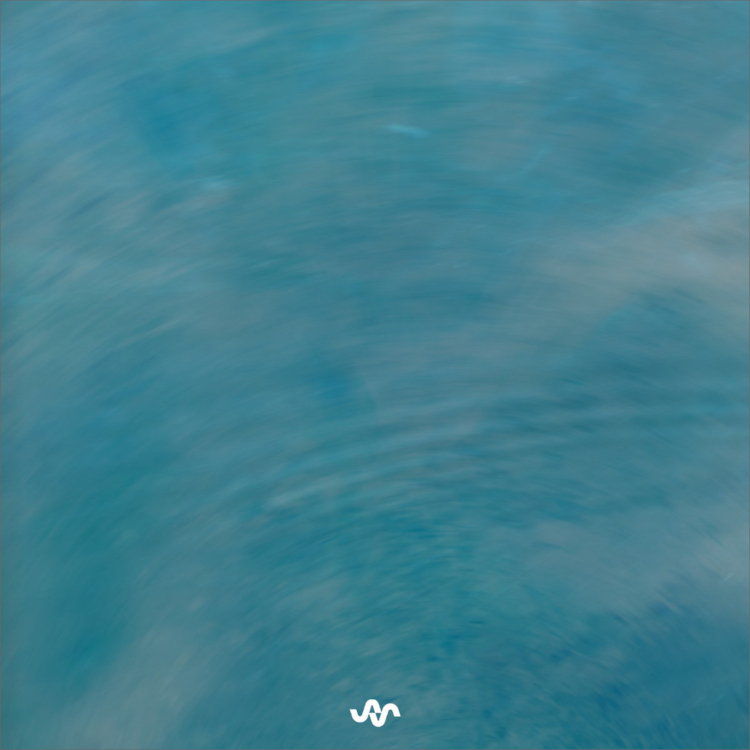
When the final sound fades, the small white emblem at the bottom of the cover comes to mind. A wave reduced to calligraphy, discreet while the blue occupies everything. Wind Paths works in much the same way: it passes through the listener, leaves behind a faint vibration and entrusts the air with carrying it away.
A form capable of appearing and dissolving within a few minutes
The cover already offers a statement of intent. A shifting blue, crossed by pale brushstrokes, occupies the entire field, leaving a small white mark near the lower edge. It could be water observed at close range, air made visible, a photograph taken in motion during a crossing. The image refuses to settle. Wind Paths follows the same impulse, entrusting its identity to whatever passes, bends and changes density. Philippe Deschamps gathers wind, waves and rain into music that is brief and lucid, animated by a calm that retains its sense of movement.
Four pieces and just over ten minutes form a single current. The compact running time keeps every element clear of decorative contemplation. The chords move slowly, changing color by small degrees; the guitar disperses its outlines; the synthesizers hold open an even light, gently varied from within. The field recordings enter the wider fabric discreetly. Sea and rain shed their role as illustrative background and become pressure, an irregular pulse, a measure beyond human intention. The record listens to the landscape as it transforms it.
The new gesture lies in the voice. Deschamps trained as a Baroque countertenor and draws on that experience here, freeing it from text. The vocal tones stretch, overlap and take on the quality of warm currents. No phrase reaches for meaning. The body emerges through breath, then merges with guitar and recorded air. This fusion forms the emotional centre of the EP. It offers a fragile presence. The listener recognises a human figure and immediately watches it dissolve into the broader movement. It is a simple decision on paper, decisive in its effect.
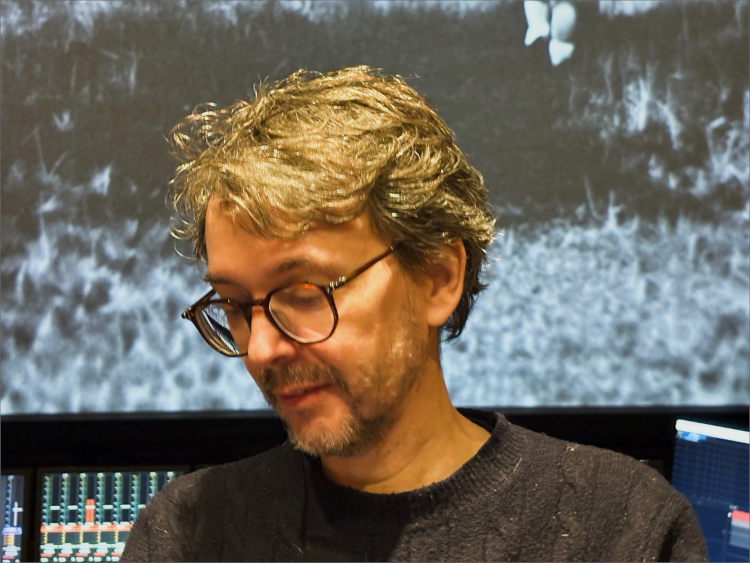
Deschamps’ path has been leading towards this synthesis for some time. Introduced to the piano as a child, later a singer, bassist and guitarist in rock and post rock groups, then trained in film sound at La Fémis, the French composer has developed an ambient body of work since 2022, nourished by natural phenomena and mental images. “Blue Baths,” “Forest of my Nights,” “The Silence of Pallas,” “Remember the Clouds,” “Endless Vanishing Lines,” and “Entering the Ocean” mark the stages of a coherent inquiry. Ocean, sky, darkness and distance provide a different organizing principle each time. Wind Paths distils that inquiry even further. The voice enters the frame and alters the relationship between landscape and memory.
Intensity develops through accumulation and minute alteration ::
His experience in cinema emerges through the precision of each entrance and fade. Deschamps understands the weight of a sound placed an instant earlier or later, and knows how to let a detail acquire prominence without demanding it. Here, that sensitivity produces a fluid montage. Forms follow one another through affinity, carried by a slow pulse that resembles breathing and, at times, the movement of the tide. There are no spectacular peaks, refrains or turns designed to reclaim the listener’s attention. Intensity develops through accumulation and minute alteration. At certain points, a low line supports the entire field; elsewhere, the texture grows lighter and the voice seems to arrive from an immeasurable distance. Few materials, carefully chosen.
The record’s ambient purity grows from this economy. Its sound world possesses body and depth, and maintains an almost tactile transparency. Silence appears within the gaps and along the fading edges of notes. Even the fuller passages leave an open area where the wind around the listener, distant traffic or movement elsewhere in the house can still be heard. The music welcomes such intrusions. Its open character encourages a porous relationship with the present. Wind Paths can drift at low volume and preserve its identity; under closer listening, it reveals subtle changes, harmonies slipping sideways and voices layered with restraint.
Such control brings its own risk. At times, the music’s gentleness brushes against a beauty held too safely, polished until friction and surprise have almost disappeared. Its brevity sharpens the issue: certain openings withdraw just as they acquire an unexpected inflection. The ending arrives early and leaves a desire for one further stretch, perhaps a little less serene. This limitation also clarifies the nature of the project. Wind Paths chooses a form capable of appearing and dissolving within a few minutes. It asks for attention without insisting upon it.
The title speaks of invisible paths, and the music realizes that idea with remarkable coherence. Each element follows its own direction, guided by shared currents. The voice rises, the guitar fades, the harmonies change their angle. Deschamps has created one of his most lucid works, bringing together his vocal training, cinematic sensibility and ambient practice within a form that feels accessible, intimate and precise.
When the final sound fades, the small white emblem at the bottom of the cover comes to mind. A wave reduced to calligraphy, discreet while the blue occupies everything. Wind Paths works in much the same way: it passes through the listener, leaves behind a faint vibration and entrusts the air with carrying it away.
Wind Paths is available on Silent Sonic. [Bandcamp]