





DiN has built an extensive catalog through precisely these kinds of creative connections, and Juxtapositions stands as a particularly strong example of what can emerge when experienced artists remain genuinely open to one another. There is considerable craft here. Its sophistication lies in the natural way its many elements coexist and transform.
The realization of a conversation that required time to develop
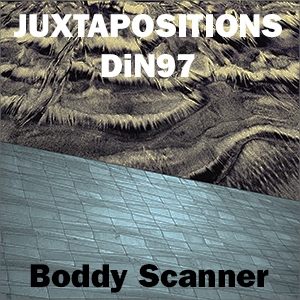
Collaboration can be a particularly revealing form of musical exchange. When two artists with long-established identities enter the same creative space, the result can either reinforce familiar strengths or uncover previously unexplored territory. On Juxtapositions, Ian Boddy and Scanner, the recording identity of Robin Rimbaud, accomplish the latter with remarkable assurance. Both are legendary figures within the broad landscape of electronic music, yet they approach sound from distinctly different perspectives. That contrast becomes the central strength of this nine-track collaboration.
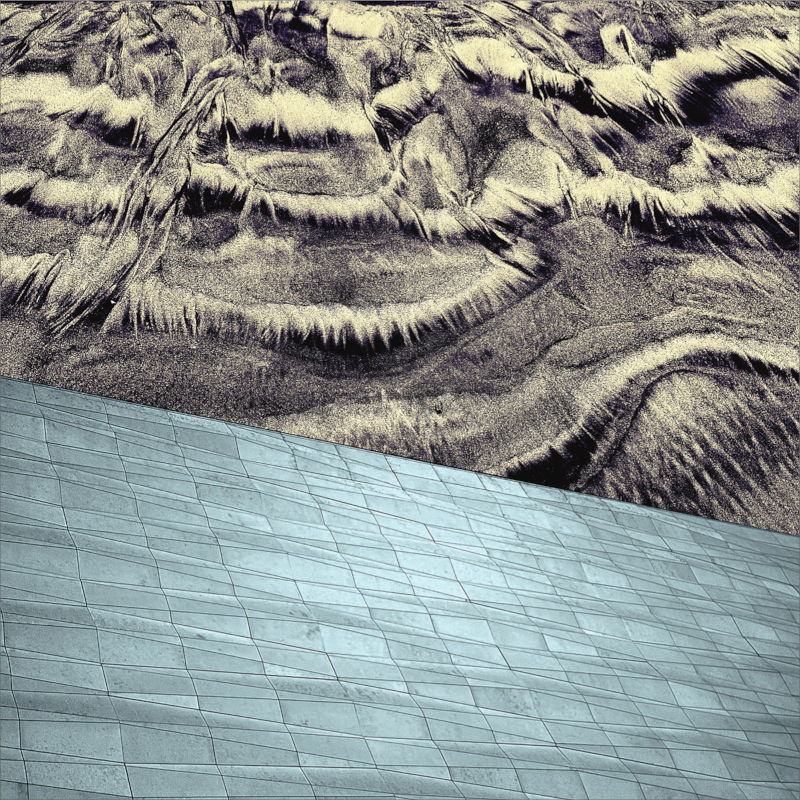
Released on Boddy‘s long-running DiN imprint, Juxtapositions brings together two musicians whose individual careers have been defined by curiosity, exploration, and an ability to continually expand their respective vocabularies. Scanner has previously appeared on DiN through his solo releases An Ascent and The Homeland of Electricity, while his work alongside Boddy at Manchester’s Subliminal Impulse festival in 2022 offered an earlier indication of what their musical connection might produce. Four years later, Juxtapositions feels less like a casual meeting of established artists and more like the realization of a conversation that required time to develop.


Fragments, environmental recordings, and elusive electronic details ::
The album’s title is particularly appropriate. Boddy and Rimbaud‘s approaches remain identifiable, but neither musician simply occupies a separate half of the sound field. Instead, their contrasting methods continually intersect and reshape one another. Cycling electronic patterns emerge and gradually lose their boundaries within more diffuse textures. Carefully articulated sequences create a sense of forward movement before dissolving into reverberant spaces filled with fragments, environmental recordings, and elusive electronic details.
The opening “Exclusion Zone” immediately establishes this sense of unstable balance. Repetition and atmosphere coexist without either becoming dominant, creating a piece that seems simultaneously structured and unsettled. The duo understands the expressive potential of restraint. Ideas are allowed to develop gradually, and changes in texture or emphasis often arrive so naturally that the listener may only recognize the transformation after it has already occurred.
“A Passing Trace” continues this approach with an appropriately elusive quality, while “Voltage in Bloom” introduces a more energized sense of motion. Throughout the album, Boddy‘s sensitivity to melodic and sequential development provides an important sense of internal architecture, while Scanner‘s interventions introduce ambiguity, disruption, and a fascination with the physical and accidental characteristics of sound. The combination is particularly effective because neither artist appears interested in forcing a stylistic compromise.
“Sotto Voce” explores quieter territory, allowing subtle shifts in tone and atmosphere to carry much of the composition’s emotional weight. This is followed by “Intersignals,” where fragments of communication and electronic activity become part of the musical environment. Scanner‘s recognizable use of radio transmissions and found audio is particularly effective throughout Juxtapositions. These elements never feel like decorative references or conceptual interruptions. Instead, they introduce a human presence that is distant, fragmented, and often impossible to fully understand.
Source material and electronic processing become increasingly difficult to locate ::
That tension between familiarity and abstraction becomes increasingly important as the album progresses. Field recordings from old houses and reverberant cellars suggest physical spaces without reducing them to easily identifiable locations. They become acoustic environments within the compositions, their resonances and imperfections blending with synthesized sound until distinctions between source material and electronic processing become increasingly difficult to locate.
“A Room of Hammers” is among the album’s most evocative titles and its slightly extended duration allows the duo to explore a particularly rich interplay between texture, resonance, and implied physicality. Sounds seem to occupy depth rather than simply appearing across the stereo field. There is a strong sense of entering spaces within the music, each one containing its own acoustic characteristics and hidden activity.
The final third of the album demonstrates how successfully Boddy and Scanner have established a shared language. “Shared Frequencies” is perhaps the most fitting title in this respect, suggesting not merely collaboration but communication through common ground discovered in the process of making the music. “Mnemonic Patterns” returns to the album’s interest in repetition and evolving structures, while “A Fleeting Glimpse” brings Juxtapositions to a close without imposing a conventional sense of resolution.
This album’s most compelling moments are often found in the details: a pattern that changes almost imperceptibly, a distant tone entering and disappearing, a reverberation suggesting an unexpected depth, or a texture gradually assuming a different character.

Two distinctive musical voices discover new possibilities ::
What makes Juxtapositions especially successful is that it avoids the temptation to present collaboration as a competition between recognizable styles. Boddy and Rimbaud bring their histories and individual sensibilities into the project, but the resulting music belongs to neither artist alone. Their differences become productive points of tension, generating compositions that move between hypnotic repetition, abstract sound design, emotional resonance, and carefully constructed electronic space.
DiN has built an extensive catalog through precisely these kinds of creative connections, and Juxtapositions stands as a particularly strong example of what can emerge when experienced artists remain genuinely open to one another. There is considerable craft here. Its sophistication lies in the natural way its many elements coexist and transform.
For listeners familiar with either artist, Juxtapositions offers the pleasure of hearing two distinctive musical voices discover new possibilities through their interaction. For those encountering their work for the first time, it is an absorbing entry point into the creative worlds of both Boddy and Scanner. More importantly, it stands on its own as a deeply considered and beautifully constructed electronic work, one whose subtle movement and hidden detail encourage repeated listening.
Juxtapositions is an album about the productive possibilities of difference. Ian Boddy and Robin Rimbaud do not erase the distance between their individual sound worlds. They explore it. Within that space between their approaches, they have created something rich, patient, mysterious, and quietly compelling.
Juxtapositions is available on DiN. [Bandcamp]