


In A Small Room, Decades Ago sounds like a return to the exact point where ambient ceased to be background and became consciousness. A warm, immersive, necessary record, engraved with the care of one who knows that certain machines, when listened to with love, still preserve the heartbeat of those who first switched them on.
An album that flows like a single organism
Electronic sound is inhabited by figures who seem to move along lateral tracks, barely lit, and from there end up guiding the secret march of an entire era. James Bernard belongs to this lineage: that of patient builders, visionary technicians, artisans capable of making a machine sing with the humility of those who know the value of the manual gesture. In the early Nineties, at the moment when rave culture was seeking a vocabulary for its most feverish side and a grammar for its own inward gathering, Bernard brought together acid, trance, breakbeats and contemplation, releasing music as Influx and Cybertrax and arriving in 1994 with Atmospherics, a key record for understanding how ambient techno could assume a cosmic stance, an earthly fever, a melodic discipline.
That music was born from limited means: sequencers, twelve-bit samplers, drum machines, bass, hands ready to govern everything in real time. Its lesson continues today precisely because it arose from a physical act a practice of sound as muscular memory, as breath educated by the darkness of clubs and the milky light of dawn. Bernard learned to think electronic music by touching its circuits, turning technical limitation into poetic principle, error into pulse, hiss into horizon. From there a method took shape that has crossed thirty years with intensity: stripping rhetoric away from technology, restoring warmth to the system, giving frequency a form of human presence.
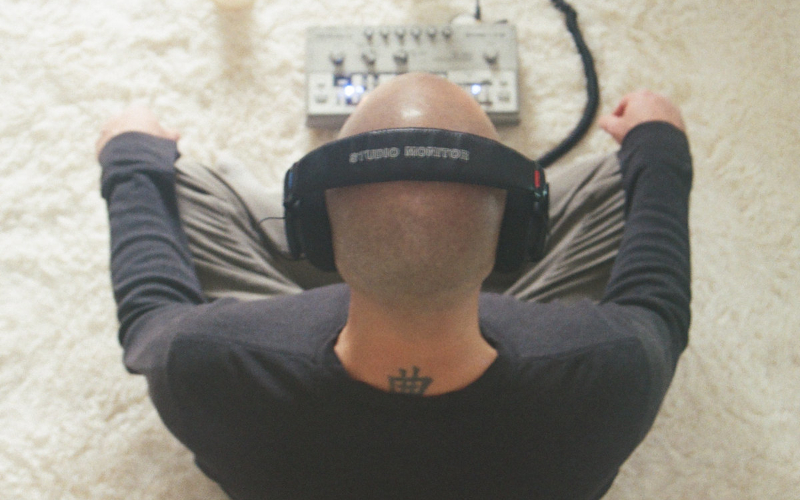
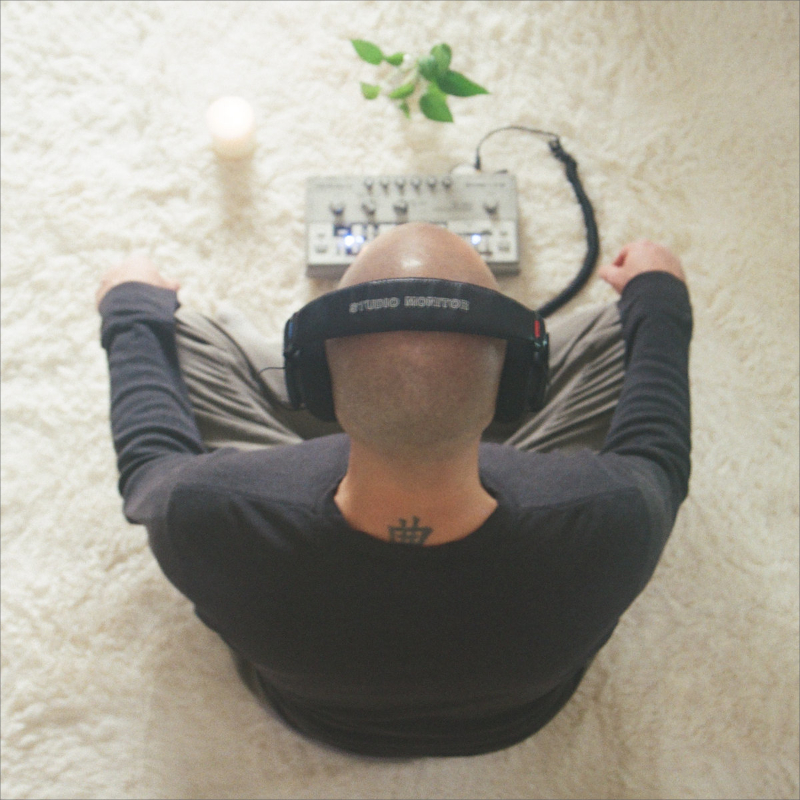
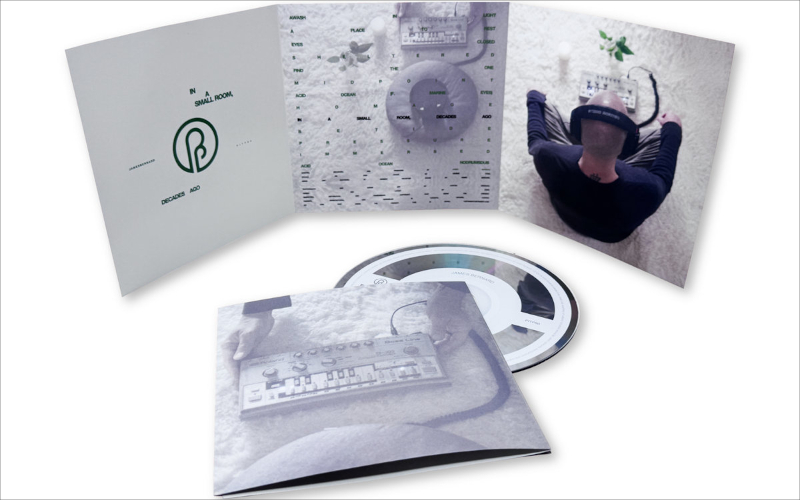
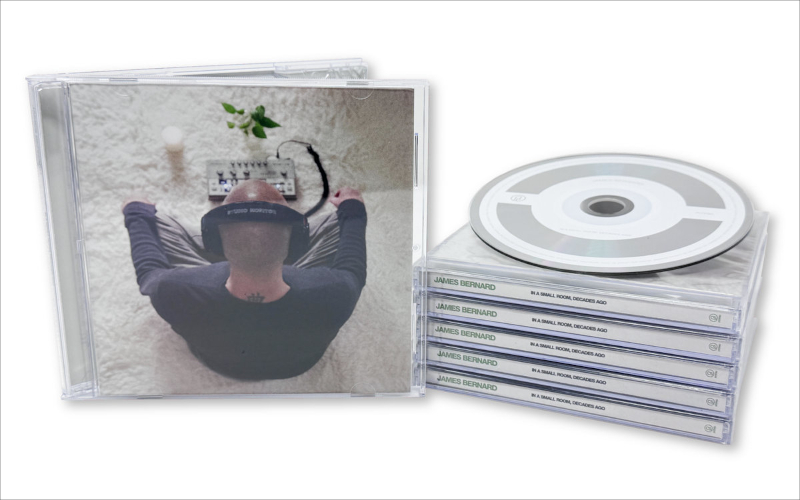
In A Small Room, Decades Ago arrives more than thirty years after that first flash and chooses return as a form of advancement. The cover, with the shaved head seen from above, the headphones enclosing the skull, the small machine listening on the carpet, already says a great deal: technology loses the triumphalism of the console and becomes a domestic object, almost a votive lamp lit to summon benevolent ghosts. Bernard looks back to the chill-out areas of New York raves, those points of decompression where the collective beat turned into dust-like particles, and draws from them an album that flows like a single organism, a slow migration of basses, acid currents, melodic vapors, soft percussion, vocal apparitions.
It hints, dissolves, lets contours emerge through a living grain ::
The music held within the record has the quality of slightly blurred photographs: it hints, dissolves, lets contours emerge through a living grain. The Roland TB-303 bites with grace and is treated as a liquid line, a filament drawing spirals inside a warm depth. The Bass VI introduces a human weight, an almost tactile fibre, while the drum machines pulse with the elegance of a slowed heartbeat, carrying the memory of the dancefloor into a collected dimension. Here ambient, acid and downtempo seek one another through natural affinity. Rhythm appears as the residue of movement, melody as a glow crossing closed eyelids, drone as air charged with serene electricity.
Bernard possesses a rare virtue: he knows the history of the machine and uses it with restraint. Across his path, from the cult status of Atmospherics to his more recent pages for Past Inside The Present, including collaborations with bvdub, zakè, 36, anthéne, From Overseas and the awakened souls project alongside Cynthia Bernard, one recognizes a fidelity to detail. That fidelity also runs through his mastering work for PITP, a place where listening becomes responsibility, a choice of depth, a care for half-light. His mark on the contemporary scene lives here: in his ability to connect the original season of intelligent rave with the present need for quiet, tactile, generous music, capable of reactivating memory and body in the same instant.
His influence works underground, like a hidden current. It can be felt in that newer ambient line searching for the density of analogue sound, in the delicacy with which many recent productions measure the relationship between beat and suspension, in the desire to bring club culture and domestic listening into dialogue. Bernard has always valued the fertile margin, the lateral area where the dancefloor becomes inner listening, where the kick continues to pulse in memory and melody becomes halo, vapor, orientation. This is his most living legacy: having understood that electronic music can preserve intimacy while maintaining full physicality, can be visionary through minimal gestures, can transform a few sound modules into a recognizable emotional landscape.
Memory here becomes active matter. The voice of marine eyes, when it emerges, carries a marine grace, fragile and wide, seeming to rise from nocturnal water crossed by synthetic reflections. The record alternates brighter zones and denser ones with the naturalness of a tide, tuning round basses, high rustlings, sequences that glitter for a few seconds and then return to the current. In certain passages a velvet acidity surfaces, almost smiling, born of the 303 and its curved alphabet; elsewhere the material thins into pure suspension, a synth glow that seems projected onto inner walls. Inquiri’s continuous mix confirms the unity of the journey.
Guided by the inner movement of frequencies ::
The most surprising element is the naturalness with which In A Small Room, Decades Ago avoids the commemorative exercise and finds a present language. The roots surface in every fold, from the rounded basses to the breathing of the machines, from acid trails to the downtempo gait, and every element appears arranged with knowing calm, in a nostalgia purified of ornament and museum impulse. Bernard rereads his own past as material still warm, carries it into the present with steady hands, shapes it into a form capable of speaking both to those who lived the rave nights and to those who know them through handed-down stories and myths. The result is music that invites us to enter its flow and allow ourselves to be guided by the inner movement of frequencies.
The deep fascination of the album lies in its form of maturity. Bernard knows the power of sound when it steps back to make space for the listener, knows the value of a barely placed kick, of a low frequency supporting everything like a hidden beam, of an acid arpeggio capable of opening private memories within an imaginary community. His contemporary electronics still carry the breath of the Nineties, and that breath is filtered through an adult sensitivity, through a sonic organism where every object has weight, function, glow.
This album, among the most accomplished ambient works of 2026, moves because it speaks of fidelity to one’s beginnings with a clear voice. Nostalgia, in Bernard’s hands, becomes affective technology: a way of rekindling the instant in which rave discovered silence, the body sought shelter in low frequency, and the night delivered a fragile promise to the morning. In A Small Room, Decades Ago sounds like a return to the exact point where ambient ceased to be background and became consciousness. A warm, immersive, necessary record, engraved with the care of one who knows that certain machines, when listened to with love, still preserve the heartbeat of those who first switched them on.
In A Small Room, Decades Ago is available on Past Inside The Present. [Bandcamp]

Related posts ::
 4PLAY :: Past Inside the Present — Awakened Souls, Tyresta, From Overseas & zakè, James Bernard & anthéne
 V/A :: Past/Present 2024 Compilation (Past Inside The Present)
 Healing Sounds from Past Inside the Present
 Inquiri :: See You Someday (Past Inside The Present)
 marine eyes :: chamomile (Past Inside the Present)