




Én Stemme succeeds because the constraint actually does the work it was designed to do. Ten artists, one oscillator each, and the result isn’t ten variations on a theme—it’s ten distinct voices proving that limitation, handled with enough curiosity, produces more individuality than freedom usually does.
Vicious Records picks a premise sharp enough to generate genuine variation
There’s a specific discipline to assembling a good compilation, one that gets undervalued constantly. Anyone can throw a dozen unrelated tracks under a single banner and call it a release. The labels that actually understand the form treat a compilation as a question, not a container, they pick a premise sharp enough to generate genuine variation, then trust the artists to answer it in their own language. The conceptual rigor of a compilation is the difference between a sampler and a statement, and Én Stemme falls firmly into the latter category.
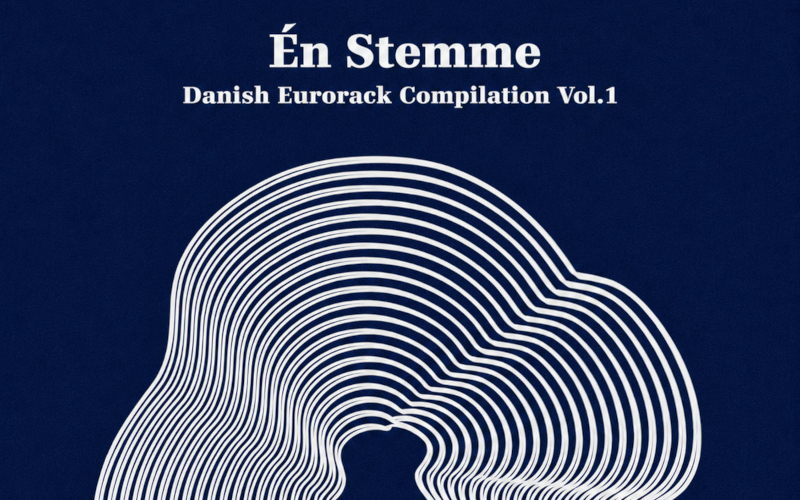
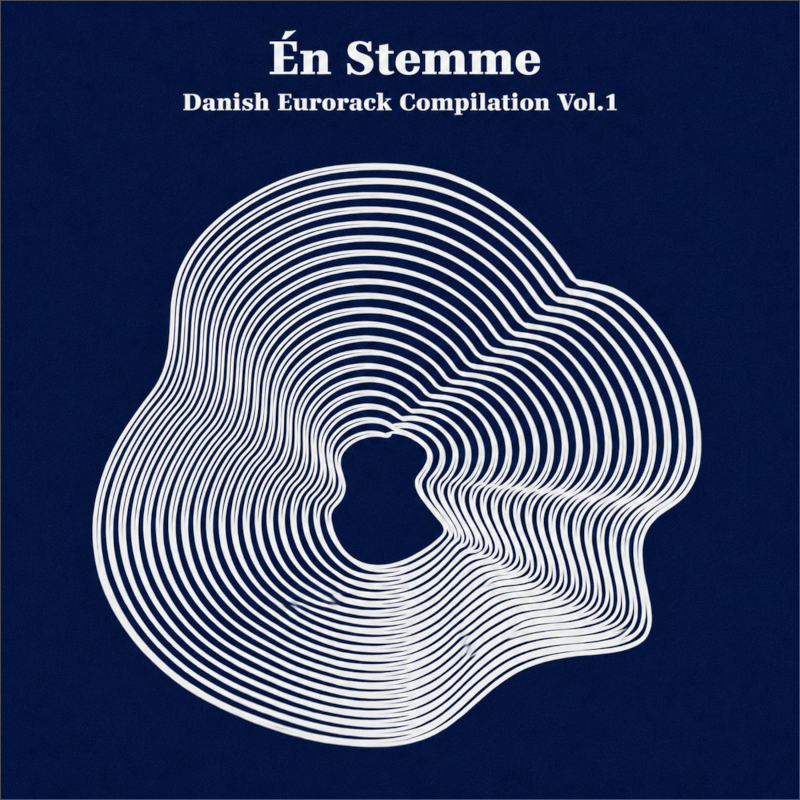
Vicious is a Copenhagen-based audio production company and label run by Lars Kivig, a musician, producer, and field recordist with nearly three decades in Denmark’s experimental music scene, with credits spanning collaborations with Thomas Wydler of The Bad Seeds and projects ranging from the dark ambient/glitch work of SKAMBIDT to the patch-study explorations of ModuLARS. Én Stemme (One Voice) takes its premise from a constraint about as austere as modular synthesis allows: one oscillator, one take, no postproduction. Ten Danish Eurorack artists, each handed the same skeletal starting point, a single VCO, nothing layered on top, nothing fixed afterward and asked to see what comes out the other side. Kivig compiled and normalized the results at Vicious Studio to give the comp a coherent listening arc while leaving each performance’s dynamics untouched. It’s a tight enough premise to actually mean something, and loose enough to let ten very different sensibilities show up clearly.
Among the standouts: “Jules,” by Iwan Kristensen. Simple in its approach like much of the comp, but the feedback that surfaces midway through the track is the real moment, an unexpected wobble, a rumble that clearly wasn’t planned but landed anyway. That’s the entire appeal of unintentional artifacts in experimental electronic music. A feedback loop, a slight overload in a filter, an oscillator drifting out of its expected range, these aren’t mistakes to be edited out, they’re the foundation of what makes a one-take recording worth hearing in the first place. You genuinely don’t know what’s going to surface out of a feedback path or a delay running on pads until it happens, and that uncertainty is the entire point of the “one oscillator, one take” premise. Needles‘ “Detour” follows the same rule but stays raw in a different way, a bass line being run through a sequence in real time, recorded in a single pass. Not bad for one take on one note.
One Oscillator, Ten artists ::

Kasper Svendsen‘s “Fluctus Vōcis” works the wave shape itself as the compositional material. From a producer’s standpoint, this is the part of modular synthesis that rewards close listening—the oscillator’s waveform isn’t a fixed, neutral building block, it’s a continuously variable shape, and the harmonic content of the sound shifts depending on where you sit between a pure sine, a triangle, and a square. Svendsen is clearly riding that variable here, pushing the wave shape toward something that sits close to a triangle or square wave but altered with enough nuance that it never settles fully into either, a kind of harmonic ambiguity that changes the character of the noise and frequency content as the piece progresses. Rasmus Visti‘s “Til Émilie” takes a gentler approach, built around a waveform that plays like a lullaby, a cute square wave with teases of arpeggios and decay stabs woven through it. Thoughtful, restrained, and clearly composed with intent despite the live, single-take constraint.
The compilation closes with Molaar‘s “Funktion,” a masterpiece of pads and atmospheric reverb applied to melodies that feel almost dreamlike, genuinely captivating. It mirrors the comp’s opener, Kiloton‘s “Remnant,” which ends just as beautifully, an intro that sounds almost menacing despite being beautiful and mysterious at the same time. Both bookend the release with that same unresolved tension: unexpected, exploratory, unmistakably experimental in nature.
Én Stemme succeeds because the constraint actually does the work it was designed to do. Ten artists, one oscillator each, and the result isn’t ten variations on a theme—it’s ten distinct voices proving that limitation, handled with enough curiosity, produces more individuality than freedom usually does.
Én stemme — Danish Eurorack Compilation V1 is available on Vicious. [Bandcamp]






![[2View] Maps and Diagrams’ beneath still stars (handstitched*) & returning light (Home Normal)](https://igloomag.com/wp/wp-content/uploads/2026/10/maps-and-diagrams-returning-light-beneath-still-stars_feat-75x75.jpg)