





By providing a slew of tips for the creative use of the tools, and by really diving into all that is on offer here, the person who uses this book is going to give back new imaginative music electronic music community, just as Feldman shares the knowledge. Put the work in, and have fun while you craft your own sound signature, the sound of your musical imagination, that uses the tools to realize the composition you first heard in your mind and soul. This alone will be what sets you apart from the clones.
Looking at core techniques
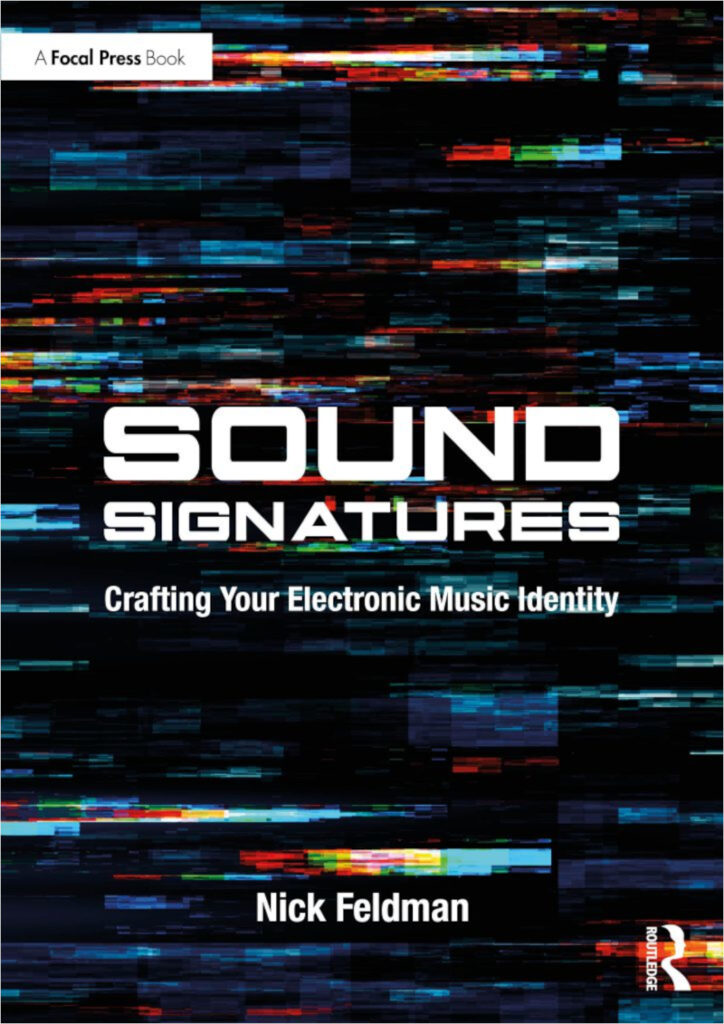
Electronic music is a craft, and applying yourself to mastering the craft takes work. Yet creativity should have an element of play, excitement and mindful interest in the process. A dedicated craftworker will also want to know some of the history of their chosen art, of what has been done before, by whom, and how the particular techniques they employ were developed and used in the past. This is where Nick Feldman’s very useful guide Sound Signatures: Crafting Your Electronic Music Identity comes into play. He helps the reader, his audience of electronic music creators, to learn all about the process of making unique songs and pieces by showing how it is done. He shows how it is done by looking at core techniques, talking to current masters of the form, and providing exercises to try out in the studio.
As such, it is useful for both the apprentice, journeyman and the master alike. Masters always keep on learning to stay at the level of master, and beginners need signposts to point them along the way. A good beginner musician will start out by being inspired by the musicians who have come before them and try to copy or emulate what they have heard. This is a good approach and gives them the skill set they need to progress in their efforts. Copying alone, however, only creates another simulacra, a sound-alike in a world already too many alike sounds and artists. Developing and refining skill at production alongside imaginative creativity is what gives an individual or group their own sound that, despite the efforts of even AI, ends up being something another can’t emulate because it is unique.
New mathematical dimensions to audio processing ::
This is the core idea at the heart of Feldman’s book, that every producer or music maker who develops their own unique sound, has a sonic signature. It’s what makes Merzbow sound different from Masonna, even though they both make noise music. It’s what makes Meat Beat Manifesto sound apart from Kid606 even though both are masters of the breakbeat. It’s why Front Line Assembly will always sound different than Skinny Puppy.
Since home recording has changed the landscape of music, democratized it so that anyone with a modest amount of funds can get into building a studio in a spare room, there has been a huge influx in the number of bedroom producers making a wide variety of electronic music. In that sense it is like any other craft or hobby: you can do it on a budget, or you can spend a fortune. Yet even a super expensive studio, with all of the latest gear, modular synths, boutique synths, test equipment, effect units and pedals, and all the latest software, won’t make a person sound unique and interesting in and of itself. More often than not, the music just ends up sounding like the tool it was made with, as composer Kim Cascone has often pointed out. To sound like more than just the tool, those tools need to be mastered with creativity in mind.
Feldman provides the field map for making the tools your own by introducing a technique, process, or area of sonic investigation across twelve chapters that go from the basics of production analysis, to specialized practices such as spectral and temporal processing. He explores synthesis, digital audio, MIDI, effects, noise, and vocal technologies in terms of their technological history, and the who and how of its use to make memorable music. Each chapter includes exercises and things to try out in the studio, suggested listening and further reading lists, and five of the chapters have interviews with musicians who are adepts in that particular area of production.

Fun can be had with the creative mixing of sounds ::
He interviews people like trumpeter and modular synthesist Sarah Belle Reid to discuss the way she has developed sensor systems and real time processing to develop extended techniques in brass. In the chapter on vocal technologies he chats with Holly Herndon about voice synthesis and her use of voice across her work. In the noise and texture chapter he talks to Amon Tobin who has been known to click, cut and chop a variety of sampled sound sources. Benn Jordan and Robert Henke (aka Monolake) to round out his interview subjects.
I was very excited he included a chapter on spectral processing, which has opened up new mathematical dimensions to audio processing, restoration and new ways of viewing sound itself. The final chapter is on dub mixing techniques, which ends the book on a fun note, because in the end how can you listen to dub music and not smile, not think about what fun can be had with the creative mixing of sounds?
If you are an electronic music maker, get this book, read it, and try out the exercises. The exercises are key, because no matter how theory one knows, or how much gear one has, if you aren’t seeing how to push your ability into new domains (whether they be temporal or spectral) the music is going to sound flat after being used over and over again. By providing a slew of tips for the creative use of the tools, and by really diving into all that is on offer here, the person who uses this book is going to give back new imaginative music electronic music community, just as Feldman shares the knowledge. Put the work in, and have fun while you craft your own sound signature, the sound of your musical imagination, that uses the tools to realize the composition you first heard in your mind and soul. This alone will be what sets you apart from the clones.
Sound Signatures :: Crafting your electronic music identity — by Nick Feldman is available on Routledge. [Purchase]