



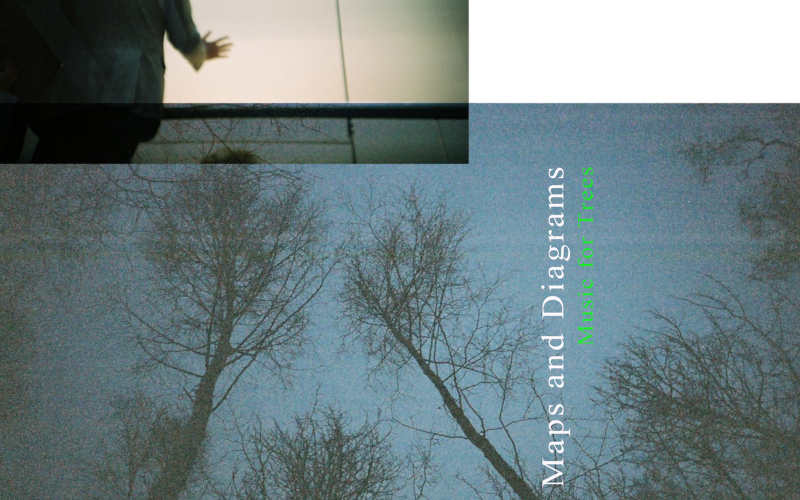



Maps and Diagrams’ music drifts like sunlight through a forest canopy, slow, dreamy, and richly layered with acoustic textures that evoke the spirit of each tree it’s named after, from oak to cedar, inviting the listener to float, ponder, and perhaps even dream alongside the trees themselves.
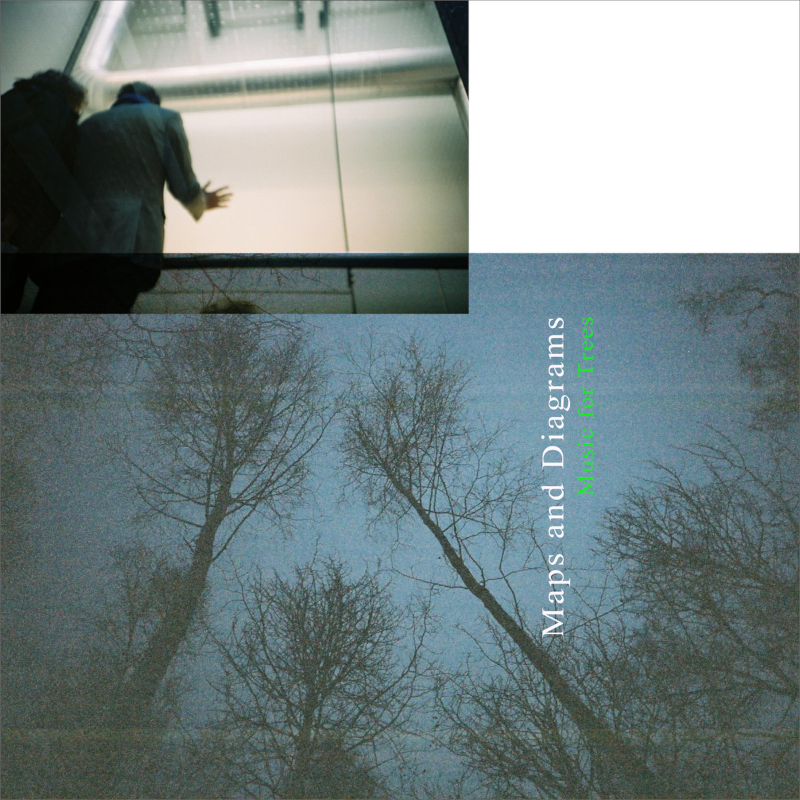
Do trees dream?
Instrumental music with a slow dreamy feeling, no wooden knocks or sounds of the wind in the boughs. I have bad luck guessing instruments but it sounds like Tim Diagram is using a kalimba, maybe a koto, a piano, some woodwinds, tapped things and just a very wee bit of enhanced electronic processing, nothing sounds aggressively unnatural. Each track is named for a family of trees, oak, maple, pine, etc. What I hear are conventional instruments, layered textures with some occasional bubbling percussion, no melodic constructions, plenty of time for some easy floating, bringing about a mood good for the snooze.
Do trees dream?
To me, the sound and this list of trees invites a forest of concepts to ponder. Does the sound simply reflect a general enthusiasm for arboreal splendor? Is this music intended to be played to or for the trees? Is this music intended to somehow represent something about these botanical species? Is the sound intended to inspire the listener to imagine something about the species of trees?
Would knowing more about each species of tree reveal something about the music? I do not know. None of these questions seem to be mutually exclusive, they can all be true. In my ancient training as a librarian, I have become inspired by the meaning of words and whatnot, the strangest things are sometimes magnetic.
“Oak” (4:11) trees have spirally arranged leaves, often with lobed edges, and a nut called an acorn, borne within a cup. The acorns and leaves contain tannic acid, which helps to guard against fungi and insects. They also live in association with many kinds of fungi including truffles. I hear a plucking of strings and tapping with sticks or felt mallets, a single note harmonica drone, and maybe a kalimba. When one instrument starts a statement it may be finished by another, and conducts a steady flow through slow, hesitating and irregular yet dreamy places with cascading reverberations. Wine barrels are made of oak; these are also used for aging alcoholic beverages such as sherry and whisky, giving them a range of flavors, colors, and aromas. Mortals who destroyed such trees were said to be punished by the gods because the ancient Greeks believed beings called hamadryads inhabited them.
Slow haunting piano chimes ::
During late winter to early spring in northeastern North America, when the night-to-day temperatures change from freezing to thawing, maple trees may be tapped for sap to make maple syrup. “Maple” (4:37) is also renowned for their autumnal leaf colors. The maple is a common symbol of strength and endurance and has been chosen as the national tree of Canada. The maple is also a symbol of Hiroshima, ubiquitous in the local meibutsu, a Japanese term for special regionally famous themes. Most maples are shade-tolerant when young and are often riparian, understory, or pioneer species rather than climax overstory trees. The leaves in most species are palmately veined and lobed, with 3 to 9 veins each leading to a lobe, one of which is central or apical. The flowers are regular, pentamerous, and borne in racemes, corymbs, or umbels. The distinctive fruits are called samaras, “maple keys,” “helicopters,” “whirlybirds” or “polynoses.” But what does the track sound like?…
I hear slow haunting piano chimes which put me in an easy-drifty mood. There are more instruments joining, silver strings float in, repeating clusters of tones come dreamily flowing along, gently swaying, the piano keeps the center throughout. Maple is considered a tonewood, or a wood that carries sound waves well, and is used in numerous musical instruments. Electric guitar necks are commonly made from maple, having good dimensional stability. Maple is also commonly used in archery as the core material in the limbs of a recurve bow due to its stiffness and strength. Maples have a long history of use for furniture production. Sugar maple wood, also known as “hard maple,” is the wood of choice for bowling pins, bowling alley lanes, pool and snooker cue shafts, and butcher’s blocks.
I think of pine trees and remember the smell of their accompanying breezes, “Pine” (4:51). I love the sight of pine trees, the sticky essence of the needles, the feel of the floor, and wondering where in the pines she slept that famous terrible night. I hear chirping woodwinds flickering like a mirage, perhaps a kalimba, a classical guitar, a floating breeze. This track offers a full service, the sound brings your pressure down and floats your boat, you can catch the details or you can let it all go and just relax. Pines are gymnosperms, which means something about naked seeds. They have cones. They have photosynthetic needles rather than leaves. Pine trees are long lived and typically reach ages of 100–1,000 years, some even more. The Pinaceae, the pine family, first appeared in the Jurassic period, the age of reptiles, one or two hundred millions of years ago. The seeds are mostly small and winged, and are anemochorous or wind-dispersed, and are generally edible. Some pine are fire-resistant and some are fire-dependent. In traditional Chinese medicine, pine resin is used for burns, wounds and skin complaints.

Watch for the birds in the woods ::
Watch for the birds in the woods, with the sound of touching string instruments, minimalist harmonica ghosts, slow gentle little percussive accents, forward and backward sounds, creaking metal clinks, gong strings, an atmosphere with tinkling chimes and creaking ropes where birds dream, the stream flows along through subtle changes and tiny new sounds peep in. There is a British Isles berry bearing tree, the “Whitebeam” (7:31), and a ghostly form emerges from some odd creaking and shimmering, whispery strings take hold and then melt into a cinematic fade. The whitebeam is a hardy, often slow-growing tree with white spring flowers and red autumn berries, frequently used for ornamental purposes in urban areas due to its pollution tolerance. The berries are a favorite of fruit-eating birds like thrushes and waxwings, though are less palatable than rowan berries. In many species, the surface of the leaves is an unremarkable mid-green, but the underside is pale to almost white, hence the name, with pale grey or white hairs, transforming the appearance of the tree in strong winds.
I hear clicks, a perhaps breathy flute, echoey bubbles, the sound of an underwater flickery dark glow, now with extra reverb and a harmonium, water percussion, reverberating string plucks in drone rainbows, bubbly flickers, and so forth. The “Baobab” (5:16) bears a many-seeded fruit, and is a defining icon of the African bushland, said to be also known as the “Upside-down tree.” Baobab trees hold cultural and spiritual significance in many African societies. They are often the sites of communal gatherings, storytelling, and rituals.
Some baobab species are sources of fiber, dye, and fuel. There are eight recognized species of these trees, with six different types found in Madagascar, one native to mainland Africa and the Arabian Peninsula, and one native to Australia. The African and Australian baobabs are similar in appearance, and the oldest splits within the baobab family are likely no older than 15 million years; thus, the Australian species represents a long-distance trans-oceanic dispersal event from Africa. The Panke baobab in Zimbabwe was some 2,450 years old when it died in 2011, making it the oldest angiosperm ever documented, and two other trees—Dorslandboom in Namibia and Glencoe in South Africa—are estimated to be approximately 2,000 years old. The fruit of the baobabs is one of their distinguishing features. The white pith in the fruit of the Australian baobab has an acidic, tart, citrus flavor. Young trees usually have slender, tapering trunks, often with a swollen base. Mature trees have massive trunks that are bottle-shaped or cylindrical and tapered from bottom to top.
A slow evolution and transformation ::
Now we are rolling along into another new sparse and dreamy reverberating atmosphere, I can see the light coming through the leaves above the trail where there are knights on horses with banners, the piano strings join with the electronics, a plucked classical guitar sometimes appears backwards and in layers. A “Redwood” (3:15) can live for thousands of years. The three redwood subfamily genera are Sequoia from coastal California and Oregon, Sequoiadendron from California’s Sierra Nevada, and Metasequoia in China. Sequoioideae, commonly referred to as redwoods, is a subfamily of coniferous trees within the family Cupressaceae, that range in the northern hemisphere, and includes the largest and tallest trees on the planet.
For the final track let there be energized harmonically rich metal. Let there be chimes that ring like church bells, bottles and bells, tinks and bowed transitions, marimba noodling, there is no significant break in the flow, there is a slow evolution and transformation. The feeling conveyed is an easy floating sensation, perhaps a prime soporific, the wisps are weaving a new fabric. My floating room is filling up with reverb, so I am turning up the weird effects slowly. The “Cedar” (15:07) is known for having aromatic wood. It turns out that Cedar is part of the English common name of many trees and other plants, particularly those of the genus Cedrus. Several species of genera Calocedrus, Thuja, and Chamaecyparis in the Pacific Northwest of North America, are referred to as “false cedars.” Some botanical authorities consider the Old-World Cedrus the only “true cedars.” What we might hear is aromatic, highly durable, and decay-resistant to the core. In ancient construction cedar is a soft wood that is easy to work with, resists insect damage and rot, while symbolizing strength, abundance, and immortality.
Tim Diagram is an artist, musician, inventor and craftsman who has always had a fascination and creative curiosity with Kankyō Ongaku and the amazing artists that have developed these exquisite landscapes over the years, “I’m constantly discovering the magical and instrumental spaces they create, it’s always something I get drawn back to, to bring me a sense of calm and a distraction from the everyday noise.”
Since releasing a track on the RND_0.34873349921 compilation on the Pause_2 label in 2001, Maps and Diagrams has released over 45 albums as a solo artist or as part of collaboration projects, he has appeared on many well-respected labels, such as; False Industries, Static Caravan, Quiet Details, ROHS!, Nomadic Kids Republic, Fluid Audio, Time Released Sound, Chemical Tapes, Smallfish, Toytronic, Expanding Records and both Moamoo and Symbolic Interaction in Japan – to name but a few. Tim‘s music also appeared several times on the world-famous John Peel radio show.
Tim runs the Handstitched* label in the UK which specializes in bespoke, handmade packaging for the more electro-acoustic and drone-like elements of sound, where he releases his own work alongside other like-minded artists. He is involved in audio-visual commissions, including art gallery installations and music videos for a global clothing brand. As well as Maps and Diagrams, Tim also records music under the Atlantis name and works in collaboration with Genoveva Kachurkova as Bluhm, with Charles Sage as Hessien, alongside Rob Lyon as Somme, Ian Hawgood as Ouvala and with Arbee under the name Emba.
Music for Trees is available on ato.archives. [Bandcamp]



![[2View] Ma Haiping/Velocity Unlocked & Various/Structure Series 3 (Molecular)](https://igloomag.com/wp/wp-content/uploads/2026/10/structure-series-3-feat-75x75.jpg)


![[2View] Nekomachi/no wonder • なるほど & tsubai/ilulissat (Perceptual Tapes)](https://igloomag.com/wp/wp-content/uploads/2026/10/nekomachi-no-wonder-tsubai-ilulissat-tapes_feat-75x75.jpg)