



After a quiet pause, See Blue Audio returns with a ritual-like gesture, entrusting its sixtieth release to Cartography of Sleep—a long-distance collaboration patiently assembled through file exchanges, where Droning Cats and NRV map sleep as a drifting terrain of drone, nuance, and attentive listening.
Mapping sleep through patient drones
It is rare for a label to return after a pause with a gesture that feels like a rite, quiet and unannounced. See Blue Audio comes back in exactly this way, entrusting its sixtieth release to an encounter born at a distance, stitched together through file exchanges and through a patience that now seems like a virtue from another time.
Cartography of Sleep immediately sets out a clear idea: to cross sleep as a territory, to recognise its shifting borders, to accept that the compass does not always point where we would like. Droning Cats, the Brussels duo led by guitars and modular synthesis, meet the touch of NRV, the project of Manabu Ito, an artist accustomed to treating drone as living matter, sensitive and carefully smoothed. What emerges is a work that favours duration and continuity, faithful to a kind of listening that asks for presence.
Here the key word is nuance. The album moves through a sonic half light where every element seems chosen by subtraction, as if the unnecessary were left outside. The guitar, often filtered and turned into something close to a veil, still keeps a physical origin, a vibration that betrays fingers, strings, wood.
Alongside it, modular synthesizers trace slow currents, and NRV completes the whole with a wide, breathable sense of space, rich in minute detail. There is no need for an explicit rhythm because the music already carries an inner pulse, a wave that returns and recedes, and in that motion images take shape without anyone forcing them.
The title speaks of cartography, and listening really gives the feeling of a map that assembles itself as you move through it, necessary for finding your way inside unstable matter. The pieces, largely without beats, behave like neighboring climate zones: a brightness that surfaces and then slips into denser shadow, a calm that holds a premonition, a beauty that asks for no permission. It is cinematic music in the most serious sense of the term, because it does not accompany an outer story, rather it lights an inner narrative, personal, different for each listener, yet guided by a precise hand.

A quiet return, slowly unfolding ::
The rarest quality of Cartography of Sleep lies in its ability to be contemplative without becoming decorative. Introspection here is delicate work: micro shifts, harmonics that appear like signals, drones that change density with an almost imperceptible slowness. In some passages the guitar seems to transform into oblique light, in others it takes on a darker hue, with restrained tension that stays under the skin. The music does not raise its voice, and for that very reason it goes deeper. It allows unease to exist as a natural part of rest, because sleep is not only surrender, it is also passage, memory rearranging itself, imagination that scratches, landscapes that bend and warp.
There is a sense of dialogue between spontaneity and precision. Droning Cats declare a free, unpredictable approach, and that unpredictability can be felt in the curves, in sudden openings, in shifts of timbral perspective. NRV brings instead a delicate emotional control, the ability to hold the whole together. The result is a subtle balance: nothing seems left to chance, yet nothing sounds rigid. The album flows like a single tale, without shouted chapters, with a progression that feels natural, almost inevitable.
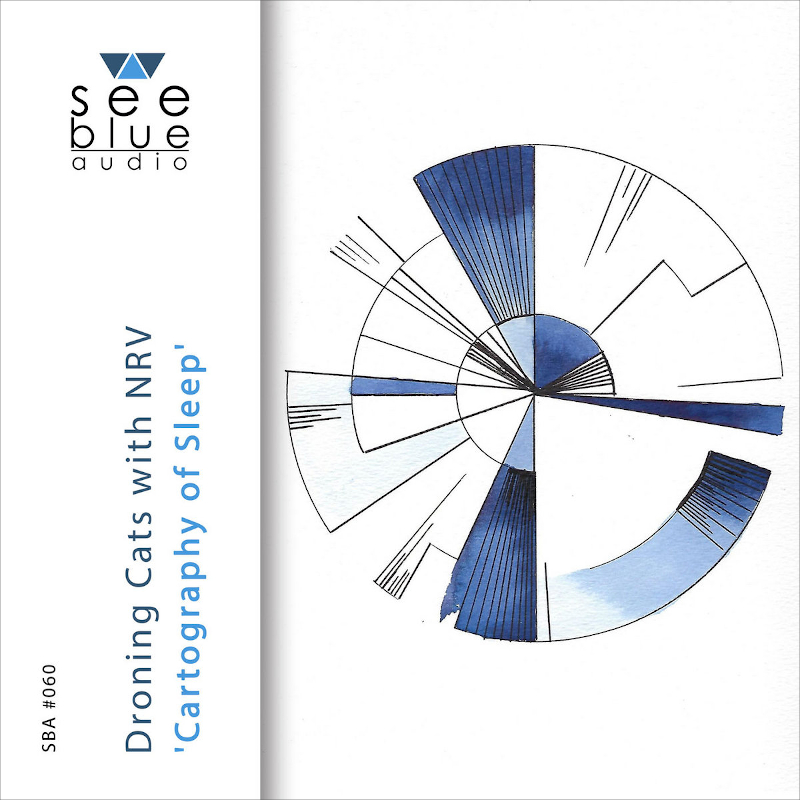
Around the music, Droning Cats build a context that matters. The booklet with texts by Matthew Duffield, written in years marked by the pandemic, and the ink illustrations by Swann Quach, made by hand, are more than an accompaniment: they widen the perception of the work, suggesting that sleep is also a place of images, words, colors, and that the arts, when they brush against one another, grow stronger. The idea of inner landscapes evoked by the illustrations finds a natural correspondence in the sounds, which seem to move with an alert calm, as if every stroke had its echo. The mastering by Simon McCorry also contributes to this sense of care, bringing details into focus without taking away air, keeping depth intact, and letting relative silence play its part.
Released on 12 December 2025, Cartography of Sleep arrives in a season of the year that already invites stillness, and it feels made to accompany the hours when the world lowers its volume. It is a record that asks for full attention and, in return, offers a different sense of space and time, broader, more human. It does not promise salvation. It offers a true pause, a suspension that resembles an ancient gesture: closing your eyes, staying with the listening, recognizing that even shadow can be a guide.
Cartography of Sleep is available on See Blue Audio. [Bandcamp]