



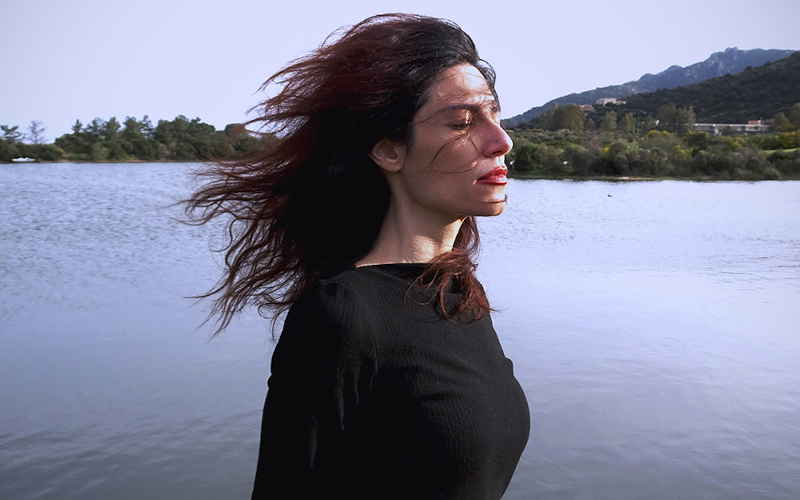


Shedir’s latest album, We Are All Strangers (n5MD), explores the delicate space between isolation and connection, inviting listeners into a world where sound becomes both a mirror and a bridge. In this intimate interview, she reflects on the emotional depth, tactile textures, and philosophical questions that shaped the record, revealing how distance can paradoxically foster closeness.

Devastate and cradle
In We Are All Strangers (n5MD, October 2025), Shedir (aka Martina Betti) delves into the tension between solitude and communion, crafting a sonic landscape where vulnerability and intimacy coexist. The album captures fleeting emotions, fragile textures, and unexpected moments of recognition, offering listeners a space to encounter themselves—and others—through sound.
Mirco Salvadori / Igloo :: We Are All Strangers: what core question courses through the entire album?
Martina Betti :: How capable are we, truly, of knowing ourselves and others, in a world that keeps separating us, splitting us, reflecting us back as incomplete images? Is otherness a sentence, or can it become a threshold? Does being strangers mean remaining alone, or guarding a secret ground where, precisely because we are unknown, we can hear ourselves in a new way?
We are bodies that brush against one another without ever fully coinciding, yet in that empty space, in the slip, in the distance, the possibility of recognition lights up.
What original necessity set this record in motion, beyond the reasons that I, perhaps too briskly, would call the usual ritual ones?
Martina Betti :: The album was born from the need to dig into the void that stretches between me and the world. A void that is not absence, but a dynamic state, crossed by fluctuations where my most searing and contradictory feelings toward humanity stir. On one hand, I feel a deep pity for all of us; on the other, I dream of embodying Shiva, the god of destruction, in order to wipe out a world torn by the atrocities of the present and make room, at last, for a new beginning.
In what ways does this album differ, in practice and in vision, from the previous one?
Martina Betti :: Before the Last Light Is Blown and the earlier works fed on a more cosmic, dilated dimension tied to time, dissolution, and mystery. There, the gaze was turned to infinity and oblivion, holding the vital tension that arises from facing death.
We Are All Strangers brings that trajectory to maturity by bending toward the intimate and the earthly: not the sky, but the fragile space between bodies, here on this ground. The track titles, formed by joined words, distill the emotional and conceptual oxymoron: estrangement and communion, solitude and contact. The album turns distance into a bridge, the enigma into sharing. Can we recognize ourselves as strangers together and, for that very reason, be closer?
Here, the writing becomes more tactile and material: the air around the sounds hosts rustles and crackles, warm and dusty, surges of raw noise, unpolished and therefore authentic. The intent was also to emphasize the raw matter of sound, its physicality.
For this reason, every track passed through a tube preamplifier built by my uncle, a wild device and proudly homemade. I chose to keep that debris and those technological imperfections, which I feel akin to human ones, because what is maladjusted or marginal often proves most expressive and alive.
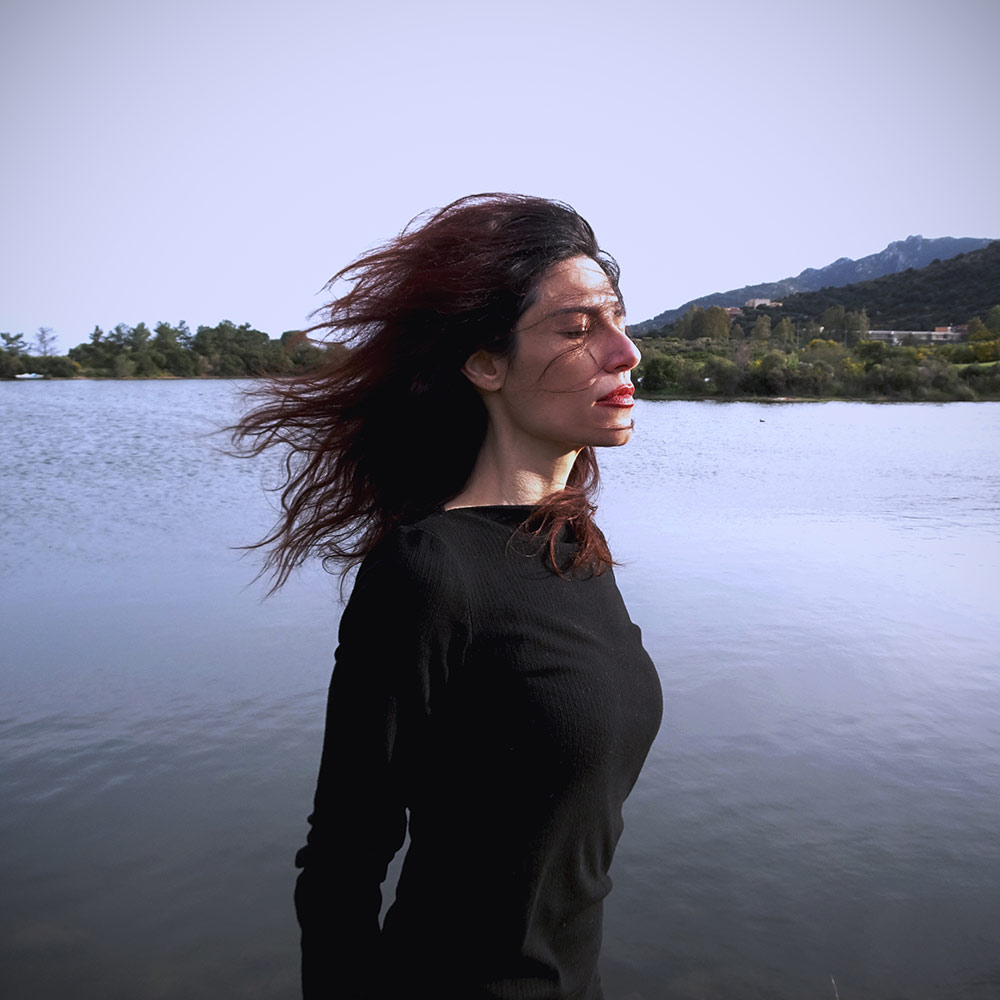
Bridging distance through intimate sound ::
Over time Shedir has acquired a highly recognizable language. Which part of this lexicon did you decide to remove compared to 2023, the year Before the Last Light Is Blown came out, and what did you want to refine or directly change?
Martina Betti :: Compared to 2023, the element I felt shifting is the blur. Blur, for me, was long a form of protection: if I do not allow you to focus on me, you cannot grasp me. It is above all a creative stance: mobile, overlapping edges become an unheard color, a color not yet invented, and everything that escapes cataloging seduces and shelters an immense potential for imagination.
Within We Are All Strangers, the contours of the sounds grow more discernible, melodies and chords are no longer so submerged, and the timbres are less wrapped in dense and intricate weaves.
Perhaps this move toward reducing sonic stratification, with greater narrative clarity, answers a deep need: to become a recognizable body, to free sound from the veils that have protected me so far, trying not to lose the balance between abstraction and definition, between clarity and intuition. Whether this is true emancipation or another form of exposure, I still have to understand. It remains constitutive of who I am to give life to places of extreme intensity, condensed and inhabited by something undefinable.
“Within We Are All Strangers, the contours of the sounds grow more discernible, melodies and chords are no longer so submerged, and the timbres are less wrapped in dense and intricate weaves.” ~Martina Betti
A question I care about: what do you mean by “intimacy of sound”? How much of that “intimacy” did you pour into We Are All Strangers?
Martina Betti :: “The intimacy of sound,” for me, is a thin threshold where vibration meets the listener without explanation, touching with delicacy their most hidden spaces.
In We Are All Strangers this dimension is deeply present. I worked as if every sound had to breathe beside the listener’s ear. In some pieces, I included personal sonic segments captured with my portable recorder: small acoustic photographs of real situations and emotional states. These fragments, whispers, phrases, breaths, were intensely shaped inside Pure Data, then poured into the flow of the composition, like secret capsules scattered through the sonic fabric.
Yours are sounds that stir the emotional oceans of our restless thoughts: what feeling would you like to reach the listener first?
Martina Betti :: Each of us draws on our own emotional resources, and it is right that music speak differently to everyone. The essential thing is that it knows how to catch us off guard. So the first feeling I would wish to arrive is simply a shiver, whether it remains inscrutable or finds a name, whether it is joyful or lacerating, it matters little. It is like understanding and feeling everything in the present instant.
There is a pause in your narrative that struck me deeply: you titled it “Soulbird,” a brief apparition of two and a half minutes that smells of silence and intimate poetry. Tell us about it.
Martina Betti :: “Soulbird” was born from an urgency of reduction: to subtract, to strip away, to let only a fragile core surface. If my work often leans toward layering and density, here I sought the opposite: a short suspension of two and a half minutes, built with few elements, almost like a held breath. It is an interior place that offers itself with discretion, where silence becomes an integral part of the discourse.
It smells of silence because it does not try to fill the space; it lets the listener perceive the delicacy of the void: a small sonic epiphany, a secret and intimate slit that opens through the sound of the piano for an instant and then quickly withdraws.
Composers I consider true masters, like Thomas Newman in the wondrous film American Beauty, taught me to reflect on the power of minimalism as a universal language able to suggest community and transcendence. They showed me that strength does not lie in excess; it lies in the capacity of repetition and simplicity to create a perceptual threshold.
The title We Are All Strangers states a distance. What makes closeness possible within this record, despite everything?
Martina Betti :: Inside this album, it is like finding yourself in a foreign country and trying desperately to communicate. We do not understand the words, yet something passes all the same: we recognize the tone, the rhythm, the intention.
From this condition, a form of prosody without words is born, built through the sounds themselves: electronic breaths that dilate, timbres that surface as if from a sonic fog, glissandos that draw the listener along. Sounds that become emotional syllables, accents, and pauses able to build an implicit language.
In We Are All Strangers, it is precisely this prosody that makes a form of closeness possible: the sounds offer a secret grammar that lets us feel one another, even when we do not fully understand. In that intermediate space, between the untranslatable and the perceptible, communion takes shape.
I am not a musician, yet I imagine a record release as a new gift the artist and composer makes to self and audience, a kind of bringing into the world of a creature capable of speaking on its own, spreading keys that help us understand it fully. Your thoughts on this.
Martina Betti :: For me, making music is an existential act: a bridge between the outer landscape and the psyche. It is also narrative matter, sentences in motion seeking interweave with collective experience.
When I let a record go, I set free parts of me that no longer belong to me. I wish them the best possible way of getting lost, far from my control, because sound wants to move, to lose itself, to become other. In this journey, the welcoming Other becomes essential: music does not remain individual, it conceives itself as shared vibration, as a movement that connects us to a wider whole.
“Inside this album it is like finding yourself in a foreign country and trying desperately to communicate…we recognize the tone, the rhythm, the intention.” ~Martina Betti
Let us come down to earth and speak of collaborations and dialogue: how important is the exchange with those who handle final sound, artwork, and publication? Does it influence your choices?
Martina Betti :: I believe that exchange with other artistic minds is fundamental. They are presences capable of switching on “emergency lights” along the often tortuous path of building an album. I am deeply grateful to Mike Cadoo, founder of n5MD, who accompanied me with care and depth, never intrusive, allowing the authentic substance of my work to emerge with clarity.
A special thank you also goes to Domenico Santomartino, friend and painter, who oversaw the cover art with a refined gaze, amplifying and giving visible form to the album’s concept with great sensitivity.
A technically canonical question: which instruments and machines did you use in composing this album?
Martina Betti :: My journey into analog synthesis remains deeply tied to the Moog family, in particular the Mother-32, which I consider an incredibly expressive instrument. Its magic already resounds in the album’s opening track. Alongside it, I drew on the versatile sonic power of the Virus TI2, able to widen the timbral spectrum in unexpected directions. Finally, some sounds were further shaped in Pure Data, through custom patches that pushed the sonic matter toward experimental and unforeseeable trajectories.
Another question I care about: the emotional responsibility of the musician. Is there a limit you set for yourself in “unsettling” the listener, and, if you are aware of it, at what point do you decide to stop?
Martina Betti :: I do not decide to stop, because I cannot. It is like finding yourself in a car with the brakes sabotaged. There is nothing to do but go, with all the shivers in my body, until the necessary crash. Until I feel shattered and scattered, dragged and driven beyond the bones, fused with sound.
On my worktable, among the instruments, I keep a mirror pointed at my face. It is my totem, the object that calls me back to myself, that returns me to the body after immersion in sound, like a fixed point in the midst of infinite space.
Bridges of reference and listening: which artists or records feel like helpful presences in this album of yours, and where do you recognize yourself in them, or diverge?
Martina Betti :: Lately, I have found myself under the sonic spell of two perfect black hearts: the Icelandic musician Hekla and the extraordinary New York artist Ash Fure. Hekla dragged my spirit into a bottomless sea, while Ash Fure shook the cells of my body with her relentless, pulsing patterns, built through radical techniques. Two ecstatic listenings that are resonating deeply in my way of conceiving the matter of sound.
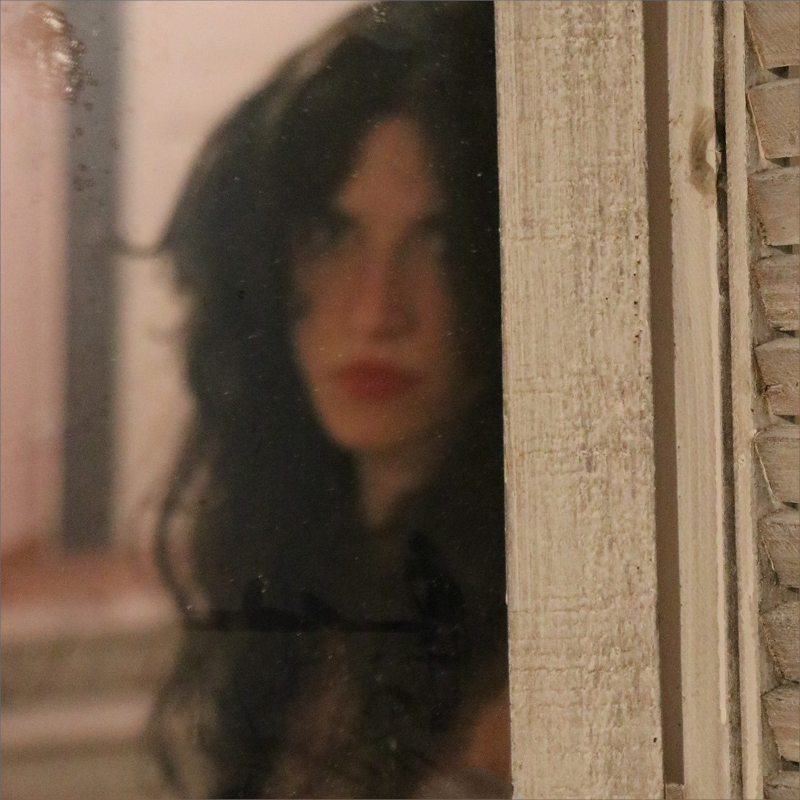
Strangers connected by sonic worlds ::
After repeated listens to your latest work, it is hard for someone like me to sort the questions that arrive unannounced. I can only bring them as they come, and I apologize. Your land, its traditions, its sounds: how important is it, and how present, in your music making?
Martina Betti :: It matters in ways I cannot measure. The history of my land sinks into about twenty thousand years of humanity. Faced with that depth of time, my presence on the planet feels tiny. I can only bow before such an ancient and mysterious civilization, steeped in magic and unfathomable traditions.
Sardinia has carved me in ways I do not fully understand yet. One vivid example is the Mammuthones, the ritual masks of the Mamoiada carnival. With their measured steps, rhythmic jumps, and the clangor of cowbells, they summoned an ancestral and unsettling atmosphere, able to evoke invisible forces and drive out evil spirits. It was humankind against demons. Think how much power and mystery condense in that sound.
Those who do not know well the reality you inhabit imagine places where Nature reigns sovereign, free to embrace or destroy. In truth there is also an entirely artificial presence looming over it, a structure created by humans, a huge refinery that dominates the skyline and challenges Nature itself. I know this contrast is one of the album’s keys. I would love to hear you speak about it.
Martina Betti :: I grew up in a town that hosts one of the largest oil refineries in Europe. Enormous tanks, smokestacks, towers, reservoirs as big as neighborhoods, very tall flares that lit the night and erased the stars. The sounds were menacing: alarm sirens announcing a plant shutdown, and in the morning a black soot settled on cars and, who knows how much, in our lungs.
I left as soon as I came of age, fleeing that unbreathable air, that unsettling yet hypnotic landscape. I grew up inside a Blade Runner film dimension. Naturally, as a child, my mind had no filters. All those sounds sedimented in me, and still today, without my deciding it, they continue to spread and echo through the recesses of my sonic imagination.
What would you like to keep pulsing in the listener’s visions after the last track: a disruptive image, a question, an emotion hard to contain?
Martina Betti :: Music lifts me beyond the gravity of things, it pushes me into a suspended elsewhere where evil shrinks and borders dissolve. It is like adopting the gaze of an astronaut, immersed in the beauty and darkness of the universe. After the last track, I would wish this gentle vertigo to remain: the feeling of seeing the world from another distance, where we become able to welcome the immeasurable disorientation that moves through us.
If Shedir could define the emotional arc of the record with three simple verbs, which would she choose, and why?
Martina Betti :: I would name only two verbs: devastate and cradle. The third I prefer to leave to you and to those who listen. I have only drawn the emotional landscape, and the motion that crosses it takes a different shape in each of you.
What can I say but thank you for your ability to animate sounds that reach the deepest levels of our spirit.
Martina Betti :: Thanks to your questions, which undress with grace, and to Igloo Magazine for welcoming my voice.
We Are All Strangers is available on n5MD. [Bandcamp]








![[2View] Nekomachi/no wonder • なるほど & tsubai/ilulissat (Perceptual Tapes)](https://igloomag.com/wp/wp-content/uploads/2026/10/nekomachi-no-wonder-tsubai-ilulissat-tapes_feat-75x75.jpg)


